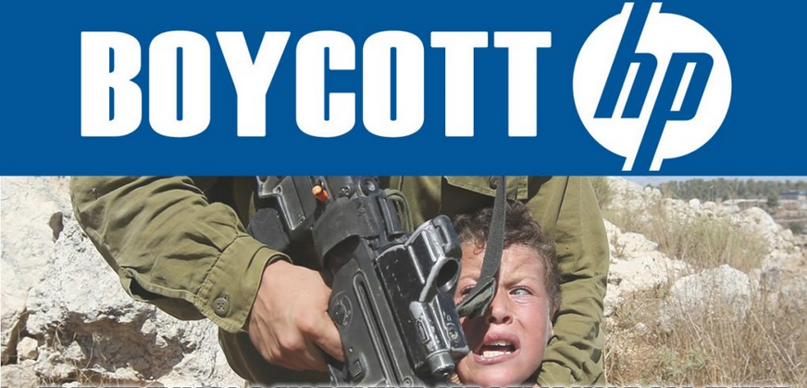
Hewlett Packard:Teknologien bak Israels krigsmaskin HP-merkede selskaper spiller sentrale roller i Israels undertrykking av palestinere. De er medskyldige i Israels okkupasjon, apartheid og bosetter-kolonier. Til alle fagforeningskamerater og palestinavenner: Palestinakomiteens Faglige Utvalg oppfordrer alle fagforeninger til å slutte opp om den internasjonale boikotten av Hewlett Packard. Vi er opptatt av at vi alle kan gjøre noe for å sette press på okkupanten, apartheidstaten og kolonimakta Israel, og setter med dette i gang en Boikott-HP-kampanje.
Derfor: – Send denne eposten videre rundt i organisasjonen og gjerne til medlemmene – Skriv ut vedlagte løpeseddel og plasser den på strategiske steder, på pauserom og spisebord. Meld gjerne fra til oss hvordan det går, hvilke reaksjoner dere møter, og om dere klarer å få arbeidsplasen eller organisasjonen til å bli HP-fri sone!Det kan bli til stoff og argumenter når vi skal drive kampanjen videre. Gå foran med et framskredent eksempel!Alle resulater og tilbakemeldinger vi får formidler vi videre til den sentrale bds-kampanja.Send til kjer-n@online.no
Om grunnlaget for boikott-aksjonen: HP leverer teknologien til – servere og drift av det israelske befolkningsregisteret, som inneholder all informasjon om palestinere på den okkuperte Vestbredden og Gaza
– kontroll av tillatelser som kreves for palestinske arbeidere som arbeider i Israel og i koloniene
– tillatelser til å krysse den grønne linja for medisinske behov, familiebesøk, utenlandsreiser og all annen bevegelsesfrihet som IOF til enhver tid trenger
– identifisering og overvåking av palestinere ved alle sjekkpunkter
– utstyr og vedlikehold av datasystemer i israelske fengsler
– vedlikeholder datasentre gjennom serverne sine for det israelske politiet.
– utstedelse av tillatelser til internasjonale besøkende på Vestbredden.
Dette fører til institusjonalisert rasediskriminering, apartheid og ulike muligheter når det gjelder bevegelsesfrihet, bolig, arbeid, ekteskap, helsetjenester og utdanning, og gir privilegier til Israels jødiske befolkning mens palestinere blir fratatt status og rettigheter.
Derfor: Boikott HP
Boikott HP er en internasjonal kampanje. Kampanja ble lansert for å få slutt på denne medvirkninga, og den fortsetter å vokse seg sterk. Den har bred støtte fra bystyrer, fagforeninger, kirker, studentforeninger og brede sivilsamfunnsorganisasjoner verden rundt. I løpet av et tiår med kampanjer er mange kontrakter mellom HP-merkede selskaper og apartheid-Israel avslutta, noe som viser at BDS-presset virker. Les om kampanja her:https://bdsmovement.net/boycott-hp
Slutt opp om kampanja for å presse HP til å avslutte kontraktene med apartheid-Israel!
Vi oppfordrer norsk fagbevegelse og andre organisasjoner – til å kartlegge omfanget av HP-materiell på din bedrift, arbeidsplass eller fagforeningskontor
– til å informere ledelse og ansatte om hva HP gjør seg skyldig i i okkupasjonen av Palestina
– til å bruke FU’s brev eller løpeseddel til å drive en opplysningskampanje
– til å undersøke om det finnes planer om nyinnkjøp av utstyr og oppfordre til ikke å kjøpe HP-utstyr
– til å skaffe propalestinske klistremerker til utdeling på arbeidsplassen, blant venner og kjente, i organisasjoner og lokalsamfunn. Oppfordringa er DEKK LOGOEN!
Bli med oss i kampanja for å presse HP til å avslutte de eksisterende kontraktene mellom HP-selskaper og apartheid-Israel!
The US Department of Justice (DOJ) is withholding more than 3 million records related to convicted sex offender Jeffrey Epstein—including files that a state attorney general says are critical to complete an ongoing criminal investigation.[1] Lawmakers say the DOJ is breaking the law by keeping them hidden.
Meanwhile, the people the DOJ should have protected were exposed.[2]Survivors’ names, addresses and intimate details of their abuse—including information identifying minors—were released, putting their privacy and safety at risk.
Now Congress has a chance to take control of the Epstein files away from the DOJ—and help survivors find justice.
The new bipartisan Epstein Files Transparency Act II (H.R.9694) would allow survivors and state prosecutors to sue the Attorney General when Epstein records are unlawfully withheld or redacted.[3]
DOJ and FBI officials who knowingly conceal, destroy, falsify or withhold Epstein records could face federal criminal penalties.
But House leadership still hasn’t scheduled H.R. 9694 for a vote. So a bipartisan group of lawmakers launched a discharge petition to force a vote. They need 218 representatives to sign—and 106 signed on within days.[4]
Now the Speaker has cut short the time they had to build support, canceling the final two voting weeks of September ahead of midterm elections.
House leadership may be making it harder to move this bill—but they don’t get the final say. Here’s where we come in: We can build public pressure on more representatives to join the push and get to 218.
Add your name and help push more representatives to act.
Survivors have been waiting for justice for almost two decades.
By 2007, federal prosecutor Marie Villafaña had spent nearly a year building an 82-page case against Epstein. She told her bosses Epstein was a danger to children and recommended 60 charges, including sex trafficking of minors. Instead, her supervisors cut a secret deal with Epstein, agreeing not to prosecute him or his co-conspirators federally.[5]
While serving his 13-month sentence at a Florida county jail, Epstein was chauffeured to a private office on «work release» where he spent 12 hours a day, 6 days a week and allegedly continued sexually abusing girls.[6]
Epstein continued to evade accountability for another decade. He wasn’t federally charged with sex trafficking until 2019—and died before he could stand trial.
Survivors are adamant that his trafficking operation was extensive. Hundreds of underage girls were exploited across Epstein’s properties in New York, Florida and elsewhere, with trafficking allegations stretching from the US Virgin Islands to the UK.
The crucial question is how he was able to get away with it for decades. And the answer is: thanks to powerful friends and institutions.[7] Banks looked the other way when his suspicious transactions were flagged, powerful associates opened doors for him, and people around him allegedly continued helping him recruit young women and girls for abuse.
Only one other person has ever been charged. How many people who participated in or facilitated Epstein’s trafficking operation have never faced consequences?
Survivors have waited long enough for institutions to do the right thing voluntarily. Now Congress can give them the power to demand it—with your help.
Public pressure can help move this bill through Congress. When thousands of us take action together, lawmakers see that demands for transparency and justice aren’t going away.
The more signatures we gather, the harder we are to ignore. Let’s show them we’re watching.
In solidarity,
Krysta and the team supporting the Freedom United community.
P.S. If you live in the US, find out if your representative has signed Discharge Petition No. 27. If not, demand that they do—every signature between now and September 17 brings this closer to a vote.
Cuban President Miguel Díaz-Canel met Monday with representatives of the agricultural sector at the Convention Palace in Havana to discuss the implementation of the 176 economic and social transformations in the countryside.
Díaz-Canel, also first secretary of the Communist Party Central Committee, said: “The country is built from the furrow.” He reaffirmed his full confidence that if there is a sector that must deliver results in the most immediate term, it is agricultural production. “We are now more aware that we can do better with all the possibilities offered by the transformations,” he said.
He spoke of the sector’s potential, the characteristics of its people, and the willingness among farmers and workers in the state agricultural system. “This discussion is not only to think about the present, it is also for us to project ourselves toward the future,” he said.
The transformations, he noted, give producers the right to decide what is produced, how it is produced, in what quantities it is produced, and how it is marketed. “That gives you autonomy, but it also gives you tremendous responsibility, because if in the end the food does not appear on the plate of Cuban families, people will not believe in the transformations,” he stressed. https://t.me/PresidenciaCuba/32561?embed=1
He recalled that other Cubans, from other sectors, will have to boost other transformations from which agricultural workers will also benefit. Those in the agricultural sector must assume themselves as “owners of the implementation of these transformations,” he said, adding that implementation can lead “to a different moment in the country’s agricultural development and therefore in food sovereignty.”
Díaz-Canel defined the 176 Economic and Social Transformations not as “a simple change of rules” but as “a change of logic.” It is “moving from being executors of plans to being managers of the productive destiny of food for the country,” he asserted.
“Today the land, inputs, marketing, financing, are closer than ever to you. The law opens doors, but those who go through the doors are the producers; the law alone does not solve; therefore, the call is for us to be ready for this challenge and to go out and seek a victory,” he said.
On September 11, Allende’s socialist was toppled by a U.S.-backed military coup led by Augusto Pinochet, barely three years after being elected.
Allende wasn’t the only casualty of the coup, as thousands of Chileans were subsequently tortured, jailed and killed by the military regime. Democracy in Chile was irreparably altered, and even now the country continues to be scarred by one of the darkest eras of fear and repression on the continent.
Social Progress Under Allende
After winning the 1970s presidential elections in Chile, the left-wing Salvador Allende worked toward social reforms and justice, nationalizing natural resources, building homes for the poor and focusing on better access to health and education.
Allende fought until the last hours of his life to defend the social gains and constitutional order. On his last speech, just minutes before the military bombed the presidential palace, he gave Chileans one last message of hope.
“I will not resign. Placed in a historic transition, I will pay the loyalty of the people with my life. And I tell them I have the certainty that the seed that we have planted in the dignified conscience of thousands and thousands of Chileans will not be shriveled. You have the power, they can destroy us, but social progress cannot be stopped neither by crime nor by force. History is ours, and people make it happen.”
Military Repression
Allende’s own army chief, Augusto Pinochet, led the coup and ordered his forces to march through the streets of Santiago, intimidating the local populace and entering La Moneda Presidential Palace by force.
Pinochet later consolidated power with the support of the United States and ruled the country with an iron fist for 17 years, until 1990. He jailed an estimated 80,000 people, tortured 30,000 and murdered around 3,200. Only 75 of more than a thousand of his former agents are serving prison sentences for human rights violations.
U.S. Intervention
With the success of the 1959 revolution in Cuba, leftist movements in Latin America were emboldened, and Washington’s Manichean Cold War world-view translated into fears—and policies—that affected much of South America.
As declassified CIA documents show, the government of Richard Nixon and Secretary of State Henry Kissinger influenced the military to overthrow Allende, and provided resources to deter any leftist movements in the country through the CIA.
As fears of the «Red Scare» grew, Washington opposed any form of socialist gains on the belief they would affect U.S. economic and political interests in the hemisphere.
Dubbed Operation Condor, a brutal campaign of political repression and state terror took hold of the continent, as the United States sought to obliterate leftist movements opposed to Washington-backed military coups in countries such as Argentina, Bolivia, Brazil, Uruguay, Paraguay — and Chile.
Modern Democracy
More that 25 years since the end of the dictatorships, social movements in Chile are still demanding that the remnants of the Pinochet regime – including the constitution passed in 1980 – be overturned.
After the coup, Pinochet’s government adopted a constitution that defended repression of basic liberties and rights, and created a convoluted electoral system designed to favor right-wing parties.
Under Michelle Bachelet’s second government, a process to change the constitution has been passed and is currently being undertaken. While popular consultations are underway, many consider the measure to be inadequate, and unlikely to lead to a reform that will include meaningful input by Chileans.
Cuban President Miguel Díaz-Canel described as “forceful” the support the Caribbean nation received at the United Nations Human Rights Council (UNHRC), where it was demonstrated that the U.S. blockade violates the individual guarantees of the Cuban people.
In a message on his official X account, Díaz-Canel stressed that the report presented by the Special Rapporteur on Unilateral Coercive Measures, Alena Douhan, “demonstrates that the blockade violates the human rights of the people of Cuba.” He highlighted that the United States “fails to confuse or disorient the international community with its lies, threats and aggressions.”
Díaz-Canel said it is urgent that they comply with the recommendations received and let Cuba live in peace, concluding: “Cuba is not a threat, the blockade is.”
The Cuban Foreign Ministry issued a statement recalling that Douhan made an official visit to Cuba from Nov. 11 to 21, 2025, at the invitation of the island’s government. According to the statement, in her report she ruled that the unilateral coercive measures imposed on Cuba have a devastating effect with the unprecedented intensification of the U.S. blockade, through the imposition of an energy siege and secondary sanctions.
Last Monday, Cuban Foreign Minister Bruno Rodríguez held a press conference in Havana, in which he specified that the cost of the U.S. blockade on Cuba between March 1, 2025 and Feb. 28, 2026, was 8,083.3 million dollars
Aparade of newly trained Puntland Security Forces soldiers, trained to combat ISIS, in the Bari region of Puntland, January 30, 2025. Photo: REUTERS/Feisal Omar
MOGADISHU, Somalia —On September 3, shortly after sunset, U.S. surveillance drones began carrying out reconnaissance missions in two areas of the Al-Miskad mountains in Puntland, Somalia, according to Puntland security officials that spoke with Drop Site. The two localities—Togga Miraale and Togga Baalade—are considered strongholds for ISIS militants by local authorities.
During the mission, the drones spotted alleged ISIS militants traveling with a donkey cart in the locality of Togga Baalade, the security officials said, and began carrying out airstrikes nearby at around 8:30 p.m. The strikes, which were accompanied by more drone surveillance missions further northwest in the Sanaag region, broke a relative lull in U.S. attacks in Somalia, justified as a means of bolstering local government forces against ISIS and Al-Shabaab militants.
AFRICOM did not respond to a request for comment, but Puntland security officials told Drop Site they expect the U.S. air campaign in Somalia only to intensify in the foreseeable future. Key to that expanded effort is the development of a new U.S. military base in the port city of Bosaso announced last month. Though the officials argue that U.S. air support is necessary for the war against ISIS in Somalia, U.S. operations have been blamed for killing and displacing thousands of civilians.
Bosaso straddles the northern Somali coast on the shores of the Gulf of Aden. Home to around 1 million people, it is also known as a major route for human trafficking and refugee flows, with East African migrants crossing the Gulf of Aden in a bid to reach Yemen and the Arab world.
The area is now becoming the focal point in a planned U.S militarization of one of the most strategic waterways in the world. An estimated 25% of global maritime traffic flows through the Gulf of Aden, while nearby on land a near two-year war continues to rage in the Al-Miskad mountains between Puntland regional forces backed by the U.S. and ISIS militants.
The U.S. has described the dry and rugged mountains of northern Somalia as the main hub from which ISIS controls its global operations. Amid an increasing number of U.S. drone strikes and raids supporting the Somali government in the war against ISIS, the United States is now expanding its presence in the port city of Bosaso and effectively building a new military base, which will be used for combat and surveillance operations targeting “terror groups” in the region as well enhancing maritime security, according to Somali security officials in Puntland. The CIA will also expand its operations there, the officials said.
On August 2, a U.S. delegation spearheaded by AFRICOM, which oversees military operations on the African continent, met with Said Abdullahi Deni, the president of the semi-autonomous Puntland region in the port city of Bosaso. Puntland is a region of Somalia that enjoys self-government of some of its affairs, while being nominally loyal to the central government in Mogadishu. Hours after the meeting, Puntland’s State House released an official statement on X announcing a new agreement.
“The United States will expand its military base in Bosaso to improve operations against terrorism and to help protect maritime security,” the statement read. The U.S. delegation, led by commander for special operations Major General Claude Tudor, also discussed “fighting terrorism and improving security in the Red Sea and the Gulf of Aden” with Deni, according to the read-out.
However, five separate Somali security officials in Puntland interviewed by Drop Site after the August 2 agreement say that the announcement mischaracterized the real significance of the agreement. The U.S. did not previously have a military base in Bosaso, they said, and the new expansion would effectively create an entirely new military footprint in the region. The officials described the current U.S. presence as an “office” used as an intelligence center for both AFRICOM and the Central Intelligence Agency (CIA).
Currently AFRICOM personnel stationed at the office in Bosaso coordinate between Puntland ground forces and the main AFRICOM headquarters in neighboring Djibouti when airstrikes or air support are needed. However, once the new U.S. base on the grounds of the airport in Bosaso is complete, the U.S. will be conducting airstrikes directly from Bosaso, Puntland security officials told Drop Site.
When the August 2 deal was announced, however, many of the Somali officials who took part in the meeting and were photographed with their U.S. counterparts were not privy to the details of the deal.
A week earlier, President Said Deni had already cemented much of the agreement in a closed-door meeting in Ethiopia with AFRICOM officials on July 27, according to Puntland security sources. One security official said that the meeting in Addis Ababa had been “where the deal for the (U.S.) base was cooked up.”
“The Americans entered the room and pulled out the agreement, which was then signed by Deni. Things were already agreed upon in Addis Ababa,” a second Puntland official confirmed. “All he did was sign on the line after [AFRICOM] handed him the document,” another official added.
“Big Brother”
The U.S. has carried out more airstrikes in Somalia under Donald Trump than under any other president combined. Ten days after being inaugurated for his second term, Trump announced that the U.S. had carried out strikes targeting a senior ISIS figure in Somalia. In the time since, the U.S. has carried out a total of 205 airstrikes in the country, with 53% of those airstrikes targeting ISIS, according to New America, a think tank that monitors U.S. military operations overseas.
In 2015, during the height of ISIS rule in Iraq and Syria, the British-Somali cleric Abdiqadir Mumin along with many fighters loyal to him broke away from Al-Shabaab, declared allegiance to the Islamic State, and founded a new branch of the group in Somalia.
The following year, ISIS militants occupied the coastal town of Qandala on the Gulf of Aden for 38 days, before withdrawing into the Al-Miskad mountains. In the years that followed, the group has expanded in size, assassinating local officials and extorting businesses in Bosaso. As it has continued to do battle with the Somali government, the ranks of ISIS have swelled with foreign fighters—mainly from neighboring Ethiopia—who now make up the majority of the fighters in the group’s Somali branch.
Puntland security officials who spoke to Drop Site described the role of CIA personnel currently stationed in Bosaso as “significant,” stating that in addition to other duties supporting operations against ISIS, CIA personnel are currently tasked with interrogating captured ISIS fighters, in particular high-value targets and foreign fighters.
Abdiweli Mohamed Yusuf, better known as Abdiweli Walalac, the most high-profile case of any ISIS-Somalia member captured, was handed over to CIA personnel stationed at the “office” in Bosaso, according to Puntland security officials.
Abdiweli was sanctioned by the U.S. Department of Treasury in 2019 for being the head of the finance office for the ISIS branch in Somalia and simultaneously was designated a Specially Designated Global Terrorist.
On July 25 of last year, Abdiweli was captured in a joint U.S.-Somali operation. According to all five separate Puntland security officials who spoke with Drop Site, the operation to capture him was actually U.S.-led rather than U.S.-supported, as initially reported—signaling America’s deepening role in counterterrorism operations under the Trump administration.
The officials who spoke to Drop Site described a helicopter raid near Xumbeys in the mountains of Somalia’s Bari region in which U.S. forces, with a Somali interpreter and commanders of the Puntland Intelligence and Security Agency (PISA), captured Abdilweli Walalawac after targeting his location in a rural area. “As soon as the Americans and PISA touched down, the U.S. had assets in the air providing cover,” a Puntland security official told Drop Site.
“He was captured while hiding with two men, who were identified as local Bedouins. They were both released after it was confirmed that they were not Daesh (ISIS) and that Abdiweli Walalac was hiding amongst the local Bedouin community to avoid detection and arrest,” he added.
After his capture, two Puntland officials said, he was taken to the CIA-run office in Bosaso where he was interrogated. The following day Abdiweli was renditioned to neighboring Djibouti. Djibouti hosts several major foreign military bases, including the U.S.’s Camp Lenoir, which has been a hub for CIA renditions across Africa since 9/11.
A 2014 joint report by U.K.-based human rights group Reprieve and New York University’s Global Justice Clinic released a chilling report revealing how the tiny Horn of Africa nation had become a major hub for the CIA’s vast rendition network across Africa.
“Here they are like a big brother,” a Puntland security official told Drop Site in reference to the influence CIA personnel have on security decisions related to ISIS in Puntland. “What they say or do goes without any questions.”
Strike Force
The agreement for the U.S. base in Bosaso is not limited to supporting U.S. military operations in the region, but also entails the U.S. creating a new local counterterrorism strike force tasked with fighting terrorist groups in the region, Puntland security officials told Drop Site.
The exact number of local Somali troops who would be part of this new local counter terrorism force is not yet clear, since the process is still in its early stages, according to the Puntland security officials interviewed by Drop Site.
“It’s been confirmed but the numbers haven’t been decided yet, there are a lot of technicalities that needed to be decided beforehand, but it’s the Americans that will be overseeing their salaries, equipping them and their training,” a Puntland security official privy to the matter told Drop Site.
This wouldn’t be the first time that the United States sought to create a counter terrorism unit in Somalia. Following 9/11, the U.S. created the Puntland Security Force (PSF). Although, the U.S. ended support for the PSF in 2020, the elite counterterror unit has continued carrying out operations in the years since, while also being implicated in using U.S. weapons to conduct attacks in densely populated civilian neighborhoods that have led to the deaths of numerous civilians, including children.
During his first term, President Barack Obama oversaw the creation of the Danab, an elite U.S.-backed, funded, and trained indigenous counterterrorism force active in south-central Somalia, tasked with combatting Al-Shabaab.
Former officials from the PSF told Drop Site that initially new recruits to Danab, whose name translates to “lightning” in Somali, were trained at PSF camps in the cities of Galkayo and Bosaso.
Puntland security officials who spoke with Drop Site say that the new U.S. base in Bosaso will also include aircraft used for combat and surveillance.
“Right now, there is a team of AFRICOM [personnel] at the office at Bosaso airport that we coordinate with when we need air support, and they coordinate with Djibouti but soon it will change,” a Puntland security official told Drop Site.
U.S. drones engaged in reconnaissance missions targeting armed non-state Islamist actors in northern Somalia’s Al-Miskad and Golis mountains are not only persisting but escalating as part of the Trump administration’s shadow war in the Horn of Africa. “U.S. airstrikes have been responsible for the death of at least two-thirds of the ISIS fighters killed since the war began last year,” a Puntland security official told Drop Site.
After nearly 18 months of war, ISIS has largely been cleared out of the Al-Miskad mountains in Bari province, but the insurgents are still holed up in pockets of the vast mountain range, which one Puntland security official simply dubbed “Tora Bora”—a reference to the mountain range in Afghanistan that once hosted Osama bin Laden and other Al Qaeda leaders.
Most of the displaced Bedouin population that once resided in the Al-Miskad mountains has yet to return, as insurgents continue to loot livestock and carry out bomb attacks.
The new U.S. base in Bosaso raises many legal questions for the local government, which enjoys a degree of autonomy that is still contested by the Somali central government based in Mogadishu. Under Somalia’s constitution, only the central government can sign agreements with foreign governments or foreign entities.
Somalia’s Ministries of Defense and Information did not respond to questions about whether they had prior knowledge about the U.S. decision to sign an agreement with Puntland to build a new military base.
A guest post by
Mohamed Gabobe Journalist & Producer based in Mogadishu, Somalia |
As Uganda prepares to deploy troops to a Gaza “stabilization force,” internal documents show a years-long Israeli program to upgrade the country’s drone capabilities.
Uganda’s parliament last month authorized an unprecedented deployment of Ugandan soldiers to Gaza as part of an international force proposed by President Donald Trump’s Board of Peace.
“The President of the Republic of Uganda is ready to deploy in the Gaza Strip,” Defense Minister Kiryowa Kiwanuka told lawmakers in a parliamentary debate about the deployment, saying a formal status-of-forces agreement would be negotiated after parliamentary approval. The vote on the measure came after Israel said that troops from “friendly countries” could participate in the mission.
The Ugandan government has so far offered no clear public explanation for why it volunteered for the mission, what role its soldiers would play, or what Kampala expects in return. The proposal has raised questions from members of the country’s parliament, including opposition lawmaker Hassan Kirumira, who asked during the debate, “On which side is our army going to fight?’”
The decision to send Ugandan troops did not emerge in a vacuum, but comes amid a rapidly expanding security relationship between Tel Aviv and Kampala that included the 2022 signing of a formal defense-cooperation agreement between the two countries.
Internal documents reviewed by Drop Site News reveal for the first time the details of a years-long program by Israeli weapons manufacturer Elbit Systems, the country’s largest weapons maker, to equip the Ugandan military with an expanding fleet of Hermes surveillance drones, as well as a suite of advanced surveillance systems intended for use by Uganda’s Military Intelligence and elite Special Forces Command (SFC)—a branch of the country’s security establishment tied to the family of President Yoweri Museveni, and his son Muhoozi Kainerugaba.
Details of the relationship come from an archive of hacked emails and documents from Elbit executive Vered Haimovich, a former Israeli military officer who became vice president of Elbit Systems’ UAV Systems Business Unit in January 2021. The archive was published by Distributed Denial of Secrets and released by Handala, an online hacking group believed to be tied to the Iranian Ministry of Intelligence. Drop Site conducted cryptographic verification on emails contained in the archive as well as verifying non-public material it contained.
In response to a request for comment, an Elbit spokesperson said, “Elbit Systems does not comment on business matters relating to its customers. The materials presented do not accurately reflect the company’s business activities.”
The Ugandan government did not respond to questions.
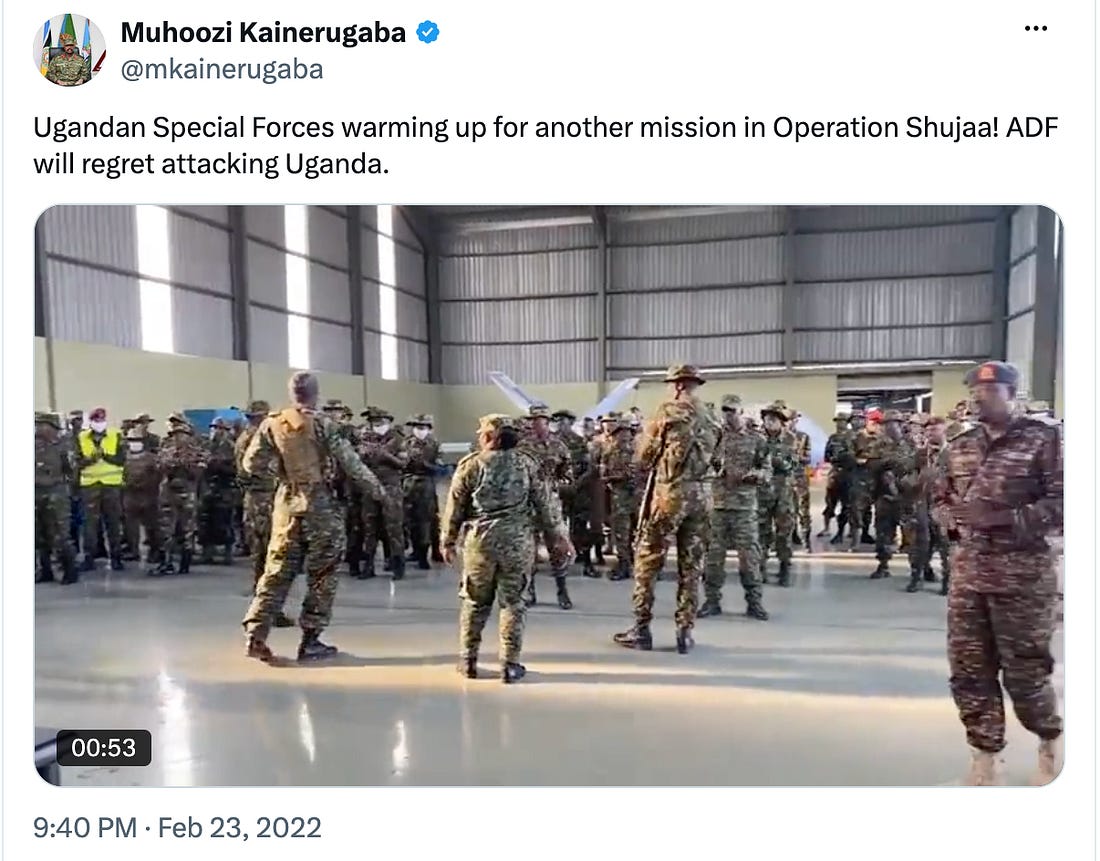
Uganda’s ownership of Elbit’s Hermes 900 was first publicly documented in February 2022, when Kainerugaba posted footage of Ugandan soldiers inside an aircraft hangar singing and clapping in front of the drone on social media with the comment “Ugandan special forces warming up for another mission in Operation Shujaa!” a reference to Uganda’s military intervention in the Democratic Republic of Congo.
Later reports claimed that the country operated “at least two dozen” of the aircraft supplied in 2019, though no details or corroboration were provided. In August 2024, a drone bearing Ugandan markings crashed in eastern Congo and was later identified by a United Nations Group of Experts report as a Hermes 900.
Despite prior evidence of military cooperation between Israel and Uganda, details about the exact nature and scale of the cooperation between Elbit and Kampala, including the scale of cooperation on the Ugandan drone program, have not previously been disclosed.
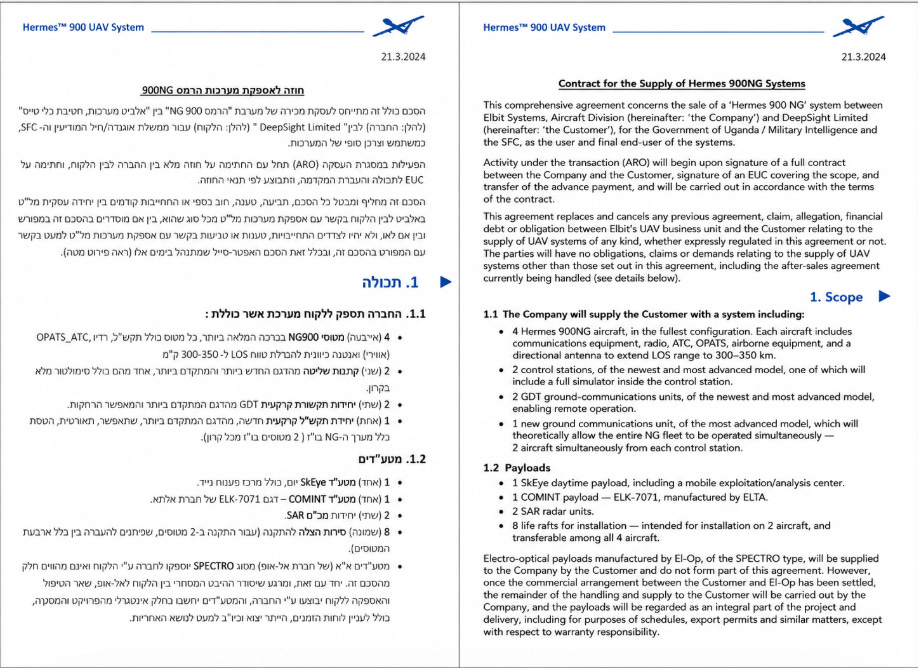
The records contained in the email archive identify lucrative contracts for the sale of military surveillance systems and other equipment from Elbit to Uganda, including a signed $52.1 million package for four Hermes 900 aircraft and supporting infrastructure dated March 2024. The documents, marked as confidential, also reveal other intelligence and weapons systems offered by Elbit to Ugandan Military Intelligence and the SFC in particular—an elite branch of the security services involved in the protection of the Museveni family and formerly commanded by Kainerugaba himself, the country’s current military chief.
A page from a March 2024 agreement for the provision of Hermes 900 systems and supporting infrastructure from Elbit Systems to Ugandan military intelligence and Special Forces Command. Machine translation provided by Drop Site.
The systems offered included advanced surveillance equipment capable of monitoring large areas continuously, intercepting communications, and producing radar images at night and through cloud cover. The documents also point to the previous sale of Israeli loitering munitions—also known as suicide drones—and other equipment used to carry out offensive operations.
In recent years, Uganda has become one of Africa’s most active military powers. Ugandan forces currently operate on missions in Somalia, the Democratic Republic of Congo, and South Sudan.
In 2025, Uganda deployed special forces to support South Sudanese President Salva Kiir’s government—an operation in which Ugandan forces provided aerial support during “repeated attacks that resulted in the killing and maiming of civilians, including children suffering severe burns consistent with incendiary bombs,” according to a United Nations inquiry.
Uganda’s relationship with Israel has continued to grow closer since the reestablishment of ties between the two countries in a 1994 normalization agreement signed by Museveni, who has been president since 1986.
Just days before the August 6 parliamentary vote approving the deployment of Ugandan troops to Gaza, Kainerugaba unveiled a monument at Entebbe airport to Yonatan Netanyahu, the older brother of Israeli Prime Minister Benjamin Netanyahu, who was killed while commanding a 1976 hostage-rescue operation at the airport.
In a since-deleted social media post, Kainerugaba suggested that the decision to build the statue in honor of Netanyahu had been divinely inspired. “For the last 4 years, My God Jesus Christ has appeared to me in dreams and visions. He told me to build a monument to Yoni Netanyahu in Entebbe. And not to fear the world. He is stronger than the world!” he wrote.
Surveillance and Strike
In February 2022, when Kainerugaba posted the footage on social media showing Ugandan soldiers with the Hermes 900, the revelation that Uganda’s military was operating the aircraft came as a surprise to many defense analysts. A report in the military intelligence publication Janes quickly identified the drone as the Hermes 900, describing it as a “previously undocumented” Ugandan capability provided by Israel.
Despite the revelation, little reliable information existed about when Kampala obtained the Hermes aircraft, or the number it had in its possession. Open-source information also indicated that Elbit had also provided mortars and other munitions used by Ugandan forces during the conflict in the Democratic Republic of Congo.
The correspondence and documents contained in the email archive indicate that Elbit was not simply a hardware supplier but an active partner over several years with Kampala in building an integrated surveillance architecture, constructing drone bases, and developing the infrastructure to carry out offensive strikes.
A September 2021 Elbit pricing sheet labeled “Uganda” describes a $16.1 million package that included two new Hermes 900 aircraft, maintenance for an additional Hermes 450 already in-country, ground-control systems, training assistance, as well as additional support with maintenance and spare parts that raised the overall price to $18.4 million.
Later that month, according to another document, Elbit and Yamasec Ltd., an aviation and security contractor operating in Uganda, signed what they called an “alignment” agreement settling disputes surrounding three earlier contracts, which revealed more details about the timing and scope of the relationship between Elbit and Uganda.
Yamasec did not respond to a request for comment.
The alignment document indicates that the Ugandan program began with Elbit providing a refurbished Hermes 450 system—an older model of the aircraft—contracted in January 2019, followed by two more refurbished systems in 2020 and 2021.
Under the agreement settling disputes over three earlier deals, Elbit was to deliver one refurbished and two new Hermes 900 aircraft, supply two new Hermes 450s, and upgrade the entire fleet’s control trailers and communications links. Shipping terms specified delivery of the requested systems and aircraft to Entebbe, Uganda.
Additional documents in the archive suggest that the agreements continued to expand in later years to include more significant expansions of Uganda’s capabilities.
A signed eight-page March 2024 contract outlines details for a $52.1 million deal to sell four Hermes 900 drones equipped with Elbit’s SkEye wide-area surveillance system and accompanying ground-based surveillance systems. The document notes that $14.2 million had already been transferred to Elbit from Uganda in 2021, and would be credited toward expansion of the deal.
In addition to specifying the terms for expanding drone capabilities, the contract also includes references to other weaponry and surveillance equipment that Elbit was providing to Uganda under separate contracts, including a AES-210 electronic-intelligence system awaiting installation in Uganda, as well as a SkyStriker system operated by the Ugandan military. SkyStriker is Elbit’s signature loitering munition—a reference to a remotely operated weapon outfitted with a warhead designed to search for and strike targets with precision by crashing into them.
The contract for the expanded cooperation was signed by a company named DeepSight Limited as Elbit’s direct customer, while identifying the Government of Uganda, Military Intelligence, and the SFC, as the end users.
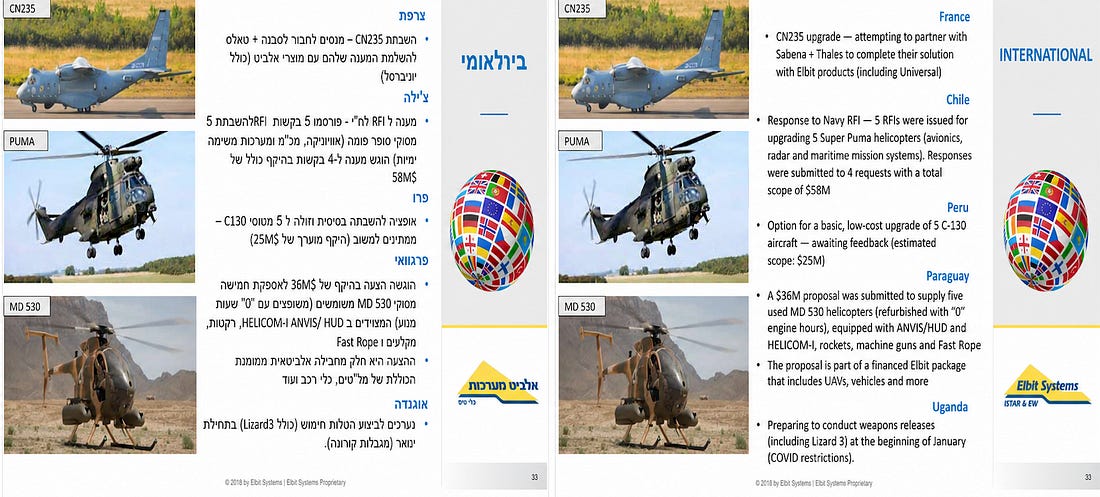
Slide from January 2022 internal Elbit Systems management presentation. Machine translation provided by Drop Site.
The archive also contains evidence that Elbit was preparing to provide more advanced offensive weapons upgrades to Uganda. A management presentation circulated internally at the beginning of January 2022 states under the heading “Uganda” that the company was “preparing to conduct weapons drops (including Lizard 3) at the beginning of January,” subject to Covid restrictions. Lizard 3 is an Elbit laser-guidance kit that the company markets to help “convert general-purpose bombs into precision-guided weapons.”
In addition to extensive sales of weapons and surveillance systems, the documents suggest Elbit was providing Uganda with help developing physical bases to operate the Hermes 900 drones and accompanying ground-based infrastructure. A July 2021 contract in the archive contains information on an order for three ground-based OPATS units for a drone base—equipment intended to automate the takeoff and landing of drones—and prices a spare-parts package to support Ugandan operations at a second base.
The basing infrastructure also appeared to set the stage for ongoing charges to the Ugandan government for support from Elbit for their military operations, while also giving a picture of the pace of expansion of the Hermes 900 fleet. Under “future options,” the same document lists a $2.3 million Hermes 900 spare-parts package to support the additional base and anticipated future maintenance charges for two existing aircraft beginning in November 2022 and a fleet of three to five aircraft beginning a year later.
Operational Problems
Despite the enthusiasm on both sides of the deal to expand the relationship, the emails also reveal serious operational problems in deploying Israeli military equipment in Uganda.
In an email message accompanying the signed 2021 alignment agreement, a representative from Yamasec told Elbit representatives that a Hermes 900 ground-control trailer had flooded and that operations had been halted as a result. “This is simply unreasonable—it is supposed to be milspec,” they wrote, using an abbreviation to denote military standards.
Despite the complaints and alleged shortcomings in fulfilling the contracts, Yamasec proposed more deals to purchase equipment from Elbit, including a proposal to connect the entire Hermes drone fleet to a proposed intelligence center capable of processing and analyzing the information collected by the aircraft and helping Ugandan security forces “close loops”—military terminology for turning raw data into operational intelligence to carry out attacks.
The communications do not indicate whether the delivery of the requested systems and supporting infrastructure took place.
Yamasec’s involvement in the deal is also notable because the company has previously been accused of transferring military equipment that listed Uganda as its contractual end-user to the government of South Sudan. In a 2018 report, the conflict monitoring organization Conflict Armament Research identified aircraft acquired through a network of entities connected to Yamasec and used in Uganda that were subsequently placed into South Sudanese military service.
That report found that, “a group of related companies owned and operated by Israeli, Ugandan, UK, and U.S. citizens based in Uganda” had acquired aircraft for Uganda, and that “one of these companies, Yamasec, then supplied these aircraft to the SPLA (Sudan People’s Liberation Movement), together with training and crew, adding that an “Israeli-Ugandan citizen who owns Yamasec Ltd” had been personally involved in the acquisition of at least one aircraft. The alleged transfers took place prior to a 2018 United Nations-imposed arms embargo on South Sudan.
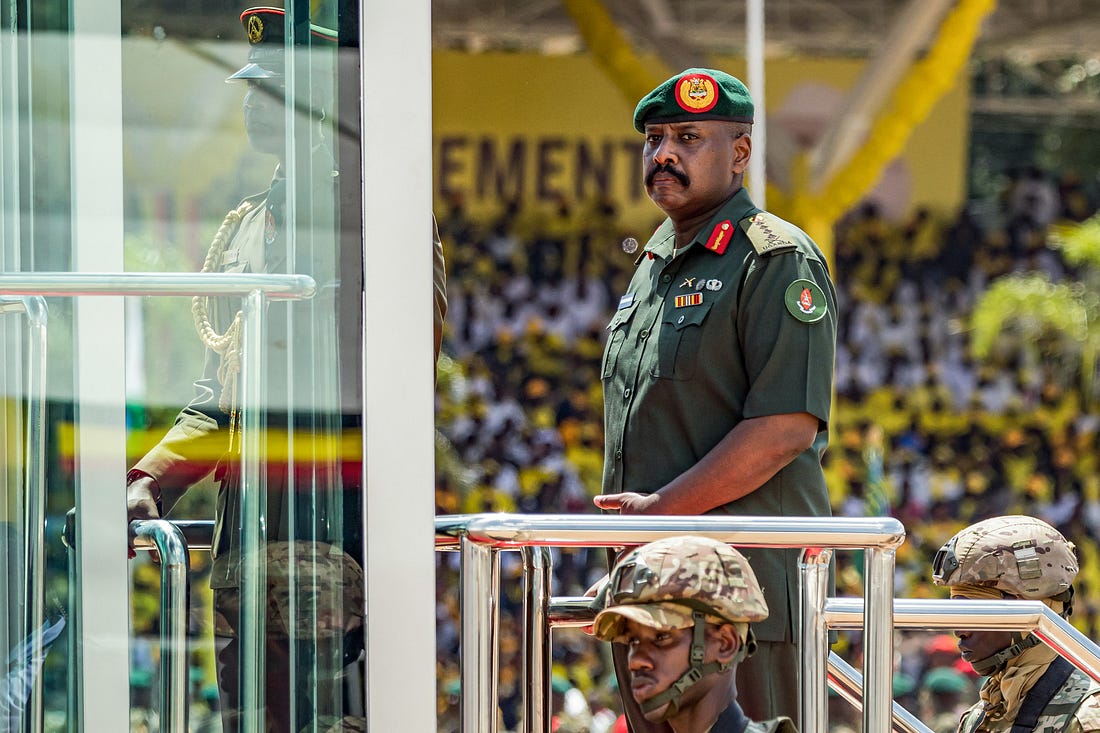
Muhoozi Kainerugaba, son of President Yoweri Museveni and Uganda’s chief of defence forces, inspects a military parade from a vehicle in Kampala on May 12, 2026. Photo by Badru Katumba / AFP via Getty Images.
Gaza Deployment
The expansion of Uganda’s military role in the region and increased ties with Israeli defense manufacturers comes as some of the same security agencies listed as customers in the Elbit deal have faced scrutiny over human rights abuses.
In December 2021, the U.S. imposed Global Magnitsky sanctions on Abel Kandiho, then commander of Uganda’s Chieftaincy of Military Intelligence—one of the security agencies listed as an end-user of Elbit equipment in the available contracts.
The U.S. Treasury statement announcing the listing said that Kandiho and other military intelligence officers had arrested, detained, and physically abused Ugandans because of their political views, nationality, or criticism of the government, describing beatings, sexual abuse, and electrocution during interrogations.
The SFC, also listed as an end-user of the weapons and surveillance equipment provided by Elbit, is one of the country’s most politically sensitive security agencies and is associated with the protection of Museveni and his family. Kainerugaba, Museveni’s son and presumed successor, commanded the SFC before rising to lead the entire military.
That support for the SFC and the Museveni family seems to have paid political dividends in Tel Aviv’s relations with Kampala.
In recent months, Kainerugaba has been increasingly vocal about Ugandan support for Israel, even threatening to attack Israel’s enemies on its behalf. “We want the war in the Middle East to end now. The world is tired of it,” he wrote in another social media post in March of this year shortly after the start of the Israeli-U.S. war against Iran. “But any talk of destroying or defeating Israel will bring us into the war. On the side of Israel!”
Israel has had a complex relationship with Uganda over the past several decades. Israel trained and equipped the Ugandan military after the country gained independence in 1962, while the country’s future military dictator Idi Amin received Israeli military training and maintained close relationships with Israeli advisers.
After Amin took power in a 1971 coup, Israel initially backed his government. But the following year Amin severed relations with Tel Aviv after Israel rejected his requests for Phantom fighter aircraft to use in a conflict against Tanzania, turning instead to Libya for military and financial support, and attempting to refashion himself as a supporter of the Palestinian cause.
Relations between Tel Aviv and Kampala reached their lowest point during the 1976 Entebbe hostage crisis, and were only reestablished by Museveni in 1994. Security, intelligence, and military cooperation have deepened since then, culminating in the renewed defense-cooperation agreement in 2022.
The support that Elbit has provided to the SFC commanded by Kainerugaba, and its role in shoring up the dynastic power of the Museveni family, offers some additional insight into the increasingly vociferous support that the country’s leadership has offered Tel Aviv, which could soon include the deployment of Ugandan troops to the Gaza Strip.
At the early August ceremony unveiling the monument to Yonatan Netanyahu at Entebbe airport, Kainerugaba honored the Israeli commando and brother of the current prime minister who died in the raid that also killed several dozen Ugandan soldiers, while praising Kampala’s expanding relationship with Tel Aviv.
“Monuments are more than stone and bronze,” Kainerugaba said. “They preserve memory, teach history, and inspire future generations. This monument, therefore, carries significance far beyond commemorating one brave individual.”
Bjørnar Moxnes (R): Vil regjeringen innføre sanksjoner mot Israels forsvarsminister Israel Katz og generalmajor Avi Bluth, slik den israelsk-palestinske fredsorganisasjonen Combatants for Peace har tatt til orde for, uten å vente på EU?
Begrunnelse
Utenriksministeren og statsministeren mottok i august to brev fra Norske venner av Combatants for Peace, som viser til oppfordringene fra Combatants of Peace om sanksjoner mot Israels forsvarsminister Israel Katz og generalmajor Avi Bluth, IDFs øverstkommanderende på Vestbredden. Combatants for Peace er en israelsk-palestinsk fredsorganisasjon som består av tidligere soldater på begge sider av konflikten. Brevene viser til at forsvarsminister Katz den 28. juli 2026 uttalte at han har instruert IDF om å forberede okkupasjon av nok en palestinsk flyktningleir på Vestbredden og at dette skal gjennomføres «etter modellen som ble brukt mot terrorleirene i Jenin, Tulkarm og Nul al-Shams», leirer som IDF allerede har ødelagt og tømt for innbyggere. Combats for Peace finner at direktivet bryter humanitærrettens regler mot kollektiv avstraffelse og etnisk rensning. Combatants for Peace vurderer videre Bluths handlinger som brudd på artikkel 27 og 33 i fjerde Genèvekonvensjon, som pålegger okkupasjonsmakten plikt til å beskytte sivilbefolkningen, ved at Bluth:
«systematisk har unnlatt å beskytte den palestinske befolkningen mot vold, samtidig som han har muliggjort omfattende ødeleggelse av infrastruktur og boliger, hindret palestinere i å nå sine arbeidsplasser og jordbruksarealer, og latt israelske bosettere væpne seg og operere side om side med hans styrker under gjennomføringen av pogromer og terrorhandlinger.»
Regjeringen innførte 10. juni 2025 innreisenekt mot to andre israelske myndighetspersoner: Finansminister Bezalel Smotrich og sikkerhetsminister Itamar Ben-Gvir. Beslutningen var hjemlet i utlendingslovens § 126 og begrunnet av regjeringen med ministrenes oppfordringer til vold og fordrivelse av palestinerne, samt Smotrichs ansvar for hvordan Israel som okkupasjonsmakt utøver kontroll over sivilbefolkningen i Palestina. Spørsmålstiller lurer derfor på om regjeringen vil ta oppfordringen fra Norske venner av Combatants for Peace til følge og a) Innføre innreisenekt og evt. andre sanksjoner mot Israel Katz og Avi Bluth. b) Koordinere dette med Storbritannia, Australia, Canada og evt. Australia, slik som i 2025, i stedet for å vente på beslutning fra EU c) Ta opp saken med EU og be om at Katz og Bluth listeføres også i EUs sanksjonsregime.
Svar
Espen Barth Eide: Flere israelske politikere har i det siste tatt til orde for handlinger som, om de blir gjennomført, vil være klart folkerettsstridige. Alvorlighetsgraden i disse utspillene og oppfordringen til vold som begås, øker stadig. De seneste uttalelsene til forsvarsminister Israel Katz samt øverstkommanderende for Israels forsvarsstyrker på Vestbredden, generalmajor Avi Bluth som representanten viser til, er ekstreme og helt uakseptable.
Norge er en tydelig forsvarer av folkeretten og en av Palestinas sterkeste støttespillere. Vi har i tre omganger sluttet oss til EUs listeføringer av voldelige bosettere og bosetterorganisasjoner under sanksjonsregimet mot alvorlige menneskerettsbrudd. Norge har også innført innreiseforbud i henhold til utlendingsloven mot over 20 voldelige bosettere og to av Israels regjeringsmedlemmer (finansminister Bezalel Smotrich og sikkerhetsminister Itamar Ben-Gvir) som har oppfordret til vold og fordrivelse av den palestinske befolkningen. Regjeringen har også sendt på høring et lovforslag om handelsforbud med varer som produseres i og eksporteres til israelske bosetninger i Palestina.
Det er ikke i samsvar med norsk sanksjonspolitikk å iverksette sanksjoner alene, og sanksjonsloven gir heller ikke hjemmel til dette. Etter norsk syn er det multilaterale, globale og tvingende sanksjoner vedtatt av FNs sikkerhetsråd eller andre tiltak med bred internasjonal oppslutning som har størst legitimitet og effekt for å påvirke en stat til å endre adferd. Derfor vil vi ta innspillet fra Combatants for Peace med oss videre i våre diskusjoner om andre potensielle tiltak med likesinnede land.