
Octopus keeps stuff out of Indonesia’s crowded landfills
Catherine Shu@catherineshu / 4:23 AM GMT+2•July 7, 2022

Image Credits: Octopus
According to the World Bank, Indonesia produces 4.8 million tons of plastic waste each year that is “mismanaged” — meaning it ends up uncollected, chucked into dumpsites or leaked from improperly managed landfills. Octopus wants to reduce that number with a platform that makes it easier to collect waste products from consumers and recycle it into raw materials that brands can reuse. The Jakarta-based startup announced today it has raised an oversubscribed round of $5 million led by Openspace and SOSV.
Octopus was founded last year by Mohammad Ichsan, Hamish Daud, Niko Adi Nugroho, Rizki Mardian and Dimas Ario, who have known each other for over a decade.
After recently launching in Jakarta, it will use its new funding for “aggressive expansion,” including five sorting facilities and 1,700 checkpoints in four cities: Jakarta, Bandung, Bali and Makassar, with the aim of handling 380 tonnes of waste ranging from plastics to electronic appliances, each month.
https://jac.yahoosandbox.com/1.2.0/safeframe.html
Ichsan said one reason he founded Octopus was because he returned to his parents’ house in Makassar for a holiday and found that a landfill 30 kilometers away emitted an unbearable stench, especially considering that he had a newborn daughter.
“I wondered what kind of world she’s going to live in,” he told TechCrunch. “Apparently this problem is not happening in certain cities but also in other cities in Southeast Asia so I started to explore more of the business by doing manual waste trading and trying to solve the problem one step at a time, starting with reducing recyclable waste that ends up in landfills by doing manual waste trading.”
Around that time, Ischan met co-founder Daud, who had the same concerns and had been doing research about ocean waste.
Octopus also points to Indonesian government regulations about waste collective referred to as 3R, or “reuse, reduce and recycle,” that are meant to reduce the amount of plastic ocean debris in the ocean by 70%. The government has reinforced these goals with initiatives like waste banks, enforcement of recycling goals for brands and producers, and a fee on plastic bags for consumers.
Octopus says that as of 2025, the Indonesian government will have spent $5.1 billion on creating a circular economy for more brands. It claims to be “the first platform to offer an end-to-end recyclable waste management logistics platform.”
The company says that over the past six months, it has grown by over 400%, with users at both ends of the supply chain. This includes 150,000 monthly users and more than 60,000 pelestari, or independent waste collectors. It claims that more than 12,000 pelestari have been able to open a bank account since joining Octopus. On the other end of the supply chain, Octopus serves more than 20 brands, including global FMCG companies who use Octopus to help meet their ESG compliance. One of its goals is to reach 100,000 pelestari by 2024.
Octopus offers two main kinds of service, said Ischan. The first one is selling post-consumer materials to the recycling industry and the second is data collection reporting for FMCG brands. For example, it helps Softex Indonesia collect used diapers from consumers with proper handling standard operating procedures from pelestari, who operate as gig workers.
For pelestari who don’t own a mobile phone to access Octopus’ app, Ischan said the company is working with social welfare bureaus to provide phones as part of local city government programs to solve unemployment in their areas.
In a prepared statement, Openspace founding partner Shane Chesson said, “Octopus is leading the way in using technology to create a step change in the size of the circular economy in Indonesia. Participants at all stages of this supply chain are incentivized to make this happen and most importantly, environmental imperatives need us to get this right.”
From: techcrunch.com
—————————————————————————————————————————
Indonesia summons Britain’s envoy after furor over rainbow Pride flag
A 2020 survey by the Pew Research Center showed that 80 percent of Indonesians believe homosexuality “should not be accepted by society.”
May 24, 2022, 11:09 PM CEST / Source: Reuters
By Reuters
Indonesia summoned Britain’s ambassador on Monday to explain the raising of an LGBTQ Pride flag at its embassy and urged foreign missions to respect local “sensitivities” following a backlash among conservatives.
Barring the sharia-ruled province of Aceh, homosexuality is not illegal in Indonesia, the world’s largest Muslim-majority country, although it is generally considered taboo.
The rainbow Pride flag was flown alongside the British flag at the country’s embassy in Jakarta on May 17 to mark the International Day Against Homophobia, Biphobia and Transphobia, according to an Instagram post by the embassy.

Alumni 212 Brotherhood, an influential conservative Islamic movement, in a statement said the flag sullied the “sacred values of Indonesia.”
Teuku Faizasyah, foreign ministry spokesperson, confirmed British ambassador Owen Jenkins had been summoned.
“The foreign ministry reminds foreign representatives to be respectful of the sensitivities among Indonesians on matters relevant with their culture, religion and belief,” he said.
A British embassy spokesperson did not immediately respond to a request for comment.
Faizasyah said that though an embassy is sovereign territory, the Vienna Convention on Diplomatic Relations stipulates only that nation’s flag can be flown.
Indonesia is becoming less tolerant of its LGBTQ community as some politicians become more vocal about Islam playing a larger role in the state, according to activists and human rights groups.
A 2020 survey by the Pew Research Center also showed that 80 percent of Indonesians believe homosexuality “should not be accepted by society.”
Last week, Indonesia’s chief security minister said a revision of the criminal code being deliberated by parliament included some articles aimed at the LGBT community, a move backed by some conservative lawmakers.
His remarks followed a backlash over a popular podcast that was forced to scrap an episode this month in which a gay couple was interviewed.
From nbcnews.com
—————————————————————————————————————————
Indonesia’s new guidelines for quieter mosques spark controversy
Jakarta tightens use of loudspeakers at dawn, limits volume to 100 decibels

The Indonesian Ministry of Religious Affairs» new guidelines on the use of loudspeakers at mosques include a volume limit of 100 decibels. © Sipa via AP
SHOTARO TANI, Nikkei staff writer
JAKARTA — Indonesia’s new guidelines to address complaints about mosque loudspeakers» volumes are sparking controversy in the Muslim-majority nation.
A circular issued on Feb. 18 by the Ministry of Religious Affairs introduced several new guidelines on loudspeakers, including maximum volume, for the more than 600,000 registered mosques in the sprawling archipelago.
Mosques use loudspeakers for calls to prayer and other matters. Over the years many people have complained about sound level and quality, especially given that some prayers take place at dawn. Despite multiple attempts to address the issue since an initial guideline was put out more than 30 years ago, a sizable portion of mosques have failed to follow the rules.
«The use of loudspeakers in mosques and prayer rooms is currently a necessity for Muslims as one of the media to spread Islam in the community. At the same time, we live in a diverse society, in terms of religion, belief, background, and others, so efforts are needed to maintain fraternity and social harmony,» said the circular, signed off by the religious affairs minister, Yaqut Cholil Qoumas.
While over 80% of Indonesians follow Islam, the country also recognizes Protestantism, Catholicism, Hinduism, Buddhism and Confucianism as official religions.
 Mosques broadcast the call to prayer five times a day: at dawn, after midday, in the afternoon, after sunset and at night. © Reuters
The circular, which amends guidelines dating to 1978, introduced for the first time a volume limit for loudspeakers, setting it at 100 decibels, and required sound quality to be «good or not discordant.» It also shortened the time allowed for Quranic recitals before the dawn call to prayer to 10 minutes, from the previous 15 minutes.
The guidelines also stated that sermons and other announcements may only use interior speakers and not external speakers.
Mosque volumes have long been a contentious issue in Indonesia. In 2012, then-Vice President Boediono, who goes by one name, faced a backlash after suggesting that mosques lower volumes for calls to prayer. In 2018, a woman in North Sumatra was sentenced to prison for blasphemy after complaining about the volume of mosque loudspeakers. And last year, people living in Tangerang on the outskirts of the capital, Jakarta, swarmed a housing complex over a resident’s alleged protest against mosque noise.
It is an issue that has caused a stir in other countries as well, even Muslim ones. In neighboring Malaysia, which leaves deciding rules on mosque loudspeakers to individual states, several states have restricted their use only for the call to prayer.
And in Saudi Arabia, a circular was issued last year that said speaker volumes should be set at no more than one-third of their maximum volume, and that they should not broadcast full sermons.
After the Indonesia’s circular was made public, a lawmaker from the Islamist opposition Prosperous Justice Party (PKS) also expressed concern over the new guidelines.
«In my opinion, the Ministry of Religious Affairs does not need to regulate very technical matters regarding worship issues, especially the use of speakers for the call to prayer, recitation, or others in the community, because this is not the same in every village,» he said, as reported by local media.
Indonesia’s internet community seemed to be divided on the new guidelines.
«It’s ok to regulate using outside speaker for call to prayer. To be honest, it is disturbing, as my house is next to a traditional mosque and every evening the noise is unbearable. Especially when [people] are reciting Quran, it feels like an earthquake in the neighbourhood,» one Twitter user quipped.
Another Twitter user, however, said it feels like Islam seems to be the only religion being targeted, and «it’s getting close to feel like living in France,» which controversially has banned the wearing of Islamic veils in public spaces. Another said: «Since I was born, call to prayer using external speaker is everywhere, no one bothered. Why is there someone who dares to regulate the call to prayer?»
—————————————————————————————————————————–
Indonesia’s new forest capital in Borneo heightens fears for orangutans» future
Tamara Thiessen, CNN • Published 21st February 2022
(CNN) —
The steamy, jungle-covered tropical island of Borneo was once considered one of the remotest, wildest places on earth. A place where orangutans and headhunters lurked undisturbed.
Together with neighboring Sumatra, it’s one of just two places in the world where the orangutan lives in the wild.
For decades, forestry and agriculture have whittled away orangutans» forest home, placing them in great peril, according to the WWF.
As deforestation accelerates and more species are lost and threatened, now more trouble lurks.
Related content
Indonesia names new capital, approving shift from Jakarta
Almost three years after announcing it, the Indonesian government is moving ahead with its plans to relocate the nation’s capital to the dense but dwindling jungles of East Kalimantan province.
That is, 730 miles (about 1,175 kilometers) away from sinking, overcrowded Jakarta to a new «forest capital,» as President Joko Widodo calls it, in Borneo’s hilly hinterland.
With the move now enshrined in law, work on Nusantara may begin this year, while relocation will start in 2024.
About an hour’s drive north of seaport Balikpapan, the location picked for the new capital straddles the North Penajam Paser and Kutai Kartanegara Regencies — or administrative districts.

An orangutan eats a pineapple at the Samboja Lodge eco-tourism resort, operated by the Borneo Orangutan Survival Foundation.
Dimas Ardian/Bloomberg/Getty Images
Orangutans» habitat continues to shrink
The government envisages the «smart city in the forest» as an innovation hub.
But alongside the excitement, there’s also deep concern for the shrinking lowland tropical rainforest and its wildlife. The UN says humans are driving the orangutan to extinction.
Without a «transformative change» in human behavior, the critically endangered animal could be extinct within a few decades, it warns.
This has led to fears that while securing a future for the sinking megalopolis, Indonesian officials are sinking the future of one of the planet’s most remarkable creatures.
«The move will bring a large population but also big demands for changes to land-use to accommodate new housing and office complexes, even food production centers,» says Anton Nurcahyo, deputy CEO of the Indonesian non-profit Borneo Orangutan Survival Foundation (BOS).

A juvenile orangutan plays at the Samboja Lodge eco-tourism resort.
Dimas Ardian/Bloomberg/Getty Images
«This inevitably will create huge changes to the surrounding habitats.»
The foundation’s orangutan rehabilitation work began in East Kalimantan in 1991.
Since 2006, its orangutan sanctuary, Samboja Lestari, has been caring for injured and orphaned orangutans, rescued from jungle destroyed by logging and palm oil crops.
It lies precisely in the area of the new capital.
Today, staff here take care of over 120 rescued orangutans in a conservation area of regenerating forest. The idea is to release them back into «areas of safe, secure natural habitat» if they regain their health. But what if the fruit-rich forests suffer further losses?
Related content
This orangutan saw a man wading in snake-infested water and decided to offer a helping hand
«The neighboring Sepaku and Samboja districts (earmarked for Nusantara) do not have wild orangutan populations,» Nurcahyo says.
«But the orangutan rehabilitation center is located here, on 1,850 hectares of forest, which needs to be preserved in its current condition.»
NGOs and locals worry that a new city of some 1.5 million residents may be disastrous for the environment.
The influx, mostly of civil servants and their families from Jakarta, could force the dispossession of people and animals.

This aerial picture taken on August 28, 2019 shows the area around Sepaku, where Indonesia’s new capital is set to be built.
STR/AFP/AFP/Getty Images
The extent of the threat to rare wildlife will depend on the ongoing planning and surveys, says BOS.
«With the unique ecosystems in East Kalimantan, it is vital to have a mitigation plan in place tailored to these specific environmental needs,» Nurcahyo insists.
«That plan is still being developed. The first step will be to evaluate and map the impact of the move.»
Local government promises environment will be protected
Kalimantan has already seen vast habitat loss and the killing of 2,000-3,000 orangutans a year since the 1970s, according to the International Union for Conservation of Nature (IUCN). The orangutan is on its red list of critically endangered species.
In a century, total populations have almost halved, says the WWF — from 230,000 to about 112,000.
Nurcahyo says about 57,350 orangutans survive in Borneo, «spread into 42 pockets of wild population.»
The big worry is that most orangutans in Kalimantan exist outside of protected areas. Or, as the WWF puts it, «in forests that are exploited for timber production or are in the process of being converted to agriculture.»

Kato — a large male orangutan — is carried in a cage from a small boat from the River Bemban to his release site in Bukit Baka Bukit Raya National Park in Central Kalimantan, Borneo, Indonesia in 2017.
Jonathan Perugia/In Pictures/Getty Images
Officials have moved to allay fears about the impact of the new capital on the environment.
The Indonesian government has pledged no protected forests will be touched in the $32 billion megaproject.
It will be «a smart city, with green technology and friendly to the environment,» promised the president while discussing the move with journalists.
East Kalimantan Governor Isran Noor told media he admits some trees will fall to make way for the 256,000-hectare (2,560 square kilometers) site, which is almost four times the size of Jakarta.
Related content
Borneo’s orangutan population slashed by more than half in 16 years
«Of course, there will be a few sacrifices, but ultimately, we aim to achieve forest revitalization,» he told local papers. «When finished it will boast at least 70% open green space.»
Poor infrastructure along with continuing logging activity even in nature reserves has so far kept mainstream orangutan tourism at bay here.
Now the government is eager for the new capital to lure foreign tourists and investments. But it’s also aware of the importance of ecotourism, and that most visitors will come to see the wildlife.

Vehicles crowd a main road leading out Jakarta during the early evening rush hour on November 30, 2021.
Bay Ismoyo/AFP/Getty Images
Forest reserves surrounding Nusantara will play a pivotal role in ensuring conservation efforts and sustainability, Governor Noor told media.
So too will the orangutan sanctuaries.
«Nature and urbanization will coexist here,» Aswin, chief of East Kalimantan’s Regional Development Planning Agency, Bappeda Kaltim, told local media.
He noted strategic environmental studies are underway to ensure the forests are taken care of.
«The important thing is that our area can become an economic, tourist and other destination.»
But he’s also boasted of the huge profits to come. Investment in East Kalimantan is set to soar by 34.5% compared to a national rise of 4.7%, he said. And economic growth will double with the relocation.
Even the buffer zone around Nusantara — from Samrinda to Balikpapan — must benefit from the move, he said.
«We need East Kalimantan to be bright and sparkling.»
The Kalimantan Rainforest in Borneo, Indonesia is one of the most biodiverse spots on Earth. Bustling with life, the dense greenery is home to orangutans, all kinds of birds, frogs, you name it. But the rainforest won’t stay that way if mining and logging continues unchecked. Which is why The Nature Conservancy’s Dr. Eddie Game is listening to the sounds of the rainforest to measure the impact of human activity on the area’s wildlife.
Amid concerns that all that will come at a cost, the regional arm of the National Development Planning Agency, Bappenas, is reportedly busy consulting local communities about ecological conservation of the jungle tract.
Kalimantan’s Heart of Borneo forests must be preserved as Nusantara takes shape, said acting chief Muhammad Raudo. (Something local officials feel could take decades, not years.) The handling of protected forests and prevention of floods and forest fires are a concern, he told local community representatives.
Glimmers of hope
Beyond the rhetoric of Borneo’s jungles being the «Paru-Paru Dunia» — «lungs of the earth» — forest burning continues. Many fires are deliberately lit to clear land for agriculture.
These have even flared up near the upcoming capital, leaving apes in wildlife rehabilitation shelters blind or severely disabled.
Some worry that logging, land-clearing and fires will only worsen as construction takes off.
«These ecosystems are already hit by large-scale coal mining, logging and monoculture oil palm plantations,» said Sophie Chao at the University of Sydney, an expert in ecology and indigeneity in Southeast Asia.
She believes the move spells more strife for indigenous populations and thousands of species of flora and fauna.
«The region of East Kalimantan is immensely rich in biodiversity, with over 133 mammals, 11 primates species and 3,000 types of trees. These are found across a diverse mosaic of karst landscapes, peat marsh, mangrove, flatland dipterocarp forest and humid forest.»
Set against that specter, there are glimmers of hope.
Nurcahyo does not rule out the chance that shifting Indonesia’s capital to Borneo could bring more attention to the orangutan’s plight and bolster conservation efforts.
«All that depends on the mitigation plan and potential ecological ramifications of the move. We, meantime, will dedicate ourselves tirelessly to the conservation of the Bornean orangutans and their habitat.»
COVID-19 cases are plummeting in Asia, and scientists aren’t 100% sure why
————————————————————————————————————————
December 10, 2021 – fortune.com
In the weeks after the 2020 Tokyo Olympics, Japan experienced its worst-ever COVID crisis.
In late August, infections surged to nearly 24,000 per day and daily deaths peaked at over 65. But since then, COVID-19 infection and death rates have fallen to their lowest seen since early 2020, with Japan recording an average of 108 cases and one death per day in the last week.
Japan’s drop in infections is likely related to a number of factors, says Karen Grépin, a public health professor at Hong Kong University. For one, 77% of Japan is fully vaccinated after its campaign got off to a slow start. Japan has also maintained relatively strict border controls and adopted near universal mask wearing and intensive contact tracing measures even as it avoids mass lockdowns.
Japan isn’t alone. Evidence of COVID-19 is also fading in other Asian countries as disparate as Indonesia, India, the Philippines, Singapore, Thailand, and Cambodia. To be sure, countries like South Korea and Vietnam are in the midst of record COVID-19 surges, but the region-wide trend is clear: COVID-19 cases have been dropping across Asia since early September.
After recording nearly 200,000 cases per day on Sept. 1, the region is recording 43,000 cases per day as of Thursday, according to the United Nations Office for the Coordination of Humanitarian Affairs, meaning the entire continent is logging roughly a third of the daily cases in the United States.
Asia’s COVID-19 decline comes as Delta-driven waves are fueling surges elsewhere. Europe, for example, is recording more daily cases now than it has since the beginning of the pandemic, with infections rising from just over 100,000 cases per day in September to nearly 400,000 today, according to Reuters.
Experts say that a recent uptick in COVID-19 vaccinations is likely the most important reason for Asia’s downward trend. But other factors like natural immunity from previous infections, Asia’s slower re-opening process compared to other parts of the world, and even seasonal weather patterns may be contributing to the falling COVID rates. Still, the factors that have eased Asia’s latest COVID wave may not be able to fend off what likely lays in store: a surge of cases from the highly-mutated Omicron variant that seems to spread faster and better evade vaccines than its predecessors.
Vaccines and borders
Asia’s vaccination campaigns got off to a slow start compared to those in U.S. and Europe, but many Asian countries quickly caught up.
Singapore is now one of the world’s most inoculated countries with 88% of its population fully vaccinated, and caseloads there are dwindling. The city-state is recording roughly 750 infections per day after reaching a record of more than 3,500 cases per day in October. Malaysia and Cambodia have fully vaccinated 78% and 81% of their populations, respectively, and COVID-19 cases have plummeted in those countries too.
High vaccination rates are a «huge factor» in declining cases in these Asian countries, says Ashley St. John, an immunologist at the Duke-NUS Medical School in Singapore. «Vaccination reduces the spread of infection and also makes it more likely that the infections do still occur are mild and often sub-clinical.»
Like Japan, many countries in Asia have also been cautious in re-opening efforts, which may be keeping case counts low. Singapore experienced a surge in COVID-19 infections amid plans to «live with the virus» and unlock its borders this fall. But even as re-opens, Singapore is restricting group gatherings and how many people can dine together at restaurants. Malaysia, meanwhile, has only partially re-opened its borders, allowing just a limited number of tourists to visit the tourist island Langkawi without quarantine.
«In Europe and North America, it was really common to see governments say, «We’re done with COVID measures, we’re done implementing all these mandates,'» says Grépin. «In Asia, countries have been much more risk averse in terms of the ways in which they’ve been opening up.»
Natural immunity and the weather
But vaccination rates and social distancing measures may not fully explain Asia’s case decline.
Indonesia, the Philippines, and India, have fully vaccinated 37%, 36%, and 35% of their populations, respectively, well below levels that might be required to achieve vaccine-induced herd immunity. Still, infections are dropping in all three countries.
Indonesia is recording its lowest level of daily COVID-19 infections since April 2020, with cases falling to 236 from 50,000 in July. The Philippines and India are also recording their lowest daily COVID rates in 18 months.
Michael Toole, an epidemiologist at Australia’s Burnet Institute, says improving vaccination rates may be helping. But these countries have likely achieved a “high level of natural immunity,” with Delta-driven waves exposing large portions of their populations to the virus during massive surges earlier this year, he says.
Another potential explanation, at least in some areas, is the weather. While much of Europe may be moving indoors as temperatures drop, people in Asia are transitioning to outdoor activities after brutally hot summers.
«There is also something to be said for seasonality as more pleasant temperatures lead to less crowding,» says Jason Tetro, a microbiologist based in Canada and author of The Germ Code. «In places like Japan, Singapore, and Indonesia, it could also be in those very hot summer months when people simply need to get into the cooler indoor air.»
But ultimately, scientists say that much of the why and when of COVID-19 waves remains a mystery.
“Although we are two years into COVID-19, we still have few answers regarding surges and drop-offs,” says Tetro.
Omicron
The new Omicron variant may be poised to disrupt Asia’s declining COVID rates. Emerging research shows that its many mutations may make the virus more likely to bypass vaccine protection and re-infect people who previously contracted COVID-19.
It is too early to know if Omicron will take hold in other countries like it has in South Africa, where the strain is driving a surge of new infections. But early signs suggest that it might be more transmissible, if less severe, than variants like Delta, meaning it could become dominant globally.
«If Omicron is more transmissible, it will out compete [Delta],» says Toole.
Grépin says that governments like Japan and Singapore are right to delay re-opening plans as the threat of Omicron looms. Such caution will allow them to «pause long enough to better understand, and reinforce domestic measures to prepare for a scenario that could lead to many, many more cases,» she says.
But ultimately, continuing to improve vaccine rates remains the best protection against the new variant.
«All evidence to date suggests that vaccines protect from severe disease caused by variants,» says St. John. «The risk of new waves will be closely linked to the level of vaccine coverage in each country.»
Related Articles
- HEALTHThe world’s oldest country is seeing less than one COVID-19 death a day
 December 7, 2021BY BLOOMBERG
- INTERNATIONALHigh vaccine rates could limit the economic fallout of Omicron across Asia—but there’s one big caveat
 November 29, 2021BY EAMON BARRETT
—————————————————————————————————————————–
8 dead, dozens hurt as Indonesia quake shakes East Java
By Associated Press AP PUBLISHED 4:29 AM ET Apr. 11, 2021
MALANG, Indonesia (AP) — A strong earthquake on Indonesia’s main island of Java killed eight people, including a woman whose motorcycle was hit by falling rocks, and damaged more than 1,300 buildings, officials said Sunday. It didn’t trigger a tsunami.
The U.S. Geological Survey said the magnitude 6.0 quake struck off the island’s southern coast at 2 p.m. Saturday. It was centered 45 kilometers (28 miles) south of Sumberpucung town of Malang District in East Java province, at a depth of 82 kilometers (51 miles).
Rahmat Triyono, the head of Indonesia’s earthquake and tsunami center, said the undersea tremblor did not have the potential to cause a tsunami. Still, he urged people to stay away from slopes of soil or rocks that have the potential for landslides.
This was the second deadly disaster to hit Indonesia this week, after Tropical Cyclone Seroja caused a severe downpour Sunday that killed at least 174 people and left 48 still missing in East Nusa Tenggara province. Some victims were buried in either mudslides or solidified lava from a volcanic eruption in November, while others were swept away by flash floods. Thousands of homes with damaged.
Saturday’s quake caused falling rocks to kill a woman on a motorcycle and badly injured her husband in East Java’s Lumajang district, said Raditya Jati, spokesperson for the National Disaster Mitigation Agency.
He said about 1,189 homes and 150 public facilities, including schools, hospitals and government offices, were damaged. Rescuers retrieved four bodies from the rubble in Lumajang’s Kali Uling village. Three people were also confirmed killed by the quake in Malang district.
Television reports showed people running in panic from malls and buildings in several cities in East Java province.
Indonesia, a vast archipelago of 270 million people, is frequently struck by earthquakes, volcanic eruptions and tsunamis because of its location on the “Ring of Fire,” an arc of volcanoes and fault lines in the Pacific Basin.
In January, a magnitude 6.2 earthquake killed at least 105 people and injured nearly 6,500, while more than 92,000 were displaced, after striking Mamuju and Majene districts in West Sulawesi province.
____
Associated Press writer Niniek Karmini in Jakarta, Indonesia contributed to this report.
Copyright 2021 The Associated Press. All rights reserved. This material may not be published, broadcast, rewritten or redistributed without permission.
Indonesia’s top palm oil deforesters are the usual shady suspects: Report
by Hans Nicholas Jong on 11 February 2021 – news.mongabay.com
- Repeat offenders dominate the 2020 list of top 10 palm oil companies responsible for palm oil-linked deforestation in Indonesia, Malaysia and Papua New Guinea, according to a new analysis.
- Some of the top deforesters are shrouded in secrecy, with scant information about them publicly available.
- Overall, 2020 saw the lowest amount of palm oil-driven deforestation in three years, likely due to the COVID-19 pandemic.
- However, a resurgent domestic market in Indonesia, coupled with rallying palm oil prices, could fuel further deforestation in 2021.
JAKARTA — Palm oil-driven deforestation is slowing down in Southeast Asia in 2020 but a handful of low-profile companies continue to drive the majority of the destruction, according to a new analysis.
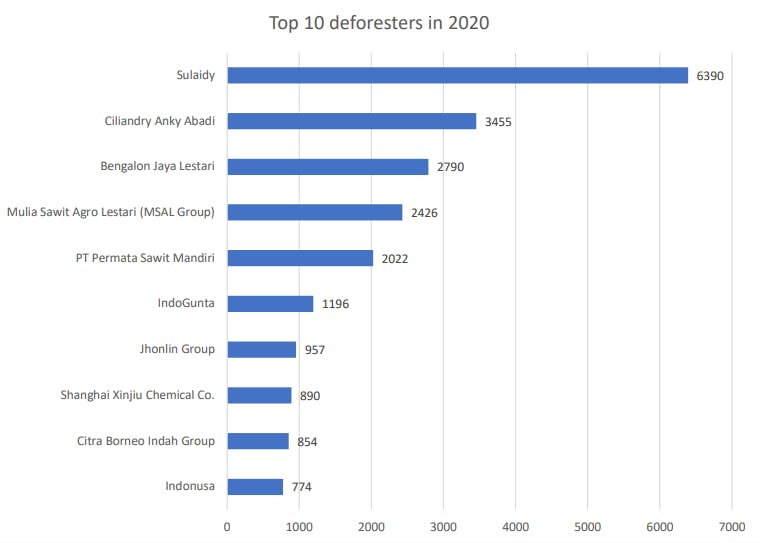
Using satellite imagery, sustainability risk analysis organization Chain Reaction Research (CRR) found that 58% of the 38,000 hectares (93,900 acres) of deforestation for oil palm plantations in Indonesia, Malaysia and Papua New Guinea occurred in the concessions of 10 companies in Indonesia.
Most of these companies also appeared in the 2018 and 2019 lists of top deforesters, and their products also end up in the supply chains of major global brands with “no deforestation, no peatland, no exploitation” (NDPE) policies.
CRR said this once again highlights “both the failure of many buyers with NDPE policies to adequately implement their policies and the risk of leakage markets.”
The remaining 42% of the deforestation is distributed among 112 other companies; the top three, by contrast, are responsible for 33% of the deforestation, according to the analysis, which was coordinated by research consultancy Aidenvironment and partner organization Earth Equalizer.
Those top three companies are all owned by Indonesian families and account for a combined 12,635 hectares (31,200 acres) of deforestation, according to CRR — an area the size of 250,000 basketball courts.
The palm oil player no one’s heard of
At the top of the list are companies owned by a little-known businessman from Sumatra named Sulaidy. CRR’s analysis pinned 6,390 hectares (15,790 acres) of deforestation to six of Sulaidy’s eight oil palm plantations in eastern Borneo. This marks the third consecutive year in which Sulaidy-associated companies have ranked first among deforesters. Of the six plantations in question, PT Borneo Citra Persada Jaya in Kutai district, East Kalimantan province, contributed the largest amount of deforestation, with 1,833 hectares (4,530 acres) of forest cleared.
Despite consistently being a top deforester, there’s little public information about Sulaidy or his closely held business group. In a 2018 report, Greenpeace linked Sulaidy with Indonesia’s billionaire Fangiono family, which owns Singapore-listed First Resources conglomerate and FAP Agri, both major players in the palm oil industry.
According to the report, Sulaidy is listed as both a senior manager and a shareholder in many Fangiono family ventures.
The opaqueness of Sulaidy’s businesses suggests that the palm oil produced from the deforested land may be finding its way into the global market through major brands undetected, a practice known as market leakage.
Sulaidy doesn’t appear to own or operate any mills (none of his companies comes up on lists of direct suppliers to companies with NPDE policies), so it’s likely he sells the pam fruit to third-party mills, according to CRR. These mills then go on to supply the global brands.
A CRR investigation last year unearthed at least one such case. It found that PT Palmdale Agrosia Lestari, a Sulaidy subsidiary, was selling palm fruit to a mill owned by PT Pundi Lahan Khatulistiwa. This mill sells the processed palm oil to several companies with NDPE policies, including Danone, Kellogg’s, Mondelēz, Nestlé and Unilever — all of which have made public commitments to purge their supply chains of deforestation.
When the alleged market leakage was reported in 2020, Unilever said it had requested its suppliers to suspend all activity with Sulaidy. Danone and Nestlé said they had launched their own internal investigations and would take corrective actions if needed, with the latter adding that it didn’t find Sulaidy’s companies in the lists of companies selling palm fruit to any of its suppliers.

Shell company in a tax haven
In second spot on CRR’s list of top palm oil deforesters last year is PT Ciliandry Anky Abadi (CAA), a privately held plantation company with a 120,000-hectare (296,500-acre) land bank in Borneo’s Central Kalimantan province. CAA first appeared in the list of top deforesters in 2018, but dropped out in 2019, before making an appearance again in 2020, where it’s been linked to 3,455 hectares (8,537 acres) of deforestation in its concessions.
Like Sulaidy, CAA has been linked to the Fangiono family, whose First Resources is a significant supplier to at least 20 traders/refiners and consumer goods companies with NDPE policies. CAA itself doesn’t have any sustainability commitments, according to CRR.
A 2018 report by CRR alleges that CAA is controlled by a shell company registered in the British Virgin Islands with ownership links to Martias Fangiono, the founder of First Resources.
Both First Resources and CAA have denied the allegation, saying they are not affiliated either financially or operationally.
CRR says CAA still supplies major brands that espouse sustainability commitments, such as Johnson & Johnson, Kellogg’s, L’Oreal and Mondelēz, through its palm oil mills, PT Tirta Madu and PT Borneo Ketapang Indah.

The newcomer and the veterans
The No. 3 deforester on CRR’s list, PT Bengalon Jaya Lestari (BJL), appears there for the first time. According to CRR, BJL cleared 2,790 hectares (6,900 acres) in 2020 on concessions held by its subsidiaries, PT Kartika Nugraha Sakti and PT Wana Jaya Abadi, in North Kalimantan province.
Since there’s little publicly available information on the group and it doesn’t appear to operate palm oil mills, BJL is one of only three companies in the top 10 that can’t definitely be connected to consumer brands with NDPE policies.
A mixture of old and new names make up the rest of the list, with repeat offenders such as the Mulia Sawit Agro Lestari (MSAL) Group and Jhonlin Group making an appearance for a third straight year.
According to the analysis, MSAL cleared 2,426 hectares (6,000 acres) of forest, peat forest, and peat in its three plantations in Central Kalimantan, while Jhonlin deforested 957 hectares (2,360 acres) in 2020 after occupying the second position for two years in a row. Jhonlin was founded by influential tycoon Andi Syamsudin Arsyad, popularly known as Haji Isam, whose business ranges from palm oil to coal mining. According to CRR, both MSAL and Jhonlin’s products appear in the supply chains of major brands with NDPE policies, such as AAK, COFCO International, Oleon, General Mills, Johnson & Johnson, Kellogg’s, and PZ Cussons.

Slowdown
CRR’s report isn’t all bleak. The palm oil-linked deforestation in the three countries, at 38,000 hectares, is the lowest in three years, down from 90,000 hectares (222,400 acres) in 2019 and 74,000 hectares (182,800 acres) in 2018.
CRR attributed the slowdown to the economic slump and travel restrictions brought by the COVID-19 pandemic. According to data from Indonesia’s oil palm business association, GAPKI, production and exports of the commodity contracted in the first half of 2020, while prices slumped across commodities markets.
Palm oil production rebounded in the second half of the year, however, driven by stronger domestic demand, leading to an increase in palm oil prices.
This could spell greater deforestation, CRR warned: “Domestic demand and rallying palm oil prices may result in an upturn in land development in 2021.”
Banner image: Excavator working in an oil palm plantation in Aceh, Sumatra, Indonesia. Image by Rhett A. Butler/Mongabay.
———————————————————————————————————————————————————————–
Treetop sensors help Indonesia eavesdrop on forests to curb illegal logging
SOLOK, Indonesia (Thomson Reuters Foundation) – Clipped onto a rope, climbing high up in a tree swaying in gusts of wind, Topher White finally reaches the roof of the rainforest and opens a laptop to run checks on a machine he built to transmit 24-hour live sound from the surrounding forest.
The machine is one of 27 “Guardian” sensors eavesdropping on forests in Indonesia’s West Sumatra province, to listen out for chainsaws as a way to tackle illegal logging in the region.
Over the next five or six years, White hopes to install tens of thousands of these audio sensors in forests around the world.
“We’re basically building a nervous system for the natural world,” he said.
White, 39, got the idea to use sound in environmental protection ten years ago, while volunteering at a conservation project for gibbons in Borneo.
“You couldn’t really monitor (the forest reservation) with people walking around, but sound seemed like a good way to capture really anything,” he told the Thomson Reuters Foundation.
With a background in engineering, White spent nearly a year building an audio detection sensor using an old mobile phone, solar panels and a microphone, then returned to Indonesia to test the system.
Today, White’s nonprofit, Rainforest Connection, is recording sounds to protect nature in a dozen countries with funding from some of the world’s largest technology companies, including Google and Huawei.
Incoming audio streams, from the Amazon to the Philippines, are analysed by artificial intelligence (AI) trained to pick out desired information, from the sounds of logging to bird calls.
If the system hears a chainsaw, it sends an alert via an app to community patrols, who can check on the ground for logging.
Since it was installed more than a year ago, local monitors say the system has made their jobs easier as they help with Indonesia’s crackdown on forest encroachment, which includes tougher law enforcement.
“(Logging) has totally stopped – people are afraid of coming to this area,” said patroller Jasrialdi, who goes by one name like many Indonesians.
CRACKDOWN ON LOGGING
The canopy sensor White was checking in West Sumatra’s Solok regency is less than an hour’s walk through the forest from the road leading to Sirukam, a village sustained mainly by farming.
Until recently, about 200 of Sirukam’s 6,000 residents opted instead for better-paid work illegally extracting timber from the forest, according to Medison, who heads the LPHM, a local forestry agency.
While cutting down some trees for community use – such as building a house – is often tolerated in Indonesia, logging timber to sell is illegal, he explained.
“There used to be no protection of the forest,” said Romi Febriandi, the elected head of the village government.
Arief Wijaya, senior manager of climate, forests and oceans at the World Resources Institute (WRI) in Indonesia, said most deforestation in the country occurs due to land clearing for extractive industries.
“But addressing the issue of improper community logging is also crucial,” he said in an online interview.
According to Global Forest Watch, a satellite monitoring service run by WRI, Indonesia’s humid old-growth forest – seen as vital for storing carbon dioxide and helping curb climate change – shrank 10% from 2002 to 2019, but the rate of tree loss decreased in the last few years.
WRI data show production from Indonesia’s logging concessions declined between 2013 and 2018, but timber harvested by communities from forests like Sirukam increased by more than 50% during the same period.
In Sirukam, a tougher approach to enforcing rules against cutting down forest trees has squeezed timber trading in the area, according to former loggers and the local government.
The crackdown led Afriadi, not his real name, to ditch logging for rice farming in 2018.
The middle-aged man, dressed in a cap and batik shirt, who agreed to speak only on condition of anonymity, had taken up logging nearly two decades ago.
“There were no other jobs,” he said.
Using chainsaws and ropes, Afriadi hauled trees out of challenging terrain – hazardous work that saw one of his team die in an accident – for which he earned up to 1.5 million rupiah ($107) per month.
Today, he makes a fraction of that as a casual labourer while barely feeding his family with what he grows on the farm.
He still fears arrest for his past as a logger. “It’s better to work on the farm because of that risk,” he said.
‘EARLY-WARNING SYSTEM’
As well as tracking forest sounds, White’s technology is also listening out for whales wandering into Vancouver’s shipping lanes and gunshots in a Greek national park to stop hunting.
The AI has gone through six updates, deepening its understanding of the natural world with each iteration.
White said he can tell just by glancing at a spectrogram if the system is hearing a bird or a primate.
And with engineers training the AI to identify more than 100 species with precision, he hopes Rainforest Connection’s systems could prove a “goldmine” for researchers.
“We would have to be doing something very wrong not to make some major ecological discoveries over the next few years,” he added.
The sensors stream audio to the cloud over a mobile phone network, which has so far limited their application to areas with viable phone reception.
To tackle that problem, the group is planning to install 32 new satellite sensors in Brazil in March, and a cheaper offline model – which stores the audio recording for someone to pick up later – is being manufactured for about $100.
Yozarwardi Usama Putra, head of West Sumatra’s forestry department, said he would like to expand the project’s “early-warning system” beyond the 27 sensors currently installed around the province.
Besides cracking down on logging, Indonesia is also working to encourage non-timber forest enterprises, he noted, adding the West Sumatra government is helping communities access equipment to cultivate and process goods from oyster mushrooms to coffee.
This year, Rainforest Connection plans to finish collecting data for peer review from Indonesia, Peru and Romania to prove the system does help curb logging, which White hopes will prompt governments to consider using the technology at a larger scale.
But some ex-loggers say protecting Indonesia’s forests comes at the cost of their livelihoods – and their voices have yet to be heard.
Afriadi’s small rice field produces just enough for his family to eat. His work as a labourer brings in 70,000 rupiah per day, but he only earns that on a handful of days each month.
Without the income from tree-cutting, he fears he may not be able to provide for his children.
“I am very worried,” he said.
($1 = 13,980.0000 rupiah)
Reporting by Harry Jacques; Editing by Jumana Farouky and Megan Rowling. Please credit the Thomson Reuters Foundation, the charitable arm of Thomson Reuters, that covers the lives of people around the world who struggle to live freely or fairly. Visit news.trust.org/climate
Our Standards: The Thomson Reuters Trust Principles.
————————————————————————————————————————————————————-
This article was published in thejakartapost.com with the title «Jiwasraya: Understanding Indonesia’s largest financial scandalBonds, stocks good asset choices for election year: Analysts». Click to read: https://www.thejakartapost.com/news/2020/10/25/jiwasraya-understanding-indonesias-largest-financial-scandal.html.
———————————————————————————————————————————————————————————-
Xanana Gusmao returns as East Timor PM in coalition government
Country’s first president and former prime minister says his coalition controls 34 of parliament’s 65 seats.

A six-party coalition in East Timor is ready to form a government led by independence hero Xanana Gusmao, it has told President Francisco Guterres in a letter, the coalition’s spokesman said on Tuesday.
Gusmao, the country’s first president and a former prime minister, announced last month that he had formed a new coalition controlling 34 of parliament’s 65 seats, saying he would prepare to form a new government.
The tiny Southeast Asian nation faced political instability since the collapse of a coalition supporting Prime Minister Taur Matan Ruak.
Gusmao, 73, led the military wing of the Revolutionary Front for an Independent East Timor that fought Indonesia, which took control of the country in 1975 after centuries of Portuguese rule.
He was jailed in Jakarta towards the end of Indonesian occupation but continued to lead the struggle for independence from behind bars.
After the Timorese voted overwhelmingly for independence in a United Nations-backed referendum in 1999, Gusmao returned to his homeland a hero and was elected the country’s first president in 2002. He then served as prime minister from 2007 until his resignation in February 2015.
East Timor, one of the world’s poorest countries, was occupied by Indonesia for 24 years, during which an estimated 100,000 East Timorese were killed.
When Indonesia left in 1999, more than 80 percent of the country’s infrastructure had been destroyed.
The country became fully independent in 2002 after three years of UN administration. It remains heavily reliant on oil and gas, which accounted for 78 percent of its 2017 state budget.
Tensions have simmered in the nascent democracy over income inequality and high unemployment.
Aside from oil, agriculture and coffee cultivation are key sectors of the economy.
SOURCE: Al Jazeera and news agencies
More:
-
Jose Ramos-Horta: East Timor will survive as oil ends——————————————————————————————
Indonesia flash floods: At least 60 people killed
Indonesia in grip of worst floods anyone can remember, and even more rain is coming.
Tens of thousands of Indonesians are stranded in emergency shelters, after some of the worst floods and landslides in years devastated entire communities.
The death toll stands at 60 but that is expected to rise, and more rain has been forecast.
Al Jazeera’s Priyanka Gupta reports.
Indonesian capital reels after floods leave 47 dead
Flooding on New Year’s Day was the worst since 2007, weather agency warns of more downpours.

Tens of thousands of evacuees remain crowded into emergency shelters, waiting for floodwaters to recede in and around Indonesia’s capital, Jakarta, as the death toll from massive New Year’s flooding reached 47, officials said.
Monsoon rains and rising rivers submerged a dozen districts in greater Jakarta and caused landslides in the Bogor and Depok districts on the city’s outskirts as well as in neighbouring Lebak, where a dozen people were buried.
National Disaster Mitigation Agency spokesman Agus Wibowo said the fatalities included people who had drowned or been electrocuted since rivers broke their banks early on Wednesday after extreme torrential rains throughout New Year’s Eve.
Three elderly people died of hypothermia.
It was the worst flooding since 2007, when 80 people died over 10 days.
|
|
«The waters came very fast, suddenly everything in my house was swept away,» said Dian Puspitasari, a mother of two, who looked overwhelmed as she tried to sweep piles of mud out of her home.
Four days after the region of 30 million people was struck by flash floods, waters have receded in many middle-class districts, but conditions remained grim in the narrow riverside alleys where the city’s poor people live.
At the peak of the flooding, about 397,000 people sought refuge in shelters across the greater metropolitan area as floodwaters reached levels of 6 metres (19 feet) in some places, Wibowo said.
Data released by his agency showed some 173,000 people were still unable to return home, mostly in the hardest-hit area of Bekasi, a satellite city of Jakarta.
More than 152,000 people remain in 98 adequately supplied emergency shelters in Bekasi, where rivers burst their banks. Much of the city was still submerged in muddy waters up to 2 metres (6.5 feet) high, according to the agency.

Electricity was restored to tens of thousands of residences and businesses as of Saturday.
Jakarta’s Halim Perdanakusuma domestic airport reopened Thursday; its runway had been submerged in the flooding.
Head of the Meteorology, Climatology and Geophysics Agency Dwikorita Karnawati said more downpours were forecast for the capital in coming days and the potential for extreme rainfall would continue across Indonesia until next month.
The flooding has highlighted Indonesia’s infrastructure problems.
Jakarta is home to 10 million people, or 30 million including those in its greater metropolitan area.
It is prone to earthquakes and flooding and is rapidly sinking due to uncontrolled extraction of groundwater. Congestion is estimated to cost the economy $6.5bn a year.
President Joko Widodo announced in August that the capital would move to a site in sparsely populated East Kalimantan province on Borneo island, known for its rainforests and orangutan population.
SOURCE: AFP news agency
More:
more on Asia Pacific
- Nissan says it will continue to pursue legal action against Ghosn
- Asian shares rebound despite Middle East tensions
- Hong Kong’s Lam promises to work closely with Beijing’s new envoy
- Scorched Australia readies for renewed bushfire threat
—————————————————————————————–
Indonesia rushes to pass bill seen as pandering to mining companies
- Indonesia’s parliament is rushing to pass a controversial mining bill by Sept. 30, when the current legislators’ term ends.
- President Joko Widodo had previously asked for deliberations of this bill and other contentious pieces of legislation to be suspended, following massive student-led protests that have turned deadly.
- Watchdogs say the bill panders to the interests of mining companies, granting them bigger concessions, longer contracts, and fewer environmental obligations.
- The Widodo administration has also criticized parliament’s rush to pass the bill, but legislators say they are within their rights to do so.
JAKARTA — Indonesia’s parliament is rushing to pass a controversial bill on coal and mineral mining before the current legislators’ term ends on Sept. 30, defying a massive public outcry over legislation seen as favoring the extractives industry at the expense of the environment and vulnerable communities.
The bill is part of a batch of highly contentious pieces of legislation that parliament has been attempting to rush through in its final days. The previous week, parliament had passed in record time an anti-corruption bill widely seen as weakening the national anti-graft commission. That, as well as attempts to similarly push through a controversial criminal code and three other pieces of legislation, including the mining bill, prompted massive protests led by university students.
At least two students have been killed in the protests that have broken out in cities across Indonesia. In the face of the protests, President Joko Widodo has asked parliament to suspend deliberations of the contentious bills, including the one on mining.
But the fact that parliament looks set to pass the mining bill imminently indicates an attempt to cater to the demands of the mining companies that would benefit under the provisions of the bill as it stands, said Merah Johansyah, the executive director of the NGO Mining Advocacy Network (Jatam).
“More than 90 percent of [the bill] facilitates businesses and investors in the mining industry,” he said. “On the other hand, environmental protection and the public interest aren’t accommodated in the bill.”
A key provision in the current 2009 mining law is that the government may not immediately extend expired mining contracts without offering the concessions to state-owned companies first. Under the new bill, however, contract holders would be allowed to automatically renew their permits two more times, for 10 years each.
Several major private companies are set to see their permits expire soon, and would benefit from such a provision. They include coal miners PT Arutmin Indonesia (whose permit expires in 2020), PT Kaltim Prima Coal (2021), PT Multi Harapan Utama (2022), PT Adaro Indonesia (2022), PT Kideco Jaya Agung (2023) and PT Berau Coal (2025).
Aryanto Nugroho, the Indonesia advocacy manager for Publish What You Pay (PWYP), a coalition calling for financial transparency in the extractives sector, said he was concerned that legislators were “trying to smuggle articles [into the bill] that only benefit a small number of people,” namely the companies with contracts that are about to expire.
The bill also stipulates no limit on the size of mining concessions that can be granted; the current law caps the size of mining operations in a single permit to 15,000 hectares (37,000 acres).

Incentives for miners
Another contentious article in the bill states the government will provide both fiscal and non-fiscal incentives for mining companies. Those that have integrated their operations with processing and refining facilities or with coal-fired power plants will be granted a mining license for production for up to 20 years, with an automatic extension of another 20 years and the possibility to further renew for another 10 years.
The bill also ensures that mining companies that develop and operate power plants themselves won’t have their mining area reduced when they extend their operations.
Merah said these provisions contradicted Indonesia’s vow to combat climate change by reducing its emissions from the burning of fossil fuels. Coal burning accounted for nearly 60 percent of Indonesia’s energy mix in 2018, and in July this year President Widodo reportedly expressed his intention to wean Indonesia off coal. But as the bill stands, this won’t happen, Merah said.
“This bill will hold Indonesia hostage by its addiction to coal,” he said. “So it’s useless for the government to say that they want to ditch dirty energy.”
The bill also contains articles under which individuals could face prosecution for defending their land rights against mining companies, Merah said. The ongoing criminalization of such land and environmental defenders is already a big problem in Indonesia, he said, with 85 people facing charges in 22 cases between 2014 and 2018.
“It means that the government and parliament didn’t consider criminalization and conflicts when they discussed this bill,” he said. “That’s why I say this bill sides with investors and mining companies, not the public.”
Merah also flagged the lack of provisions protecting the rights of indigenous peoples to their land. “There are no articles that talk about indigenous rights, even though we know that some mining concessions are located on indigenous peoples’ lands,” he said.
Nor is there a requirement in the bill for mining companies to rehabilitate the abandoned mining pits in their concessions once they are done operating. Such a requirement exists in the 2009 law, but compliance is notoriously patchy, with children frequently drowning in these rain-filled pits. The problem will only get worse if the requirement is removed, Merah said.
“The thousands of [abandoned] mining pits became an issue during the presidential debates, because they’ve claimed the lives of many children,” he said. “But Article 99 of this bill says these mining pits can be used for irrigation and as tourism sites. So 90 percent of this bill doesn’t talk about the public interest or about saving the environment.”

Lack of public participation
Aryanto said activists and people affected by mines around the country had never been invited by parliament to discuss the bill.
“Have the government and the parliament been transparent and participatory in the deliberation of this bill that’s so strategic and relevant to the lives of many people?” he said. “The ones invited [to discuss the bill] were either businesses or academics, but never from civil society, let alone the victims who live around mines. So who are [the legislators] representing?”
Hendrik Siregar, a researcher with the natural-resources watchdog Auriga, also said the circumstances around parliament’s handling of the bill were suspicious.
He noted that the government, when asking that the deliberations be delayed, had cited the fact that it had not yet completed and submitted an assessment of potentially problematic provisions in the bill, known as a DIM. But late at night on Sept. 25, with no observers present, officials from the Ministry of Energy and Mineral Resources submitted to parliament their DIM that they acknowledged was not yet finished. He also noted that the energy minister wasn’t present during that late-night meeting, and that only eight legislators showed up.
“We know people who work at night are either thieves or robbers,” Hendrik said. “[Politicians] like to complain that our natural resources are being robbed, while they’re doing the same thing.
“It’s obvious that this is like a game,” he added. “When the president says [the deliberations should be] postponed, but then there’s a submission of the DIM, that means there’s [going to be] deliberations.”

‘Tomorrow it can be done’
Ego Syahrial, the secretary-general of the Ministry of Energy and Natural Resources and the official responsible for compiling and submitting the DIM, also questioned parliament’s insistence on proceeding with its deliberations on the back of that incomplete assessment.
“I said the list in the DIM is incomplete,” he told local media the day after the submission. “Please take a note that we’re submitting a DIM document that’s incomplete. And in accordance with an instruction by the president, we’re not [supposed to be] deliberating [the bill] now, only postponing it until the next [parliamentary] period.”
Ego said the government’s assessment, even though it was incomplete, listed 938 points of disagreement with the provisions in the bill as drafted by legislators. He said he had reminded the legislators of the president’s request and pointed out that the assessment contained an objection from the industry minister, who also had his own views on the draft.
The legislators, however, say the bill is fair game for passage now that the government has submitted the DIM, and that any criticism about the bill should not be targeted at parliament.
“Don’t say that parliament [is to blame],” Ridwan Hisjam, the deputy chairman of the parliamentary commission on energy policy, told local media. “Be angry at the government instead, at Jokowi. Why are [you] angry at us? Who submitted this [DIM] last night?”
With the DIM submitted, legislators have decided to press ahead with passing the bill immediately, before their term ends on Sept. 30.
“Do you want to have a legacy or not?” Ridwan told local media. “If you want to have a legacy, then we can just [pass the bill]. Tomorrow it can be done.”
————————————————————————————————-
Not just about sex: Indonesia’s protests explained
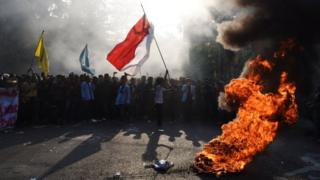 Image copyright AFP
For days, Indonesia has been rocked by student protests against a new corruption law and plans for a draconian criminal code.
The most headline-grabbing issue is a proposed ban on extramarital sex, but the protests go far beyond that.
They focus on corruption, plans to outlaw insulting the president and a toughening of blasphemy laws.
While the vote on some of the new bills has been postponed, observers fear the protests will continue.
What are the protests about?
The demonstrations were triggered by a new law which critics say weakens Indonesia’s anti-corruption agency.
While that law has already been passed and protesters are now demanding for it to be repealed, they have a long list of other demands and grievances.
Protesters march against changes to the corruption law
«It’s not a one-issue protest,» explained Andreas Harsono of Human Rights Watch in Indonesia. «And it’s also not a unified or organised movement.»
The anger is, for instance, directed at plans for a new criminal code, at troops in the unrest-hit Papua region, and at the failure to stem forest fires in Sumatra and Borneo that are causing toxic haze across South East Asia.
«People are trying to protect their civil liberties and individual liberties,» Djayadi Hanan, lecturer in political science at Paramadina University in Jakarta, told the BBC.
«And they are upset that the president is disappointing them by not moving strongly against corruption.»
What’s in the new criminal code?
For years already, Indonesia has been planning to reform its criminal code which dates back to Dutch colonial rule.
Now that the new draft is on the table, many feel it would roll back years of progress and reform in the country.
It would outlaw sex outside of marriage and criminalise abortion in the absence of a medical emergency or rape.
The last days have seen multiple clashes with police
It would also outlaw insulting the president and expand blasphemy laws, already a very sensitive issue in the country.
In 2017, the governor of Jakarta was jailed for blasphemy in a case that many felt highlighted a shift towards a more conservative and religious society.
But the protests have also developed into a general expression of anger with the government.
«In Kalimantan, the demonstrations include the farmers union and indigenous people struggling with the toxic forest and peat fires,» Mr Harsono told the BBC.
«In Java, the focus is on corruption while in Papua it’s about racism and human rights abuses.»
Indonesia’s restive region of West Papua has been hit by a wave of violence over the past days after hundreds of protesters, mostly high school students, set fire to several buildings on Monday.
The role of Widodo
Indonesia’s president Joko Widodo rose to political power as a man of the people.
Coming from a humble background, he was seen as not a typical politician – in a country where entrenched elites have long called the shots.
And it’s those high expectations which might be the reason why so many are disappointed with him.
Widodo – a man of the people no more?
The public sees corruption as a massive problem and many expected the president to uphold or even strengthen the role of the anti-corruption agency.
«There are two explanations here,» Mr Hanan concludes.
«Either the president is still a good guy but there is just a lot of pressure on him. Or he is now showing his true colours and is just an ordinary politician after all.
«I think it might be a mix of both.»
How big are the protests?
The demonstrations have been among the biggest anti-government rallies since 1998 when protests brought down the Suharto dictatorship.
Tens of thousands have taken to the streets across the country with Jakarta being only one focal point.

Many of the marches ended in clashes with the police using tear gas and water cannons against protesters throwing stones and petrol bombs.
One student died on Thursday after clashes in Kendari on Sulawesi island. Several hundred are thought to have been injured over the past days in Jakarta alone.
Hundreds of students have been arrested after street battles in the capital and other cities across the country.
What happens next?
Most observers expect the unrest to continue – the protesters are insisting the new law on corruption has to be repealed.
After days of insisting there would be changes, President Widodo on Thursday for the first time suggested he might consider revoking the law.
The vote on the reform of the penal code, along with laws on mining, land and labour, has been postponed, but many fear the new bills might just be passed next month.
All eyes are on the president, who earlier this year was elected for a second term and will be sworn in on 20 October.
«The ball is now in court of the president,» says Mr Hanan.
«There is a lot of anger among the public with many people feeling betrayed. They see him as turning his back on the people – after they’d been very loyal to him.»
Reporting by the BBC’s Andreas Illmer.
———————————————————————————————-
After protests, Indonesia president considers dropping anti-graft law
reuters.com – SEPTEMBER 26, 2019
JAKARTA (Reuters) – Indonesian President Joko Widodo said on Thursday he is considering revoking a new law governing the country’s anti-corruption agency, which has alarmed activists and helped drive the biggest student protests in decades.
In a televised address, Widodo said he had received a lot of feedback on the new law including on whether to use his authority to replace it by issuing a regulation instead.
“Of course we will consider it, assess it immediately,” Widodo told reporters.
The Corruption Eradication Commission, known by its Indonesian initials, KPK, has prosecuted hundreds of politicians, officials and businessmen since its formation in 2002, becoming one of the country’s most respected agencies.
Activists say revisions to the law approved by parliament last week will hurt the fight against graft. The changes include curbing the agency’s freedom to wiretap suspects and creating a committee to oversee the agency.
Anger over the new law and a plan to revise Indonesia’s criminal code that would ban extramarital sex and penalize insulting the president’s honor have sparked student rallies.
Tens of thousands have joined the biggest rallies since 1998 student protests fueled unrest that led to the fall of former strongman Suharto.
Widodo has delayed parliament’s vote on the criminal code, which would replace a Dutch colonial-era set of laws, saying a new parliament should review the bill next month.
On Thursday, Widodo also said he would look at feedback on whether it “intruded too far into private lives and at other chapters, including the code on insulting the president”.
While the proposed ban on extra-marital sex has grabbed headlines abroad, the bill covers 628 articles in total and opposition in the country of 260 million people is based on a much wider set of concerns than sex.
The bill also penalizes teachers of Marxist-Leninist ideology and women who have abortions in the absence of a medical emergency or rape.
STUDENT KILLED
The student rallies this week across a number of cities turned violent in several places with police firing tear gas and water cannon and with more than 300 hurt in Jakarta alone.
A student died after being shot during a protest outside the parliament in Kendari on Sulawesi island, CNN Indonesia cited army commander Colonel Yustinus Nono Yulianto as saying.
Another student was critically hurt in Jakarta with head injuries, officials and the university said.
Amnesty International said authorities should “immediately initiate a thorough and impartial investigation into massive police violence against students during protests”.
At least 200 people have been arrested since the rallies began on Monday, national police chief Tito Karnavian told a news conference.
Indonesia’s Chief Security Minister Wiranto has said the student protests were hijacked by a group aiming to disrupt parliament and the inauguration of President Widodo next month for a new term.
Widodo is due to be sworn in for a second term on Oct. 20 after winning this year’s general election.
Wiranto did not name the group he said was manipulating the protests, but he described an effort to get radical Islamic groups, soccer supporters and labor groups to join the rallies.
————————————————————————————————
20 killed and dozens hurt in protests in Indonesia’s Papua province
JAKARTA, Indonesia —
At least 20 people were killed Monday, including three shot by police, in violent protests by hundreds of people sparked by rumors that a teacher insulted an indigenous student in Indonesia’s restive Papua province, officials said.
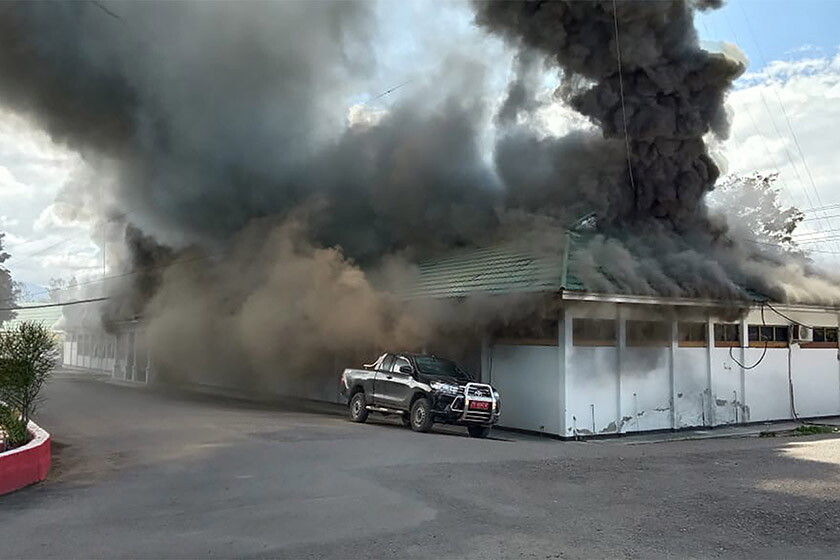
An angry mob torched local government buildings, shops and homes and set fire to cars and motorbikes on several roads leading to the district chief’s office in Wamena city, said Papua police chief Rudolf Alberth Rodja.
Papua military spokesman Eko Daryanto said at least 16 civilians, including 13 from other provinces, were killed in Wamena, mostly after being trapped in burning houses or shops.
He said at least one soldier and three civilians died in a protest in Jayapura, the provincial capital.
About 65 civilians were injured in Wamena and five police officers were critically injured in Jayapura, he said.
Television video showed orange flames and black smoke billowing from burning buildings in Wamena.
Rodja said the protest was triggered by rumors that a high school teacher in Wamena who is not from Papua called an indigenous Papuan student a “monkey” last week.
He said that a police investigation did not find any evidence of racism against the student, and that false rumors have been spreading among students in other schools and native communities.
“We believe this false information was intentionally designed to create riots,” Rodja told reporters in Jayapura. “This is a hoax and I call on people in Papua not to be provoked by untrue news.”
Police spokesman Ahmad Musthofa Kamal said students from another school in Wamena who refused to join the protest brawled with another group of students.
Video circulated on the internet showed dozens of people, many armed with machetes, standing in front of their shops and homes to protect them from the mob.
Joko Harjani, an airport official, said the protest forced authorities to close the city’s airport until the situation returns to normal.
The protest came days after Indonesian authorities managed to get the province under control following weeks of violent demonstrations by thousands of people in Papua and West Papua provinces against alleged racism toward Papuans. At least one soldier and four civilians were killed in that violence.
The previous protests were triggered by videos circulated on the internet showing security forces calling university students “monkeys” and “dogs” in East Java province’s Surabaya city when they stormed a dormitory where students were staying after a torn Indonesian flag was found in a sewer.
The videos prompted hundreds of Papuan students who study in other provinces to return home and force a local state university to accommodate them.
Daryanto said a mob of students attacked a soldier and several police officers in Jayapura with machetes and rocks, forcing security forces to respond with gunfire, killing three civilians. The soldier died on the way to a hospital. At least five police officers were in critical condition.
Conflicts between indigenous Papuans and Indonesian security forces are common in the impoverished Papua region, a former Dutch colony in the western part of New Guinea island that is ethnically and culturally distinct from much of Indonesia.
Papua was incorporated into Indonesia in 1969 after a U.N.-sponsored ballot that was widely seen as a sham. Since then, a low-level insurgency has simmered in the mineral-rich region, which is divided into two provinces, Papua and West Papua.
In recent years, some Papuan students, including some who study in other provinces, have become vocal in calling for self-determination for their region.
———————————————————————————-
Indonesia haze causes sky to turn blood red

Skies over an Indonesian province turned red over the weekend, thanks to the widespread forest fires which have plagued huge parts of the country.
One resident in Jambi province, who captured pictures of the sky, said the haze had «hurt her eyes and throat».
Every year, fires in Indonesia create a smoky haze that can end up blanketing the entire South East Asian region.
A meteorology expert told the BBC the unusual sky was caused by a phenomenon known as Rayleigh scattering.
- Why do forests keep burning?
- Indonesia haze: «I’m worried about my baby’s health»
- What is slash and burn?
Eka Wulandari, from the Mekar Sari village in Jambi province, captured the blood-red skies in a series of photos taken at around midday on Saturday.
The haze conditions had been especially «thick that [day]», she said.
The 21-year-old posted the pictures on Facebook. They have since been shared more than 34,000 times.
But she told BBC Indonesian that many online had doubted whether or not the photos were real.
«But it’s true. [It’s a] real photo and video that I took with my phone,» she said, adding that haze conditions remained severe on Monday.
Another Twitter user posted a video showing similarly coloured skies.
«This is not Mars. This is Jambi,» said user Zuni Shofi Yatun Nisa. «We humans need clean air, not smoke.»
Indonesia meteorological agency BMKG said satellite imagery revealed numerous hot spots and «thick smoke distribution» in the area around the Jambi region.
Associate Professor Koh Tieh Yong, of the Singapore University of Social Sciences, explained that this phenomenon, known as Rayleigh scattering, has to do with certain types of particles that are present during a period of haze.
«In the smoke haze, the most abundant particles are around 1 micrometre in size, but these particles do not change the colour of the light we see,» he told the BBC.
«There are also smaller particles, around 0.05 micrometres or less, that don’t make up a lot of the haze but are still somewhat more abundant during a haze period [than a normal non-haze period]… but this is enough to give an extra tendency to scatter red light more in the forward and backward directions than blue light – and that is why would you see more red than blue.»
He said the fact the photos were taken around noon could have caused the sky to appear more red.
«If the sun is overhead and you look up, [you will be looking] in the line of the sun, so it would appear that more of the sky is red.»
Prof Koh added that this phenomenon would not «modify the air temperature».
This year’s haze levels have been some of the worst in years.
The haze is caused by open burning in Indonesia and to a lesser extent, parts of Malaysia. The burning usually peaks from July to October during Indonesia’s dry season. According to Indonesia’s national disaster agency, some 328,724 hectares of land had already been burnt in the first eight months of the year.
Part of the blame for the haze lies with big corporations and small-scale farmers, which take advantage of the dry conditions to clear vegetation for palm oil, pulp and paper plantations using the slash-and-burn method.
This slash-and-burn technique employed by many in the region is arguably the easiest way for farmers to clear their land and helps them get rid of any disease that may have affected their crops.
However, these fires often spin out of control and spread into protected forested areas.
Slash-and-burn is illegal in Indonesia but has been allowed to continue for years, with some saying corruption and weak governance have contributed to the situation.
———————————————————————————————-
As Indonesia mulls a move away from direct presidential elections, is dynastic politics here to stay?
- President Joko Widodo is part of a new crop of Indonesian politicians elected without a famous family name or political links
- But the country’s political elite, including former president Megawati, are proposing changes to the way the president is elected
The election of President Joko Widodo in 2014 has often been described as a watershed moment in Indonesian political history.
Born outside the country’s political elite, Jokowi, as he is commonly known, represents a new breed of politicians who have risen to prominence without the benefit of a famous family name or being related to a figure of influence. Others in this category are Surabaya Mayor Tri Rismaharini, previously a career civil servant, and West Java Governor Ridwan Kamil, who was an architect and mayor of Bandung before becoming governor.
So does this new crop of politicians represent a shift in a country where elite families traditionally control access to power and wealth, and is dynastic politics on its way out in Indonesia? For the moment, the answer appears to be a resounding no.
This is especially apparent after a recent proposal to amend the 1945 Constitution to restore full power to the People’s Consultative Assembly (MPR), a parliamentary chamber encompassing members of the House of Representatives plus representatives of groups in society, including the military. This could give the MPR a greater mandate than the president, and could once again give it the authority to appoint a president through an internal election, ending the current system of having the president directly elected by the people.
While Jokowi has indicated his opposition to the move, arguing that citizens should have the right to appoint their leader directly, one of the prominent politicians who has flouted this proposal is his chief political patron, Megawati Sukarnoputri – a former president and the eldest daughter of the country’s first president Sukarno.

Megawati has been at the helm of the ruling Indonesian Democratic Party of Struggle (PDI-P) since its foundation in 1999 and was last month re-elected “by acclamation” for another five years. She urged members at the party congress to commit to reinstating the earlier system.
As leader of the largest party in parliament, she is often described as the power behind the throne. And as the first Indonesian president who was related to an earlier president, Megawati’s dynastic credentials remain unequalled.
Her own political career provides a glimpse into how dynastic politics works. After her father was toppled in 1966, she spent decades in the political wilderness until his successor, Suharto, finally relented and allowed her to run for parliament in 1987.
Even though she was politically inexperienced, her status as Sukarno’s daughter proved attractive to Indonesians who had become disenchanted with Suharto’s presidency and were nostalgic for her father’s style of leadership.
After Suharto’s fall from power in 1998, she became Indonesia’s first female vice-president the following year and assumed the presidency herself in 2001 after president Abdurrahman Wahid’s impeachment. However, in Indonesia’s first direct presidential election in 2004, she lost to one of her own former ministers, Susilo Bambang Yudhoyono (commonly known as SBY).

Despite her defeat, Megawati stayed on as chairwoman of PDI-P. In the 2009 presidential election, she ran against SBY for the second time and lost. In 2014, she changed tack by deciding against another run and instead backed Jokowi, contenting herself with the role of “kingmaker”.
There are also political dynasties of more recent lineage, such as SBY’s Cikeas clan, named after the area in West Java where the former president lives. While SBY’s own parents came from humble stock, his father-in-law was Sarwo Edhie Wibowo, a powerful and well-connected general under Suharto.
The dynastic aspirations of the Cikeas clan first became apparent during a notorious political scandal involving the party SBY had formed, Partai Democrat (PD), in the run-up to the 2014 presidential election. PD held a convention to select its presidential candidate, but then unceremoniously cast the winner Dahlan Iskan aside and decided to “keep it in the family” by nominating SBY’s brother-in-law instead.
The institution of direct gubernatorial and mayoral elections in 2005, aimed at decentralising power and bringing democracy to local government, has inadvertently given rise to a plethora of local dynasties eager to carve out their fiefdoms in the provinces.
Spouses and offspring of outgoing mayors and governors have been nominated to succeed their relatives. In 2016, at least 11 per cent of the sitting regional executives were related to their predecessors. The 2017 and 2018 regional elections saw at least 18 candidates who were related to incumbents who could not run again, having served two terms of office.
Notable among them was Banten province’s political dynasty of Ratu Atut Chosiyah, who was a two-term governor until she was charged and convicted of corruption in 2014. Despite her tainted record, members of her family continue to dominate politics in the province. Chosiyah’s son Andika Hazrumy was elected as deputy governor in 2017. Her sister and sister-in-law also successfully ran for offices as regents.
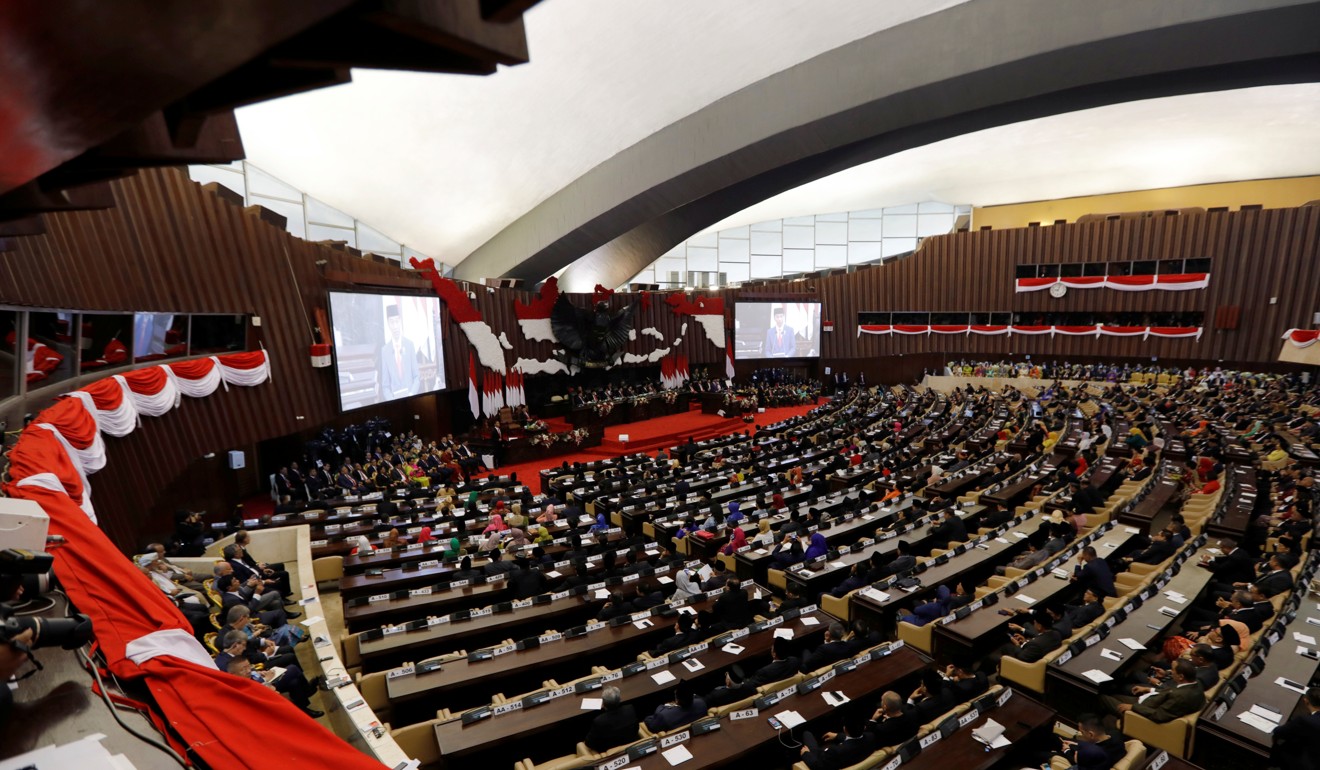
A great irony lies in the fact that Indonesia’s democratic system allows dynastic politics to thrive, which was seen in a 2015 Constitutional Court ruling against a regulation banning relatives of sitting executives from running for office.
New leaders like Jokowi and Rismaharini, whose elections seemed to herald the breakdown of the dynastic tradition in politics, may end up becoming the progenitors of new dynasties. Jokowi’s eldest son, Gibran Rakabuming Raka, for example, has recently received overwhelming support from several political parties to run for the mayoralty of Solo, a position his father once occupied. Rismaharini’s eldest son, Fuad Bernardi, is also being groomed to succeed his mother.
As Jokowi is barred from running again, the next presidential election in 2024 will probably feature a heated race between the heirs of various dynasties.
Megawati, for instance, may be trying to safeguard her two political heirs, daughter Puan Maharani and son Ananda Prabowo. As both lack charisma and mass appeal, they are unlikely to perform well in direct elections. So her party has announced its goal of having the MPR once again empowered to choose the president.
Achieving this objective will not be easy. PDI-P does not have an absolute majority in parliament and controls only 133 of the total 575 seats. But the fact that the party is prepared to mount a challenge to the constitution only goes to show the resolve of this wing of the political elite.
Dynastic politics in Indonesia is still a formidable force. Only increased discernment on the part of Indonesian voters can deal it a crippling blow. Until that happens, dynastic politics will continue to prosper.
Johannes Nugroho is a writer and political analyst from Surabaya, Indonesia
———————————————————————————————–
7 November 2018
World’s first figurative art is of an unknown animal in Borneo

Pindi Setiawanpainting
At first glance you might miss it. But a faint drawing of an unknown animal on a cave wall in a remote Borneo jungle is the oldest known figurative art. The painting was made at least 40,000 years ago, predating famous depictions of animals found on European caves and shaking up our understanding of the origins of art – a key innovation in human history.
The limestone caves of the remote East Kalimantan province of Borneo are adorned with thousands of images in three distinct styles: reddish-orange hand stencils and paintings of animals, purple hand stencils with intricate designs as well as human figures, and complex black depictions of humans, boats and geometric patterns. But the dates when these painting were created were a mystery.
“The art was discovered in the 1990s. We wanted to find out exactly how old it was,” says Maxime Aubert of Griffiths University in Queensland, Australia.
So he and his colleagues analysed the calcite layers covering the paintings. This crystalline material is deposited by dripping water and analysis of the uranium it contains gives a date for when the art beneath was created.
On a panel of depicting large reddish-orange wild-cattle, the researchers discovered that a faint animal had been drawn between 40,000 and 52,000 years ago. This makes it the oldest known figurative art and builds on the 2014 discovery of a hand stencil dating back at least 35,700 years on the neighbouring Indonesian island of Sulawesi. “It was quite amazing,” says Aubert.

Luc-Henri Fage
The ability to depict real-life objects seems to have developed tens of thousands of years after humans first started to draw. The oldest drawing in the world is a 73,000 year-old crosshatch found in a South African cave. In Europe, the oldest art is also an abstract symbol of red lines and a hand stencil, made by Neanderthals around 65,000 years ago.
But these abstract designs are simpler than representational art, which makes the Borneo discovery particularly significant. “Figurative art is a more complex thing to do,” says Aubert.
The finding adds to the mounting evidence that Southeast Asia is a key site for the development of art, not just Europe as once thought. At the same time as art was developing in Europe, he says, “humans were making sophisticated paintings on the opposite side of the world.”
The researchers also found that the three different painting styles were created in three distinct phases, probably by different waves of people.
The purple-coloured painting style started around 20,000 thousand years ago. It is very different from the original reddish phase, depicting human figures with elaborate headdresses dancing and hunting, along with hand stencils decorated with geometric motifs, sometimes joined together by lines like a family tree.
The black paintings of people and boats are much more recent, and may be associated with the movement of Neolithic farmers into the region about 4,000 years ago.
The artists of all three phases are unknown. “That’s one of the big questions,” says Aubert, who plans to go back to Borneo next year to conduct archaeological investigations to find out more about these people.
Journal reference: Nature, DOI: 10.1038/s41586-018-0679-9
——————————————————————————————————–
Zulfiqar could have come home from Indonesia had the foreign ministry taken action
-
Rimmel Mohydin Dawn/ANN
 Zulfiqar Ali was taken into custody in Indonesia on drug-related charges back in 2004. (JPP/File)
It is an election year. You would think that the government would be all over an easy win.
Zulfiqar Ali offered that. An innocent Pakistani citizen languishing on Indonesia’s death row on false drug charges needed saving. An Indonesian government inquiry concluded that he was innocent in 2010. After that, by any standard, he had no business being incarcerated let alone staying at risk of execution.
This was a diplomatic tour de force waiting to happen.
Bringing him home would be Pakistan showing the world the high value it places on the lives of its citizens, that no one could take away their right to a fair trial without consequences. It would have exemplified Pakistan’s diplomatic prowess. The government would have come across as assertive, responsible, sympathetic — everything you want to be seen as to get votes.
It wasn’t particularly difficult to do. The bulk of the work had been done. Were there enough eyes on the case? Yes. When Indonesia issued his execution warrants in July 2016, a relentless media campaign took root, invigorated by the outrage of Pakistan’s citizenry.
The noise was deafening and the right phone calls were made to Indonesia. Zulfiqar’s life was spared at the last moment, a feat that the governments of the other foreign nationals executed that night were unable to achieve.
He called me then, giddy. He said he had never felt more proud to be a Pakistani.
Was there a reasonable chance of success? Absolutely. President Joko Widodo had scheduled a trip to Pakistan in January 2018. We pounced and the campaign became too loud to ignore, including the voices of the then speaker of the National Assembly and the parliamentarian Shazia Marri.
On the day of President Widodo’s arrival, the then foreign minister tweeted that Zulfiqar’s case would be raised and made good on that promise. President Widodo promised to re-examine the case on humanitarian grounds. The intention had already been stated. It just had to be followed up — forcefully.
Was there any risk? No. Zulfiqar’s innocence had been confirmed by a fact-finding inquiry instituted by the former president of Indonesia, Susilo Bambang Yudhoyono. It had found conclusive signs of human rights abuses at every stage of his case, publicly confirmed by Hafid Abbas, a member of the inquiry team who authored the report.
And now he had terminal stage four liver cancer. He was a deeply unwell man — no threat to anyone.
The photo-op of Zulfiqar taking a flight back to Pakistan, with its leadership waiting at the tarmac would have played well. So well, we might have forgiven them for their indifference to his wrongful conviction for 14 years.
Fourteen years is a long time. When Zulfiqar was arrested, the president of Pakistan was Gen Musharraf, Facebook had just been created and Saddam Hussein was still on trial.
And yesterday, Zulfiqar died — innocent in truth, but still a convict by law.
Why did this happen? Was it incompetence? Or worse still, indifference? Bureaucracy? Could it have been avoided at all?
Zulfiqar’s suffering on death row, culminating in his demise demonstrates the dangers of not having a consular protection policy. Without a clear set of protocols, that consular staff should be trained and obligated to follow, it is no surprise that Zulfiqar’s innocence was ignored for eight years, and his incarceration for 14.
When Zulfiqar was arrested, no one from the Pakistan embassy visited him. If they had, what they would have found would have astounded them. And what they saw, I have to believe, would have inspired action.
For three days after his arrest, he was kicked, punched and threatened with death by the police to obtain the only piece of evidence against him: a self-incriminating torture-induced confession. The police have never found any material proof of his involvement.
He never recovered from the stomach and kidney injuries he suffered, despite emergency surgeries that, in a cruel twist, he had to pay for.
In Asma Shafi v. The Federation, Justice Mansoor Ali Shah repeatedly called on the foreign affairs ministry to present a consular policy. After years of litigation, the only thing the representatives from the ministry could produce was a set of guidelines. Guidelines that they were forced to create under orders from the Supreme Court in 2010, and that no one seems to follow.
The fact that after over 70 years of existence, the ministry is yet to devise a consular protection policy can only be a mark of cruel indifference. There are 9,360 Pakistanis in jails worldwide. Many of them are cases just like his.
Make no mistake, Zulfiqar dying the way he did is on the ministry of foreign affairs. They had the time, resources and the public support to take action. It was a win-win.
But if there’s no consular policy, the citizens of Pakistan can only lose.
The writer is head of communications for Justice Project Pakistan. Twitter: @Rimmel_Mohydin
This article appeared on the Dawn newspaper website, which is a member of Asia News Network and a media partner of The Jakarta Post
——————————————————————————————————–
Indonesians take «concrete stand» against cement plant
5 April 2017
Farmers in Indonesia are resorting to extreme measures of protest to show the government how the construction of a cement factory will paralyse their lives.
Sticking their feet in cement and thus unable to move for days, the women behind the rallies are called the Kartinis of Kendeng – named after Indonesia’s most famous female fighter for women’s rights, Raden Adjeng Kartini.
The women say that cement factories built in the Karst Mountains in central Java will ruin their land and pollute their water-supply and irrigation systems.
«I will fight to my last drop of blood because our ancestors fought for this land for hundreds of years, and that’s why we now can enjoy the water and the fruits from this land,» Sukinah, a protest leader, said.
«We won’t allow it to disappear like that.»
 |
| Women say cement factories built in Karst Mountains will ruin their land [Bagus Indahono/EPA] |
Kendeng Mountain is a part of the Karst Mountains that contains not only springs and underground rivers but also chalk that is used in the production of cement.
While smaller companies have been mining here for years, now larger ones are coming.
But the legal battle is ongoing.
READ MORE: Indonesian tribes rally for land rights
One factory was due to start production last November, until the Supreme Court revoked its permit, saying the company’s environmental programme was unclear.
The state governor re-issued the permit after PT Semen Indonesia nearly halved the area it planned to mine.
Environmental groups say the permit goes against the Supreme Court decision.
Then Indonesian President Joko Widodo intervened in the dispute and ordered a new environmental assessment.
 |
| Cement companies say factories will help develop impoverished region [Beawiharta/Reuters] |
While the women fight to protect their land, the cement companies insist factories will help develop the impoverished region.
«At the national level, the mine and factory will help maintain Indonesia’s development and the demand for cement can be fulfilled,» said Heru Indra Wijayanto, project manager.
But while the company promises the factory will provide work for nearly 2,000 people, the farmers say their land can provide an income to many more.
«What we want to show is that Indonesia is being shackled by cement and by the industry,» said Gunretno, an activist.
«Indonesia is an agrarian nation, what needs to be done is to develop farm land.»
 |
| Java’s Kendeng Mountain contains springs, underground rivers and chalk [Beawiharta/Reuters] |
The girl who was «stolen» by a soldier
-
26 March 2017
- From the section Asia

When she was only five years old, Isabelina Pinto was taken from her family by an Indonesian soldier. She was one of thousands of children taken to Indonesia during its brutal 30-year occupation of East Timor. Decades later she found her family and now works to reunite others. The BBC’s Rebecca Henschke tells her story.
She remembers clearly the day an Indonesian soldier visited her family in their village in Viqueque.
It was a Sunday after church, the time of day when Christian soldiers tried to get close to the ordinary residents of Catholic-majority East Timor.
«The soldier said «if we don’t take this child, we can kill you all». He wanted a daughter, he didn’t have one,» Isabelina recalls.
It didn’t take long for her to realise she was being taken away from home.
«I was crying and crying. When we got to the port he lost his patience and he plunged me into the sea.
«He pushed me under the water two times. The other soldiers said «Why did you do that, you have made her faint?'»
«So she will forget East Timor,» came his reply.

She didn’t forget.
Isabelina now makes it her life’s work to find the «lost children» who have now grown up and to find the families they were taken from.
It is estimated that around 4,000 children from East Timor were separated from their families between 1975 and 1999 by the Indonesian military, state, or religious organisations.
Why take the children?
«They were removed without the genuine consent of their parents; some of them were well cared for, educated and loved. But many were abused or abandoned,» says Galuh Wandita, director of Asia Justice and Rights (AJAR).
«The military wanted to «adopt» the children of the resistance as a way to punish, weaken and humiliate the enemy,» she says.
It’s not clear exactly why such a practice was encouraged but the psychology of occupation may well play a role. Bringing home a child became almost a trophy, proof of the military’s success in subjugating rebellious East Timor. In other cases, religious groups promised parents that they would be educated, but converted them to Islam.

Some of the army figures who «adopted» Timorese children are still powerful figures in Indonesia. The BBC approached them for comment, but they declined.
«Those who took children acted out of varied motivations,» says Helene Van Klinken, author of Making them Indonesian.
«Some wanted to educate and promote Indonesian culture and showcase its superiority,» she points out.
It did create an extraordinary generation and many of East Timor’s «lost children» have grown up to make names for themselves in their own right.

Alfredo Reinado was recruited by the military when he was 11 and taken back to Java in a wooden box that was nailed shut so he couldn’t escape. He went on to stage an attempted coup in East Timor in 2008.
Thomas Americo, who was the first boxer in Indonesia to compete against an international title holder, was also taken as a child.
«They picked out people who were good at sport,» says Dr Klinken.
«I think they were hoping that they would become the military for East Timor, but they had problems with them because they trained them up and then they joined the resistance.»
The former head of the Indonesian military, Prabowo Subianto Djojohadikusumo, adopted a number of children from East Timor and Papua.
One of them was Hercules Rozario Marcal, who has become a notorious gang leader in Jakarta and is currently serving a jail sentence.
A hard life
The officer who took Isabelina had always wanted a daughter, but her memories are of sexual abuse.

«He did things from the very beginning on the boat that were not the things you do to a daughter,» she said.
«The only thing he didn’t do was rape me.»
Isabelina’s family never stopped looking for her and a few years ago when her nephew went to study in Indonesia, he tracked her down.
«My oldest child ran in saying your relative is here, he looks so much like you!
«I went back into the bedroom to pray and I started crying. My son came in and said, «why are you crying. You can stop now…your family is here!'»
Her work has seen her reunite nearly 40 lost children with their families. She travels across the Indonesian archipelago trying to track them down using photos and bits of information she gleans from teams in East Timor.

«I know what it feels like to not see your family for 30 years. Missing your family for that long is incredibly painful. It’s like you’re living a lie.»
Long journey home
In 2008 a bilateral Commission of Truth and Friendship (CTF) recommended the establishment of a commission for the disappeared that would include looking for children who were separated due to the conflict.
«It’s a delicate issue,» says Jacinto Alves, one of the Timorese Commissioners. «It’s been eight years and not much has been achieved.»
The person now in charge of following up Indonesia’s response to the recommendations is Wiranto, a former military general indicted by a United Nations panel for atrocities in East Timor.
As army chief, he was implicated by the panel in the bloodshed in which nearly 1,000 people died. His office did not respond to the BBC’s request for an interview.
But the Indonesian government supports the reunions organised through AJAR. They help participants get passports and travel documents and paid for some flights home.
The Timorese government welcomes the returning lost children with open arms and offers them dual citizenship, but Indonesia does not.
Indonesia says they help facilitate reunions in the spirit of «reconciliation», but insists on calling them «separated children» and does not accept that they were taken by force.
Hard to come home
Many of the lost children no longer speak the local language, Tetem, and many have converted to Islam.
«All of them have lived a very hard life…they have been tough all their lives and now they need to work hard again to build up trust and fit back into a family life. I feel sorry for them,» says Isabelina.
They often return too late to see their mother or father again.

«Other than time travel we cannot reach back to the past and fill the abducted children’s long lonely nights…but there is an opportunity to right a wrong. But the remaining time is short,» says Galuh Wandita.
What kept Isabelina going all those years was something her father told her before she left.
«When you look at the sky and feel the warmth of the sun and at night, see the moonlight, your family will be seeing the same thing and you will know that they are missing you.»
Indonesia to declare war on marine plastic debris: Environment minister
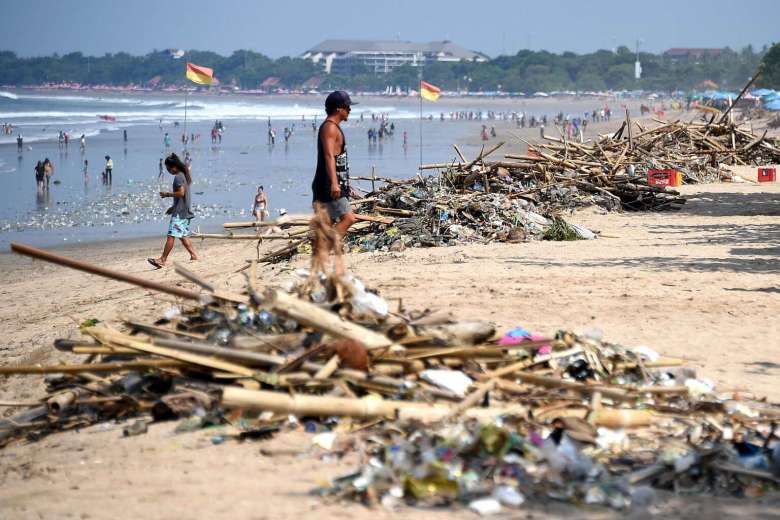
BANJARMASIN (JAKARTA POST/ASIA NEWS NETWORK) – Indonesia will declare its commitment to combat plastic debris in marines on Feb 23 when it hosts the fourth World’s Ocean Summit in Bali, the country’s environment minister said.
Studies indicate that the country may be the second-biggest contributor to marine plastic debris worldwide, with an estimated 1.3 million tonnes originating from the archipelago annually.
Environment and Forestry Minister Siti Nurbaya Bakar said on Saturday (Feb 18) Indonesia is among 10 countries committed to combating the problem.
«Indonesia has received special attention because we are one of 10 countries, including Brazil, committed to cleaning up waste in the ocean,» she said during the commemoration of National Waste Awareness Day in Banjarmasin, South Kalimantan.
Siti added that the government would officially declare the commitment on Feb 23.
Indonesia is also scheduled to present a national action plan during the fourth World’s Ocean Summit in Bali from Feb 22 to 24.
In January 2016, a World Economic Forum report concluded that with the current trajectory, there would be more plastic than fish measured by weight in the world’s oceans by 2050.
A previous study by APEC estimated that marine pollution cost member economies US$1.3 billion.
Moreover, 95 per cent of the value of plastic packaging material, worth US$80-120 billion annually, is lost to the global economy.
—————————————————————————————–
Indonesia takes aim at radicals behind governor protests

Candidate in the running to lead the Indonesian capital Jakarta Basuki Tjahaja Purnama talks as his deputy Djarot Saiful Hidayat stands during a televised debate in Jakarta. Photo: Reuters
Reuters Sunday, Feb 5, 2017: Indonesia is moving to rein in a notorious Islamic hardline group which spearheaded protests against Jakarta’s Christian governor, but experts warn it will be tough to bring to heel a network with close ties to the establishment. The Islamic Defenders Front (FPI) has in recent years become the face of hardline Islam in the world’s most populous Muslim-majority country, growing in influence despite being a fringe organisation whose extreme views are rejected by most.
The group has raided bars selling alcohol during the holy month of Ramadan, forced the cancellation of a concert by Lady Gaga – whom they dubbed «the devil’s messenger» – with noisy protests, and led demonstrations against the Miss World beauty pageant when it came to Indonesia. googletag.cmd.push(function() { googletag.display(«dfp-ad-midarticlespecial»); }); Led by firebrand cleric Rizieq Shihab, the FPI helped organise recent mass rallies – which attracted conservative and moderate Muslims – against Jakarta governor Basuki Tjahaja Purnama, an ethnic Chinese Christian, who is on trial for allegedly insulting Islam. The protest movement against Purnama – accused of insulting the Quran while campaigning for re-election in polls later this month – propelled the hardliners from being a marginal group to the centre of national politics, alarming observers and some in the government. Now authorities are seeking to put the muzzle back on the radicals, with police stepping up an investigation into Shihab in a move seen as supported by President Joko Widodo and his administration. «This is unprecedented, it is the first time that the president and the government is openly challenging this Islamist group,» Tobias Basuki, an analyst from Jakarta think-tank the Centre for Strategic and International Studies (CSIS), told AFP. Last week police named the cleric a suspect for allegedly defaming Indonesia’s founding president, Sukarno, and the state ideology in a speech several years ago, meaning authorities believe there is enough evidence for him to stand trial. Basuki said successive governments had shied away from cracking down for fear of being accused of attacking Islam but the current administration decided to «make a stand» as concerns mounted about the hardliners» influence. The radicals have reacted angrily. Hundreds have rallied in support of Shihab – who has served two short jail terms in the past – whenever he is hauled in for police questioning. Authorities «want to stifle an Islamic people’s movement, which is demanding justice against a blasphemer», FPI spokesman Slamet Maarif told AFP. While they often hit the headlines with their colourful, noisy protests, the FPI does not have a huge following in the country of 255 million people. The group claims to have four million members but Ian Wilson, an expert on the FPI from Australia’s Murdoch University, estimated the figure at a maximum of 200,000. That is a fraction of the tens of millions who are members of Indonesia’s two major, moderate Muslim organisations, Nahdlatul Ulama and the Muhammadiyah. But efforts to tackle the FPI are complicated by its long history of links to some members of the establishment, who have in the past used the group to carry out their dirty work, said Guntur Romli, a progressive Muslim activist. «Some in the bureaucracy and opportunistic politicians like the group as they can be used as a weapon, while claiming to act in the name of Islam,» said the activist, who is also a member of Purnama’s election campaign team. The FPI was founded in 1998 as Indonesia transitioned from dictatorship to democracy, and experts believe the military and police had a hand in its formation, hoping they could use the group against their enemies during the tumultuous period. The police have on many occasions been seen working with the FPI when it conducts raids, or standing by and taking no action, while members of the elite sometimes allegedly hire the group to help in their murky business dealings. While the current crackdown is viewed as long overdue, it may not do away with the FPI forever, with analysts doubting the government will disband the group as the process is complicated. They believe the moves against Shihab are aimed at preventing trouble in the coming months during the Jakarta election and Purnama’s court case. But once the current controversies blow over, «it is likely that it’s going to be back to business as usual,» Basuki of CSIS warned.
– See more at: http://news.asiaone.com/news/asia/indonesia-takes-aim-radicals-behind-governor-protests#sthash.P54kbBTa.dpuf
————————————————————————————
Indonesia suspends cartel membership to avoid cuts
- 2 Dec 2016 – bankokpost.com

JAKARTA: Indonesia has suspended its membership of the Organization of Petroleum Exporting Countries, less than a year after rejoining the cartel, as the net oil importer said it could not agree to the group’s production cuts.
The decision came as the cartel agreed its first oil output cut since 2008 in a bid to tackle overcapacity and prop up prices.
The suspension could be a setback for Indonesia, Opec’s only East Asian member, which had hoped to benefit from being closer to Opec countries when it reactivated its membership at the start of the year.
Opec had proposed Indonesia cut oil production by about 37,000 barrels per day (bpd), or about 5% of its output, which would dent the already slipping oil rent in Southeast Asia’s largest economy.
Indonesia’s Energy and Mineral Resources Minister Ignasius Jonan, who attended the Vienna meeting, said the only reduction Indonesia could accept was a cut of 5,000 bpd, which had been approved in the country’s 2017 budget.
«There are still big government revenue needs in the 2017 budget,» he said, adding that as a net oil importer a cut to production would not benefit Indonesia, particularly at a time when oil prices were expected to go up.
The temporary suspension was in the best interest of all Opec members, the Energy and Mineral Resources Ministry said in a statement.
It was not clear whether Indonesia was asked to suspend its membership or if it left voluntarily. Qatar, the current Opec president, said on Wednesday that Indonesia had been suspended.
For Saudi Arabia — which took the lion’s share of cuts — a key criteria for the deal was collective action by Opec beyond those countries, Iran, Libya and Nigeria, which were given an exemption, said Jason Gammel of US investment bank Jefferies.
«Indonesia was the only member to not participate and their Opec membership was «frozen»; otherwise the group demonstrated more cohesiveness than at any point since at least the 1.5 million barrels per day cut in 2008,» he said.
Indonesia is seen as a somewhat odd member of Opec and has had a patchy membership history.
After first joining in 1962, it left in 2009 as dwindling production meant it had become a net importer of crude oil, which is against Opec’s statute for full membership.
Since rejoining, Indonesia has made several deals on crude imports, overseas upstream investments and refining partnerships, including with Opec bigwigs Iran and Saudi Arabia.
Indonesia’s crude oil output peaked at around 1.7 million barrels per day in the mid-1990s. But with few significant oil discoveries in Western Indonesia in the past 10 years, production has fallen to roughly half that as old fields have matured and died.
The industry is a vital part of the Indonesian economy, but its contribution to state revenue has dropped from around 25% in 2006 to an expected 3.4% this year, according to data compiled by consulting firm PricewaterhouseCoopers(PwC).
————————————————————————————
Indonesia’s Gotta Catch All the Communists

Three days later, it was the dead reds. Following the conclusion of an activist-initiated “people’s tribunal” in The Hague that found the Indonesian government “responsible for genocide” in the 1965-1966 killing of at least 400,000 people suspected of being associated with the Indonesian Communist Party (PKI), Ryamizard again fronted the press.
The tribunal’s findings were “lies,” he said. “If we listen to them, we will break apart,” he warned. “This is the work of the PKI.”
In reality, neither of these things is true. Pokémon Go might be annoying to some — and it did suffer from a gaping initial privacy hole — but it’s still just a game. And the PKI, for its part, was wiped from the Earth; those killings half a century ago effectively eradicated the left from Indonesia’s political map, along with many ethnic Chinese. The slaughter, in turn, paved the way for the rise of the late dictator Suharto, whose kleptocracy lasted until 1998 on a base of steady anti-communist propaganda. Even today, both Marxist teachings and the PKI are banned under Indonesian law.
But Ryamizard’s comments are part of a worrying wave of often xenophobic paranoia under the presidency of Joko Widodo, popularly known as Jokowi, who was elected in 2014. Despite campaigning on promises of deepening democratic reforms — and pledging to resolve past rights abuses like the 1965-1966 killings — the former Jakarta governor’s rule has been marked by a series of panics over threats that are either grossly exaggerated or straight-up fictional.
Some have come from Jokowi himself. The president has been a strong advocate of the idea (based on questionable evidence) that the country faces a “drug emergency.” Under Jokowi’s direction, the country has executed 18 drug convicts since last year, including four last month. The vast majority of those killed have been foreigners.
Of more concern have been two intertwined scare campaigns being run by reactionaries both inside and outside Jokowi’s administration — often in ways that embarrass and undermine the president.
One is the red scare. Since mid-2015, police, soldiers, and vigilantes have broken up dozens of events, from film screenings to meetings of massacre survivors, which have been labeled “communist.” Meanwhile, Islamists and nationalist groups have held rallies of thousands of people vowing to “crush” communism in cities and towns, and the media have carried grave warnings by prominent Indonesians of a looming red takeover.
At the same time, there has been a rising panic about so-called proxy wars being waged by unnamed foreign enemies against Indonesia. Armed forces chief Gen. Gatot Nurmantyo, appointed by Jokowi last year, has frequently raised the specter of these enemies spreading immorality and drugs in order to create chaos and steal Indonesia’s wealth. In February, amid a nationwide campaign of hate speech against lesbian, gay, bisexual, and transgender Indonesians, which was sparked by a backlash against a support group at the University of Indonesia, Ryamizard labeled the fight for LGBT rights as a threat with the potential to do more harm than nuclear weapons.
The defense minister was a driving force in the creation last year of Bela Negara (meaning “Defend the Nation”), an organization that claims 1.8 million members and aims to instill nationalism through paramilitary-style training, including reportedly teaching civilians how to use weapons. Paramilitary groups have been popular in Indonesia since before the Suharto era and played a key role in both the 1965-1966 massacres and violence across the country in the years surrounding Suharto’s fall.
The nationalist tide has left Jokowi’s administration in a policy muddle. Jokowi has pledged to address the troubled legacy of the 50-year-old massacres and in April organized the country’s first symposium featuring both survivors and the military. But no matter what happens, a state apology for the killings is off the cards, presidential spokesman Johan Budi told Foreign Policy.
Budi pointed out that Jokowi has already instructed overzealous authorities to rein in raids against events deemed “communist.” This has indeed happened. But the president has done nothing to muzzle senior figures invoking the red menace or talking of proxy wars.
“The president can’t ignore reports from the community … that there are some people trying to bring the communist party back in Indonesia,” Budi said. “The president has to respond.”
Jokowi’s attempt at the middle road is pleasing no one.
Jokowi’s attempt at the middle road is pleasing no one. Despite the fact that he has given Cold Warriors open slather in his administration, opponents frequently seek to label him as a red in disguise. In June, a collection of former Suharto-era generals organized their own symposium to counter the government’s reconciliation effort. The crowd included members of Islamist street thug groups such as the Islamic Defenders Front (FPI), an organization formed by generals in 1998 to fight pro-democracy protesters in the streets. Also in attendance were uniformed members of Bela Negara.
Jokowi’s support for even limited reconciliation over the mass killings means “he’s pretty much part of efforts to bring communism back,” Ahmad Shobri Lubis, the head of the FPI, told FP. “It’s a twisted, crazy step. It goes against common sense that the government would ask for forgiveness from criminals. It’s madness.”
But not everyone in Indonesia has bought into the hype. Social media has frequently pilloried the more hysterical announcements, and reactions from some of the establishment — including military types — have ranged from eye rolling to alarm.
In Indonesia’s muddled party system, opinions similarly vary, including within Jokowi’s Indonesian Democratic Party of Struggle (PDI-P). Former President Megawati Sukarnoputri, who championed Ryamizard’s appointment and has a reputation for brittle nationalism, heads the party.
Others take a different view. The paranoid upsurge is “all bullshit,” T.B. Hasanuddin, a former general and a senior PDI-P politician, told FP.
Behind it all is a collection of former generals who are being driven by two factors, Hasanuddin said. One is fear that a reckoning over the bloody legacy of the 1965-1966 killings — in which the military and traditional elite are deeply implicated — could unleash chaos. The other is a more concerted attempt to use vague bogeymen to fight the country’s democratization, he said. For some, these fever dreams are simply a cynical ploy. For others, they are indisputable fact, born of indoctrination during Suharto’s 31-year New Order regime.
“There are those from the military who, in the way they analyze things, always need there to be threats. If there are no threats, then they need to make them up,” Hasanuddin said. “Now it’s communism.”
Why is all this happening under Jokowi? Less than two years ago, the former furniture salesman was hailed as a new hope in a political system dominated by old faces with ties to the New Order. Liberals flocked to Jokowi’s campaign, seeing him as a democratic bulwark against his main rival, Prabowo Subianto, a former general (and former son-in-law of Suharto) implicated in serious human rights abuses.
But Jokowi has long sought to accommodate the old guard. Even during the transitional period between his election and taking office, Jokowi began an embrace of hard-liners close to Megawati, who retains undisputed control of the PDI-P.
“He’s just weak,” said Ian Wilson, an Indonesia expert at Australia’s Murdoch University. “He’s been outmaneuvered by seasoned players, seasoned brokers, and the kind of warlords of elite politics, including someone like Megawati, [who is] an ultranationalist and a militarist.”
Observers of Indonesia have hoped of late that Jokowi might finally be finding his feet. But even if he is increasingly calling the shots, the result is still a doubling down on his embrace of the old dinosaurs. In a late July reshuffle, the president sidelined Luhut Panjaitan, a relatively liberal former soldier, as the chief security minister and replaced him with Wiranto — who, like many Indonesians, only goes by one name — a former general indicted by a United Nations-backed tribunal for crimes against humanity in East Timor.
Wiranto, a man accused of having command responsibility for militia violence in 1999 that is believed to have killed well over 1,000 civilians, is now in charge of handling the government’s response to past abuses. This includes the 1965-1966 killings and his own alleged crimes.
Few rights advocates now expect much from Jokowi’s administration.
Photo credit: AGOES RUDIANTO/NurPhoto via Getty Images
From: foreignpolicy.com
—————————————————————————————————
Good-bye, Indonesia
West Papua is fighting for independence from Indonesia — but will it win regional solidarity for its efforts?

Papuan students wearing the Morning Star flag, a symbol of Papuan independence, in 2006. Sumaryanto Bronto / Flickr

