Akbar Shahid Ahmed, author of Crossing the Red Line: Biden, His Advisors, Harris and Israel’s War in Gaza

Crossing the Red Line

Biden, His Advisors, and Israel’s War in Gaza

Wednesday, October 28, 2026, 2:00 pm – 3:15 pm – gwu.edu

Crossing the Red Line Event Graphic

The Middle East Policy Forum will host award-winning foreign affairs journalist Akbar Shahid Ahmed, author of Crossing the Red Line: Biden, His Advisors, and Israel’s War in Gaza, on Wednesday, October 28. In a discussion moderated by Professor Marc Lynch, Ahmed will offer his powerful and authoritative account of how the Biden administration fueled atrocities in Gaza.

In vivid prose and with unparalleled access to insiders, Ahmed depicts a White House that resisted a course correction as its failures became undeniable. He probes Biden’s inner circle,  whose choices fueled tens of thousands of avoidable deaths among Palestinians, Lebanese, and Israelis, torpedoed long-time standards for warfare, and created a more dangerous world for us all. The Biden administration’s decisions drove voter backlash that helped Donald Trump regain power, and established patterns of impunity that have spurred wider bloodshed under Trump.

Crossing the Red Line is an urgent reckoning with Biden’s record on Gaza that is vital to understanding historic damage to America’s standing in the world, and a period whose dark consequences will resonate globally for decades to come.

We hope you will join the Middle East Policy Forum to hear from Akbar Shahid Ahmed about his new book. This event is open to the general public and media. Copies of Crossing the Red Line will be available for purchase at the event.

Speakers:
  • Akbar Shahid Ahmed is the diplomatic correspondent at NOTUS. For his Gaza coverage, he has received a Writers Guild Award and a New York Press Club Award and has twice been named a finalist for the Livingston Award. Based in Washington, D.C., Ahmed previously covered foreign policy at HuffPost for twelve years. He is a Yale graduate who grew up in Karachi, Pakistan.
  • Dr. Marc Lynch received his B.A. in Political Science from Duke University and his M.A. and Ph.D. in Government from Cornell University. He teaches courses on Middle Eastern politics and international relations. Professor Lynch is also the founding director of the Project on Middle East Political Science and co-director of the Program on African Social Research, editor of the book series Columbia Studies in Middle East Politics, and associate editor of The Monkey Cage political science blog. His recent books include: The Political Science of the Middle East: Theory and Research After the Arab Uprisings (edited with Sean Yom and Jillian Schwedler); The New Arab Wars: Anarchy and Uprising in the Middle East; The Arab Uprising: Unfinished Revolutions of the New Middle East; The Arab Uprisings Explained, and Voices of the New Arab Public; and America’s Middle East: The Ruination of a Region (Hurst Publishers/Oxford University Press).

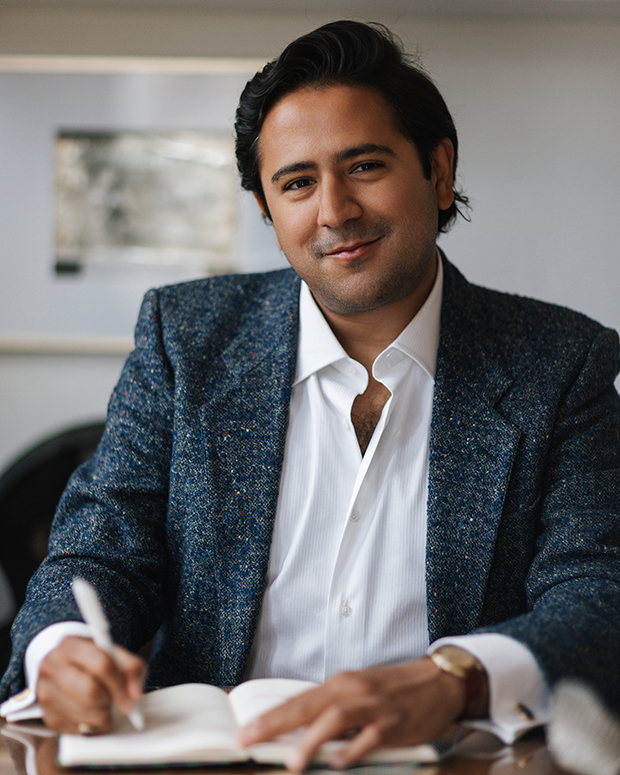
Photo by Hannah Yoest

Akbar Shahid Ahmed

Akbar Shahid Ahmed is the diplomatic correspondent at The Washington Sun. For his Gaza coverage, he has received a Writers Guild Award and a New York Press Club Award and has twice been named a finalist for the Livingston Award. Based in Washington, D.C., Ahmed previously covered foreign policy at HuffPost for twelve years. He is a Yale graduate who grew up in Karachi, Pakistan.

wwnorton.com


“Crossing the Red Line”: Akbar Shahid Ahmed on Biden, His Advisers, Harris & Israel’s War in Gaza

StorySeptember 25, 2026 – democracynow.org


Guests

Links

We speak with journalist Akbar Shahid Ahmed, whose new book, Crossing the Red Line, looks at how President Joe Biden and top figures in his administration supported Israel’s brutal war in Gaza despite the soaring death toll and growing alarm over widespread war crimes committed by the Israeli military.

“The policies that we’ve seen entrenched and, frankly, worsened and become more dangerous and deadly under Donald Trump were really established by Biden’s team,” says Ahmed, who says there is “bipartisan continuity” on Israel-Palestine between the two presidents.

Transcript

This is a rush transcript. Copy may not be in its final form.

AMY GOODMAN: This is Democracy Now!, democracynow.org. I’m Amy Goodman.

We end today’s show with journalist Akbar Shahid Ahmed. His new book is Crossing the Red Line: Biden, His Adisors, and Israel’s War in Gaza. The book is based on interviews with more than 150 officials and others involved in shaping the Biden administration’s policies in the Middle East. Akbar Shahid Ahmed covers U.S. foreign policy for The Washington Sun.

Welcome back to Democracy Now!, Akbar. This is a fascinating book. What I found so interesting is that so many of these officials who spoke to you did not want to be identified. Can you talk about why that is? And as we talk about what’s happening in Israel, Occupied Territories, in West Bank and Gaza, why you have chosen to write a book on the Biden administration?

AKBAR SHAHID AHMED: Thanks for having me, Amy.

I think it’s so crucial to look back at the Biden administration’s policy for two reasons. First, because the policies that we’ve seen entrenched and, frankly, worsened and become more dangerous and deadly under Donald Trump were really established by Biden’s team — the full, unprecedented blockade on Gaza, a real U.S. tolerance of expanded violence in the occupied West Bank, Lebanon, Syria, and a dodging of accountability for what U.S. government officials very often know are violations of American and international law.

I also think when we look at people like the policymakers, some of whom you interviewed earlier, Darializa from New York, the agenda that they are setting out when they talk about a different approach to Gaza, to Israel-Palestine, to respond to the popular demand for a new U.S. position there, that hinges on the Biden team.

A lot of the people I talked to, as you mentioned, were anonymous for fear of reprisal, for fear of pro-Israel hard-liners preventing them from getting future jobs. And what’s shocking about this kind of Biden team, too, and the culture I cover, is that, meanwhile, the architects of that Gaza policy, figures like Biden’s Middle East adviser Brett McGurk, who was celebrated this week at the U.N., Jake Sullivan positioning himself to be in a future Democratic administration, they’re not afraid of facing any reprisal for their choices, that very often were enabling atrocities.

AMY GOODMAN: So, if you can talk about their significance and what exactly they did in the Biden administration? You argue, obviously, that they set the stage for what Trump has simply escalated.

AKBAR SHAHID AHMED: I think when we —

AMY GOODMAN: And who was speaking inside against what was happening?

AKBAR SHAHID AHMED: Absolutely. So, President Biden, a longtime professed Zionist — right? — and obviously in mental decline, as we now know, in that final year or so of his presidency, it was really him and this small group of about four men around him: Sullivan and McGurk, who I mentioned; Tony Blinken, the secretary of state; Jon Finer, his deputy national security adviser. What I heard so often from officials was the sense that Gaza policy was treated differently. Even officials up to the cabinet level, officials in intelligence positions, people in nonpartisan career jobs told me they were seeing the president less and involved less than they had been even earlier in the Biden administration and in handling crises like Ukraine, Sudan, other top issues.

What this has led to in the Trump era is really a tolerance of increased Israeli escalation, right? So, if we look at a policy like the Iran war, the Biden administration very often positioned itself as a defender of Israel as Israel was escalating, as we’ve discussed on the show, again and again versus Iran, making clear that they were kind of building up for the assault we’ve now seen, with all its consequences. The Biden team made the choice, rather than tell Israel, “We need you to rein this in,” and importantly, while they were publicly saying they wanted to avoid regional war, to send the troops, to send the weapons that made these escalations now under Trump possible.

When we think about who was challenging this, there were some figures. I mean, Samantha Power, famously author of a book on genocide, was Biden’s USAID chief. She, to a degree, was someone who inside the administration was arguing for a different approach. But I’ll note, Amy, that a lot of those figures weren’t willing to resign, and, frankly, other than Power, even in talking to me for the historical record, weren’t willing to put their names on what they had said, or, importantly, to criticize their colleagues. And I think until you break from those cycles of tolerating mass civilian casualties in a U.S. official’s role, you’re not going to have a different approach.

AMY GOODMAN: OK, I want to go to President Biden’s national security adviser, Jake Sullivan, back in 2024, denying Israel is carrying out a genocide in Gaza.

JAKE SULLIVAN: We believe Israel can and must do more to ensure the protection and well-being of innocent civilians. We do not believe what is happening in Gaza is a genocide. We have been firmly on record rejecting that proposition. … We have paused the shipment of 2,000-pound bombs, because we do not believe they should be dropped in densely populated cities.

AMY GOODMAN: And the State Department spokesperson under former President Biden, Matt Miller, admitted in May last year that he believes Israel committed war crimes in Gaza. This reversal came after he spent more than a year as the face of the Biden administration’s foreign policy, repeatedly defending Israel against allegations of war crimes and genocide. This was Miller speaking in April of 2024.

MATTHEW MILLER: We have been very clear that we want to see Israel do everything it can to minimize civilian casualties. We have made clear that they need to do every — that they need to operate at all times in full compliance with international humanitarian law. At the same time, we are committed to Israel’s right to self-defense.

AMY GOODMAN: But during an interview with Sky News in June, Matt Miller said he believed Israel did commit war crimes in Gaza and that Israeli soldiers are not being held accountable.

MATTHEW MILLER: I don’t think it’s a genocide, but I think the — I think it is, without a doubt, true that Israel has committed war crimes.

MARK STONE: You wouldn’t have said that at the podium.

MATTHEW MILLER: Yeah, look, because I — I mean, when you’re at the podium, you’re not expressing your personal opinion. You’re expressing the conclusions of the United States government.

AMY GOODMAN: I mean, you’re at the podium expressing the views of the government, not my own views. Akbar Shahid Ahmed, that was Matt Miller, what he said. If you can elaborate on this and how the tone was set, right through the top, and exactly what we’re talking about now? You had President Biden and the person who may run for president again, Kamala Harris. And the significance of what she did when she was running for president and lost, and then how she views this issue today, what you understand?

AKBAR SHAHID AHMED: The kind of denials that you highlighted there, Amy, were so crucial to sustaining this horrific policy, because, as I reveal in my book, figures like Jake Sullivan and Brett McGurk, Biden’s Middle East adviser, were, for instance, telling their colleagues, “We don’t believe the Palestinians are starving. They don’t look skinny in the photographs.” That sends a signal throughout the entire U.S. government apparatus of what the top of the system thinks, chilling people further down.

Also, when you look at that Matt Miller statement, what I illuminate in Crossing the Red Line and hope people can take from it for future policy and for accountability is a system of denial. The Biden administration, in 16 months, never reached a single firm conclusion of a war crime. But I was told by several lawyers, State Department, White House, in the words of one, “If they wanted us to find a war crime, we could have confirmed it.” Instead, the Biden administration sustained what one official described to me as, quote, “herd impunity,” essentially allowing plausible deniability, because, as Matt Miller says there, the U.S. government never confirmed, so there wasn’t that one piece of paper that required them to say something happened that was a war crime or ethnic cleansing. Meanwhile, I reveal in the book, they were using the term “ethnic cleansing” all the time.

On Harris, she wasn’t a major player in these decisions. That doesn’t wash her hands of responsibility, right? And I’ve asked her team repeatedly if she wants to express specific regret, right up until August of this year, just before this book tour. They haven’t been willing to provide any kind of statement on policies she would have opposed. And in my reporting, again, nearly 175 interviews, I never found evidence that Harris pushed for a policy change, although sometimes she pushed for rhetorical shifts to show more sympathy towards Palestinians.

AMY GOODMAN: Back in 2024, when she was vice president, Kamala Harris called for a ceasefire in Gaza, made the comment in a speech in Selma, Alabama, marking the 59th anniversary of Bloody Sunday. This is what she said.

VICE PRESIDENT KAMALA HARRIS: And given the immense scale of suffering in Gaza, there must be an immediate ceasefire, for at least the next six weeks, which is what is currently on the table. This will get the hostages out and get a significant amount of aid in. This would allow us to build something more enduring to ensure Israel is secure and to respect the right of the Palestinian people to dignity, freedom and self-determination. Hamas claims it wants a ceasefire. Well, there is a deal on the table. And as we have said, Hamas needs to agree to that deal. Let’s get a ceasefire. Let’s reunite the hostages with their families. And let’s provide immediate relief to the people of Gaza.

AMY GOODMAN: So, that was Vice President Kamala Harris speaking in Selma, calling for a six-week ceasefire. Then you have the DNC, and, Akbar Shahid Ahmed, this is particularly significant, as we were there at the — at her presidential convention, when people sat down overnight, the uncommitted, demanding a Palestinian American legislator be also able to address the DNC. They were denied that. Talk about Kamala Harris’s role in that.

AKBAR SHAHID AHMED: I remember you and Nermeen and me covering that sit-in, Amy, right? We were there with them for hours. And what was so significant about that moment was these were people saying, “We’re Democrats. We want to help you win the election and defeat Donald Trump.” They were not saying, by any means, “We’re your opponents.”

Instead, what Harris and her team did was reach a decision at that point to not permit a Palestinian speaker. And I was told in my reporting to sort of present the idea of a Palestinian American speaker — after, by the way, an Israeli American couple whose son was held hostage had already spoken — to present that as too politically risky, something they weren’t willing to do. I wasn’t able to confirm whether Harris made that call, the donor class made that call, or figures like Jen O’Malley Dillon, the Biden campaign manager, who was still running her campaign.

But the fact that it’s that kind of collective ethos of treating Palestinians that way also gives the lie to the Biden administration’s repeated claims that they were, quote, “the most diverse administration in history.” They were running with that kind of administration. Harris was running as a historic candidate to potentially be the first woman president, half-Black, half-South Asian, speaking at places like Selma, while I was told the people who actually made the decisions, particularly on Gaza, were by no means representing a broad range of experience or a broad range of diversity in this country. And Palestinians and various communities inside the Democratic coalition felt really dismissed. I was told by one Harris campaign staffer after her speech at that convention, “Well, we felt we got everyone, except the Muslims and Arabs.” So, that’s what it was. That gives you a taste of the ethos.

AMY GOODMAN: In this last minute we have together, in your book, Crossing the Red Line: Biden, His Advisors, and Israel’s War in Gaza, what do you want people to take away from this, as we move forward?

AKBAR SHAHID AHMED: I hope people understand there was a bipartisan continuity between Trump and Biden on Israel-Palestine prior to October 7th that helped fuel the conditions that led to that attack and the atrocities of that day, the war that followed. And then the Biden administration, as I detail, in the lame-duck period, despite new intelligence findings, despite new legal conclusions, essentially enabled Trump to get on a path to the Iran war, to have a Gaza ceasefire in which Palestinians were still consistently being denied food and medicine, that’s not optional under international law, and to permit continued fighting in Lebanon and beyond, as we’ve seen. So, I hope people understand that that’s a pattern that can be broken.

AMY GOODMAN: Akbar Shahid Ahmed, I want to thank you so much for being with us, author of Crossing the Red Line: Biden, His Advisors, and Israel’s War in Gaza. The book is just out.

And that does it for today’s show. I am in London for the weekend. Steal This Story, Please! is playing at the Hackney Picturehouse tonight. I’ll be speaking afterwards with director Carl Deal of the film Steal This Story, Please!, about Democracy Now!, Sunday at Cinéma Lumière, also in London, in South Kensington, and then in Lewes, then to Copenhagen and Berlin. I’m Amy Goodman.

The original content of this program is licensed under a Creative Commons Attribution-Noncommercial-No Derivative Works 3.0 United States License. Please attribute legal copies of this work to democracynow.org. Some of the work(s) that this program incorporates, however, may be separately licensed. For further information or additional permissions, contact us.


Up Next

“The World After Gaza”: Author Pankaj Mishra on Gaza & the Return of 19th-C. “Rapacious Imperialism”

Posta under genocide, Midt-Austen, Palestina | Merkt , , , , , , | Kommenter innlegget

Brazil Election Urgent Statement: NO to US Interference!

Solidarity Statement on the Brazilian Presidential Election – nocoupinbrazil.wordpress.com

Parliamentarians, trade union leaders, writers and peace and social justice campaigners have signed the following statement against US interference in Brazil’s presidential election, and in support of the Brazilian social movements working for a more equal and just society, ahead of the election this Sunday.

On Sunday 25 October, Brazilians vote in a crucial run-off election between progressive President Lula and far-right candidate Flávio Bolsonaro, son of former president Jair Bolsonaro, who was jailed for his role in attempting a coup to overturn the 2022 election result.

The election will shape the future not only of Brazil but of wider Latin America, where far-right forces backed by Washington have made huge inroads in recent years as Trump seeks greater influence over the region and, especially, its rare earth minerals, which are essential for advanced technologies and AI.

The first-round results and subsequent opinion polls indicate an incredibly close contest.

We believe it is for the Brazilian people alone to decide their country’s future, free from outside interference.

So we are deeply alarmed that the Trump administration has made clear its support for the Bolsonaro movement and has been intervening in Brazilian politics in the run-up to the election.

This has involved economic and diplomatic pressure, including the imposition of punitive tariffs on Brazilian goods explicitly linked to political goals, Trump holding a White House meeting with Flávio Bolsonaro, and reported US funding for groups seeking to undermine Brazilian institutions.

There are also mounting concerns about the role of interference by US-based tech platforms in the election, including suppression of pro-Lula content and online political adverts funded from the US in breach of Brazilian electoral law.

All this led 31 members of the US Congress to recently express alarm at the scale of US interference and destabilisation in Brazil.

Brazilian social movements and trade unions have warned that a victory for Flávio Bolsonaro would pose a threat to the social progress achieved in recent years, a danger to the Amazon, to the rights of Brazil’s large black population and other minorities, and even to democracy itself.

We oppose all US interference in Brazil’s election and stand in solidarity with the Brazilian people, their democratic rights and the social movements working for a more equal and just society.

Initial signatories include:

Richard Burgon MP, Chair of the Brazil Solidarity Initiative

Diane Abbott MP

Lorraine Beavers MP

Órfhlaith Begley MP

Apsana Begum MP

Siân Berry MP

Ian Byrne MP

Ellie Chowns MP

Jeremy Corbyn MP

Pat Cullen MP

Carla Denyer MP

Neil Duncan-Jordan MP

Colum Eastwood MP

Cat Eccles MP

John Finucane MP

Chris Hazzard MP

Dáire Hughes MP

Imran Hussain MP

Kim Johnson MP

Ian Lavery MP

Brian Leishman MP

Clive Lewis MP

Rebecca Long-Bailey MP

Cathal Mallaghan MP

Rachael Maskell MP

Paul Maskey MP

John McDonnell MP

Grahame Morris MP

Simon Opher MP

Kate Osborne MP

Adrian Ramsay MP

Bell Ribeiro-Addy MP

Hannah Spencer MP

Jon Trickett MP

Nadia Whittome MP

Christine Blower, Member of the House of Lords

John Hendy KC, Member of the House of Lords

Prem Sikka, Member of the House of Lords

Tony Woodley, Member of the House of Lords

Andrea Egan, General Secretary, UNISON

Maryam Eslamdoust, General Secretary, TSSA

Paul Fleming, General Secretary, Equity

Steve Gillan, General Secretary, POA

Daniel Kebede, General Secretary, NEU

Gawain Little, General Secretary, GFTU

Dave Ward, General Secretary, CWU

Sarah Woolley, General Secretary, BFAWU

Matt Wrack, General Secretary, NASUWT

Steve Wright, General Secretary, FBU

Jess Barnard, Labour NEC member

Marcus Barnett, Tribune

Sue Branford, Latin America Bureau

Lee Brown, Brazil Solidarity Initiative

Ben Chacko, Editor, Morning Star

Luke Daniel, President, Caribbean Labour Solidarity

Dr Francisco Dominguez, Co-author, Right-Wing Politics in the New Latin America

Sabby Dhalu, Co-Convenor, Stand up to Racism

Lindsey German, Convenor, Stop the War Coalition

Kate Hudson, Vice-President, CND

Myriam Kane, Black Liberation Alliance

Pablo Navarrete, Founding Editor, Alborada

Matt Willgress, Editor, Labour Outlook

Tim Young, Labour Friends of Progressive Latin America

Posta under Fagrørsle og kamp, Latin-Amerika | Merkt , , , , , , | Kommenter innlegget

Gaza’s last remaining voices – Brave journalists of a proud people!

BUS-MARAM-ANAS

04:09

Between Us

Gaza’s last remaining voices

Al Jazeera’s Maram Humaid takes us through the legacy of Anas al-Sharif and Mohammed Qreiqeh, who were killed by Israel along with two other Al Jazeera colleagues. She reflects on journalism in Gaza and the increasing danger reporters face on the frontline.

From: aljazeera.com


04:47

Between Us

6 Nov 2025 – aljazeera.com

Gaza’s fragile freedom

After 19 months in Israeli detention, Al Jazeera’s Ibrahim al-Khalili reflects on his brother’s release and the deep scars left on freed Palestinian prisoners.

Posta under genocide, Kvinne- og jentekamp, Midt-Austen, Palestina | Merkt , , , , , , | Kommenter innlegget

Huge protests in France over education, rising prices and neo-liberalism – People in Power!

Huge protests in France over education, rising prices

18. Oct. 2026 – nhk.or.jp

Huge demonstrations have been held in France demanding measures against rising prices and other problems. The protests coincided with those by high school students who have been calling for an improvement of their educational environment.

The demonstrations on Saturday backed by labor unions and others called on the government to deal with surging costs of fuel and other goods. France’s Interior Ministry said 110 marches were held in the country and they drew about 550,000 people.

In central Paris, a large crowd marched chanting slogans and carrying placards expressing dissatisfaction with the government’s handling of the situation.

A woman who took part in the protest expressed her anger, saying there is a sense of social discontent and everyone has had enough. She also complained about expensive gas prices in her country, and blamed its present status on the administration of French President Emmanuel Macron’s years of governance.

The weekend demonstrations were joined by high school students who have been protesting since last month, as well as university students who support their movement.

A male high school student stressed that many people are rallying over issues affecting high schools. He added that he believes the larger the scale of protest becomes, the more the country will take notice of the problem.

Meanwhile, vandalism took place along with the demonstrations in various parts of the country. Shops in a Paris square were set alight, and the town hall in the central city of Limoges was set ablaze. Public facilities and stores have been damaged by arson and looting across the country.

Local media were reporting the chaos in various parts of the country sparked by clashes between demonstrators and police.

Interior Minister Laurent Nunez said authorities have detained about 400 people on suspicion of acts of violence and other disturbances.

Posta under Europa, Fagrørsle og kamp, Politic&Society | Merkt , , , , , | Kommenter innlegget

17. oktober: Internasjonal dag for avskaffelse av fattigdom – Verdens militærutgifter kan avskaffe fattigdom 100-vis av ganger!

Internasjonal dag for avskaffelse av fattigdom

SIST OPPDATERT: 30.09.2026 – fn-sambandet.no

Fattigdom handler om mer enn mangel på penger. Det handler også om manglende tilgang til grunnleggende rettigheter og muligheter. Den internasjonale dagen for avskaffelse av fattigdom setter søkelys på kampen mot fattigdom og retten til et verdig liv for alle.

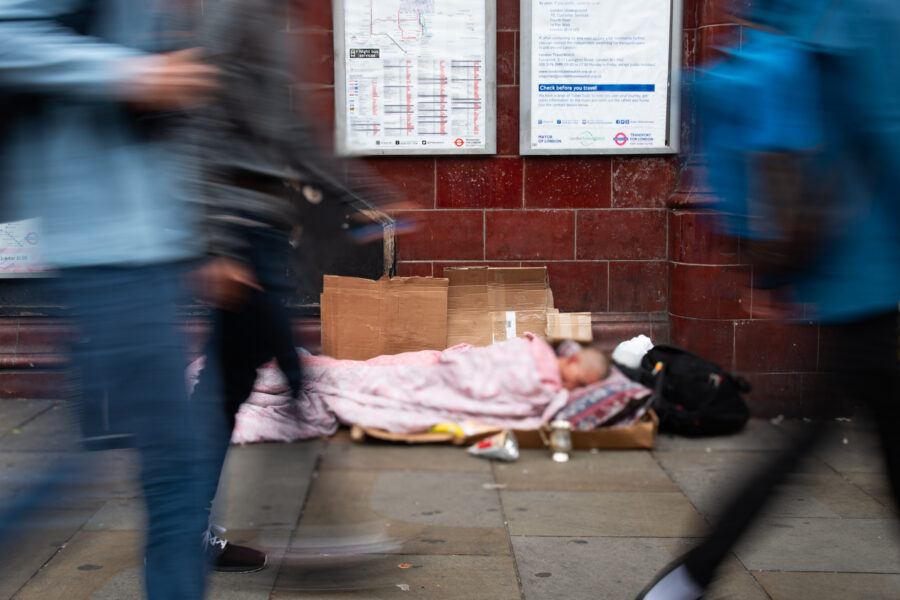
En hjemløs person ligger under et teppe på fortauet i London, mens forbipasserende går forbi. Foto: iStock/mpalis

Ifølge FNs bærekraftsmålsrapport for 2026 lever anslagsvis 826 millioner mennesker i ekstrem fattigdom. Det tilsvarer rundt ti prosent av verdens befolkning.

Verden har gjort store fremskritt i kampen mot fattigdom siden 1990, men utviklingen har stagnert de siste årene. Konflikter, klimaendringer, økonomisk ulikhet og økte levekostnader gjør det vanskeligere å redusere fattigdommen ytterligere.

Fattigdom rammer særlig mennesker i Afrika sør for Sahara og i land preget av konflikt og ustabilitet. Skal fattigdommen utryddes, må flere få tilgang til utdanning, helsetjenester, sosial beskyttelse og muligheter til å skape seg et levebrød.

FNs bærekraftsmål og fattigdomsreduksjon

Bærekraftsmål 1 – Utrydde fattigdom har som mål å utrydde alle former for fattigdom i hele verden innen 2030.

Et av delmålene er å utrydde ekstrem fattigdom. Verdensbanken definerer ekstrem fattigdom som å leve for mindre enn 3 dollar om dagen, justert for forskjeller i prisnivå mellom land. Et annet delmål er å minst halvere andelen mennesker som lever i fattigdom, slik dette defineres nasjonalt.

Fattigdom handler imidlertid om mer enn inntekt. Mangel på mat, rent vann, utdanning, helsetjenester og trygge boforhold er også viktige dimensjoner ved fattigdom.

Å bekjempe fattigdom krever derfor både inkluderende økonomisk utvikling, mindre ulikhet og gode velferdsordninger som sikrer mennesker grunnleggende rettigheter og muligheter.

Disse barna i Peru er opptatt av FNs bærekraftsmål. Foto: UN Photo.
Barn i Peru med FNs bærekraftsmål. Bærekraftsmål 1 handler om å utrydde alle former for fattigdom innen 2030. Foto: UN Photo

Bakgrunn

Den internasjonale dagen for avskaffelse av fattigdom har sitt utspring i en markering 17. oktober 1987, da over 100 000 mennesker samlet seg på Trocadéro-plassen i Paris, på initiativ fra den franske presten og menneskerettighetsforkjemperen Joseph Wresinski.

Samlingen fant sted på samme sted som Verdenserklæringen om menneskerettighetene ble vedtatt i 1948. Deltakerne samlet seg for å hedre mennesker som hadde mistet livet som følge av ekstrem fattigdom, vold og sult, og for å understreke at fattigdom også er et spørsmål om menneskerettigheter.

Under markeringen ble det avduket en minnestein med et budskap om at ekstrem fattigdom innebærer brudd på menneskerettighetene, og at vi har et felles ansvar for å sikre at disse rettighetene blir respektert.

I 1992 vedtok FNs generalforsamling at 17. oktober skulle være den internasjonale dagen for avskaffelse av fattigdom.

Dagen skal også løfte frem stemmene og erfaringene til mennesker som selv lever i fattigdom, og sikre at de får delta i beslutninger som påvirker deres egne liv.

Lær mer

<abbr title="

Verdens felles arbeidsplan for å utrydde fattigdom, bekjempe ulikhet og stoppe klimaendringene innen 2030.

«>FNs bærekraftsmål nummer 1: Utrydde fattigdom

Temaside om fattigdom

Temaside om menneskerettigheter

Verdenserklæringen om menneskerettigheter

17oktober

Dagen setter søkelys på kampen mot fattigdom og retten til et verdig liv for alle.

Les mer om dagen på FNs egne siderarrow_forward

Posta under Politikk&Samfunn, Vår globale verd | Merkt , , , , | Kommenter innlegget

Kunstutstilling: Kunstfront for FRED og MOT krig!

Roger og Ivar går sammen om et tydelig budskap i Fana

Kunstnerne Ivar Tveito Jørdre (t.v.) og Roger Gjerstad slår seg sammen på Nesttun for å levere et brennende politisk opprør mot krig.Foto: Privat

Av Ståle Melhus Oppdatert: 14.10.26 12:37Publisert: 13.10.26 19:30

Ivar Tveito Jørdre og Roger Gjerstad slår seg sammen på Nesttun for å levere et brennende politisk opprør mot krig.

Torsdag 15. oktober åpner utstillingen i «Småsalen» i Fana Kulturhus på Nesttun, og den varer frem til 9. november. Dette er tredje gang Ivar Tveito Jørdre stiller ut i kulturhuset, etter utstillinger høsten 2021 og 2023. Denne gangen stiller han ut sammen med Roger Gjerstad. 

Kunstnerne oppgir et tydelig budskap med utstillingen.

— Motivene kan ofte ha politisk uttrykk, men i alle typer motiv er det maleriske det sentrale. Det viktigste er likevel at kunsten på selvstendig grunnlag skal tale sin «egen sak». Mange av mine arbeider er direkte kommentarer til og analyser av verdens politiske og sosiale situasjon. Drivkraften i kunsten er et ønske om endring av de rådende maktstrukturene, og å inspirere folk til å tenke og handle for endring. Med denne utstillingen har Roger og jeg et viktig budskap: Kunstfront for fred og mot krig! sier Ivar Tveito Jørdre. 

Billedkunst og politisk engasjement

Jørdre har vært kunstner i over 40 år og har utdanning fra Tønsberg Yrkesskule og Bergen Tegne og Maleskole, i tillegg til hovedfag i klassisk arkeologi. Han bor på Kronstad og er aktiv i flere organisasjoner, blant annet Antikrigsinitiativet i Norge, Palestinakomiteen og Latin-Amerika Gruppa i Bergen.

På utstillingen deltar Jørdre med oljemalerier, blyanttegninger og olje på kartong, inkludert maleriet «Tilstand» fra 2024. Arbeidene hans veksler mellom det figurative og det abstrakte. 

— Mange av arbeida mine er direkte kommentarer til og analyser av verdens politiske og sosiale situasjon, både lokalt og globalt, sier Jørdre. 

Lang erfaring i kunstlivet

Roger Gjerstad har utdanning fra Universitetet i Bergen og Vestlandets Kunstakademi. Han har vært bosatt i Åsane siden 1971 og har tidligere vært leder for Bildende Kunstneres Forening Hordaland (BKFH). Gjerstad har stilt ut på både Vestlandsutstillingen og Høstutstillingen, og han er medlem i Antikrigsinitiativet i Norge. 

I Fana Kulturhus viser Gjerstad store tresnittpaneler, malerier og andre arbeider, deriblant verket «Slik er vi….enda» fra 2006. 

Utstillingen åpner torsdag 15. oktober klokken 19.00.

Publisert første gong i Fanaposten.no – 14.10.26

Posta under Art & Science, Artist/Kunstnar, Marxisme, nedrustning, Noreg - Norway | Merkt , , , , , , , , , , | Kommenter innlegget

The big play of the insane players of corruption – The big uggly Trump-kids!

«The Trump-kids of Corruption!, Acrylic on paper, Ivar Tveito Jørdre

Pay to Play to Play to Pay

How the system now works

Robert Reich Oct 9

Friends,

Here’s today’s trivia question (which may turn out to be not at trivial at all when all the facts emerge): Who solicited money from a presidential donor in return for access to the head of the IRS over the donor’s taxes, was a Fox News host, was engaged to the son of the U.S. president, was the former wife of someone who wants to be the next U.S. president, who raised money for and spoke at a rally that led to an attack on the U.S. Capitol, and now is a U.S. ambassador?

If you guessed Kimberly Guilfoyle, you’d be correct on all counts.

Rarely has a person been so enmeshed in the workings (or one might say, dysfunctions) of our current political-economic-media-influence system as Guilfoyle.

From 2001 to 2005, Guilfoyle was married to Gavin Newsom, now governor of California. In 2018, she began dating Donald Trump Jr., became engaged to him in 2020, and emerged as one of his father’s most outspoken defenders and a MAGA icon.

After Trump’s 2020 defeat, Guilfoyle sought to turn her status into a profitable business ventures including lines of hair care and fragrance products and a medspa. She also launched a political consulting firm and sought work in public relations.

In 2022, she launched what she termed an upscale vodka and champagne brand, American Dream, organizing a dinner for Mar-a-Lago guests that participants realized halfway through was an investment pitch.

According to a report in yesterday’s Wall Street Journal by Dana Mattioli, Drew Hinshaw, Rebecca Ballhaus, and Joe Parkinson, Trump grew frustrated with Guilfoyle for soliciting investments from Mar-a-Lago members for her companies, and complained that Guilfoyle was supposed to be raising money for him but instead was at his club raising money for herself.

The Journal reports that after Trump won the 2024 election, Eric Deters — a Trump donor and former co-owner of Snappy Tomato Pizza, a regional restaurant chain, who had mounted unsuccessful runs for Congress and governor — began soliciting Guilfoyle’s help on several matters, including gaining access to incoming Internal Revenue Service Commissioner Billy Long, to discuss an IRS probe into Deters’s tax deductions.

Guilfoyle offered to use her sway as Donald Jr.’s former fiancée. Deters promised to pay her as much as $1 million if she were successful.

Her engagement to Trump Jr. ended in December 2024. On December 10, 2024, Trump nominated Guilfoyle to be the U.S. ambassador to Greece.

After Billy Long was confirmed IRS commissioner, Guilfoyle sent him a congratulatory note, attaching a letter Deters had written outlining his tax dispute: “Don Jr. and I are very close with Eric Deters and his wife and I know he sent you a letter,” she wrote. “I am hoping I know how busy you are that you could give some time and attention to it.”

She assured Deters that “I wrote him a very nice message. Told him how important it was that you’re close to me and to don.”

The Journal reports that as her confirmation hearing approached, Guilfoyle complained to friends that she was broke.

She reached out to Deters with an urgent request: She needed $100,000 that she said she owed American Express — and needed Deters to give it to her in a way that wouldn’t leave a paper trail. “It won’t show up anywhere if you wire money to American Express,” she wrote on Signal, according to messages reviewed by the Journal.

“Honey please I need you to get this done for me today,” she texted Deters, adding a prayer hands emoji and a PDF with bill payment instructions from American Express. “You could just send it here,” she wrote on July 3, 2025, just days before her July 9 confirmation hearing.

Deters ultimately did not make the payment, But the set of transactions illuminates the casual pay-to-play world in which Trump, his family, appointees, and donors all operate.

The Senate confirmed Guilfoyle as ambassador to Greece on September 18, 2025.

Billy Long is now the U.S. ambassador to Iceland.

The top two Democrats on the House Foreign Affairs and Senate Foreign Relations committees have now called for an investigation into Guilfoyle.

Congressional Democrats are already looking into claims reported last month by the Journal that Guilfoyle told guests at a reception that the U.S. could undermine the Greek government if it chose to, that she promoted the business interests of one particular Greek construction and energy company, and allowed its lobbyist into private diplomatic meetings.

In Trump world, being close to power creates a special economy of getting and giving. The arenas include Fox News, Mar-a-Lago, the White House, Capitol Hill, and extend even to our foreign embassies. All relationships within these arenas — personal, romantic, political, diplomatic — are transactional.

Posta under Imperialism | Merkt , , , , | Éin kommentar

Huge demonstrators in India after the election commission purged over 130 million people from voter rolls

India Uses Overwhelming Force to Quell Delhi Protests

India has launched an unprecedented crackdown on demonstrators after the election commission purged over 130 million people from voter rolls.

BIPLOB KUMAR DAS AND FATIMA KHAN OCT 11 – dropsitenews.com

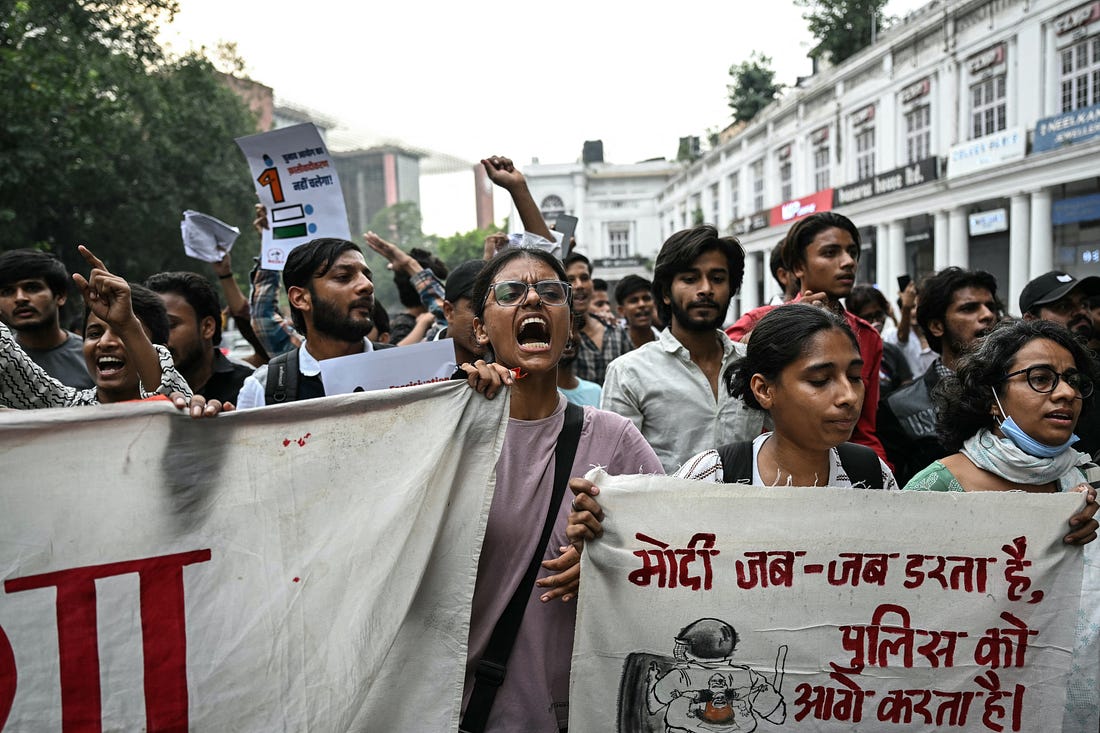
Demonstrators shout slogans during a protest demanding the resignation of India’s Chief Election Commissioner Gyanesh Kumar over alleged voter roll irregularities, near Jantar Mantar in New Delhi on October 11, 2026. Photo by Sajjad HUSSAIN / AFP via Getty Images.

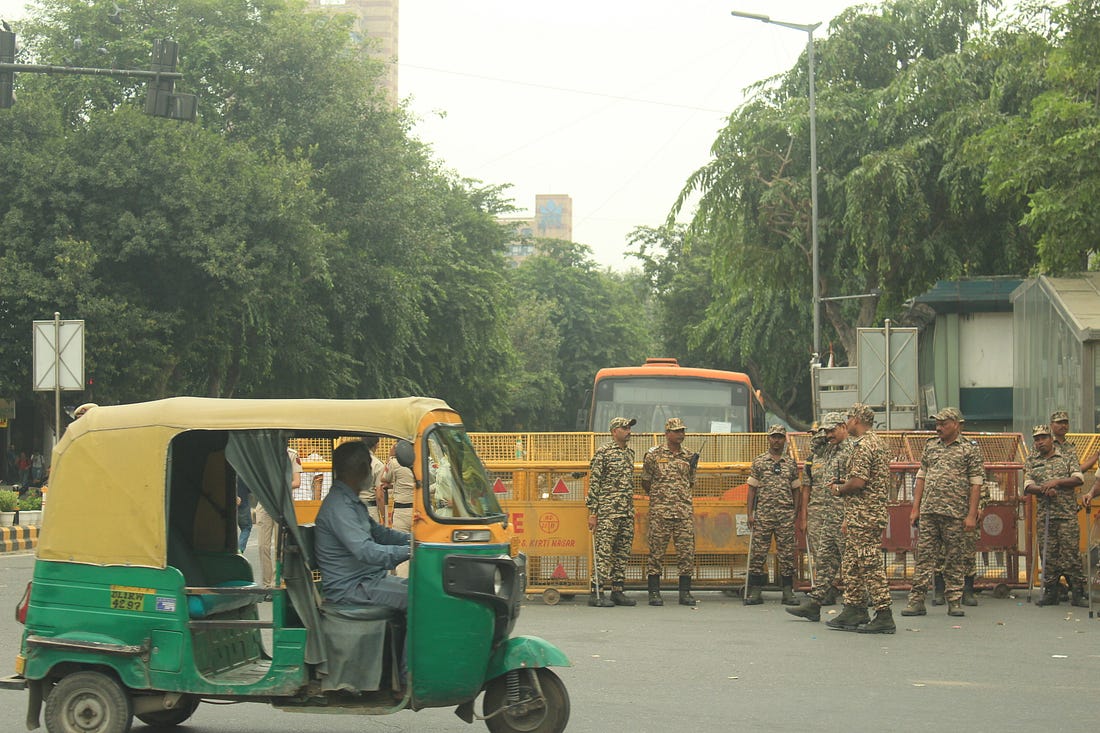
DELHI, India—Indian authorities enforced an unprecedented crackdown on demonstrations across Delhi on Saturday and Sunday, as student groups and citizen networks, including lawyers and doctors organized to provide support for people protesting a massive purge of voter lists. The government deployed over 20,000 police and paramilitary personnel to prevent protestors from gathering in the city, pulling forces from border areas, including Kashmir, into Delhi.

For the past two weeks, protestors across India have been demanding the resignation of India’s chief election commissioner, Gyanesh Kumar, after an investigation by The Indian Express, a prominent daily, revealed that the country’s election commission had deleted more than 130 million people from voter rolls without due process.

The call for large demonstrations on Saturday was made by the Cockroach Janata Party (CJP), which in July led widespread protests against the education minister Dharmendra Pradhan for irregularities in nationwide examinations, leading to his resignation. On Saturday, Delhi police detained Abhijeet Dipke, the founder of CJP, along with several other leaders of the group, on their airplane when they arrived at the Delhi airport, holding them until Sunday morning.

The mobilization was supposed to be held at the designated protest site of Jantar Mantar, but it was entirely barricaded by the police, and most of central Delhi was under police lockdown.

Police barricades in Delhi. Photo by Biplob Kumar Das for Drop Site News.

Many of those who responded to the CJP’s call to action were out on the streets on their way to Jantar Mantar when Dipke and others were detained in the flight. Unable to reach the protest site, they wandered around the city. “Everytime the police stopped us on our way here, we told them we are tourists who are lost, so they let us pass by,” said Shubham Sharma, 22, who was there with his 20-year-old cousin, Harsh.

Multiple journalists were detained, despite wearing their press badges. Lawyers were detained as well, including senior Supreme Court advocate Shadan Farasat, who was carried by his arms and legs to a police station. Overall, police detained over 2,000 protestors on Saturday, reported Reuters. Among those detained was the distinguished welfare economist Jean Drèze, who is originally from Belgium but has lived in India for nearly five decades, working on issues of poverty. “In almost 50 years of being in India, I have never seen such use of force to quell protests,” Drèze told Drop Site from the police station.

Another protestor, 40-year-old Maalvi Mishra said that even as she was entering the lane to get to the protest site, she was told by the police that “Jantar Mantar is not in Delhi,” and that she should go home. “I managed to come here but so many others couldn’t,” she said, as she held up a copy of the constitution in her hands, surrounded by cops and border security forces all around.

As protesters began entering the neighboring areas, police detained anyone who appeared to be heading towards the protest site.

“I reached Delhi from Punjab early in the morning and have been here since,” said Karan Singh, who had travelled alone to attend the protests. “It was incredibly difficult to reach here, I had to walk for almost an hour. The police presence in the area makes it feel like it’s fully a dictatorship,” he said.

Drop Site saw protestors being detained within minutes of chanting slogans, or as soon as they merely came close to the barricaded roads outside Jantar Mantar. It wasn’t just protestors—many were picked up from far beyond the protest premises, from arbitrary spots in the city, without explanation. “I didn’t know anything about the protest, I am in the city for some work with my wife. The police just whisked me away without informing me why,” said Mohammad Rahim, who was detained along with nearly 40 others in front of the New Delhi Railway Station.

In addition to the brute force applied by security forces, members of the right-wing Hindu Raksha Dal (Hindu Protection Force), who mobilized in support of the Narendra Modi government, were seen harassing some protestors. In a video that’s now gone viral, four men were seen attacking a man and a woman, beating them up, with the police not intervening to stop them. The four were arrested on Sunday.

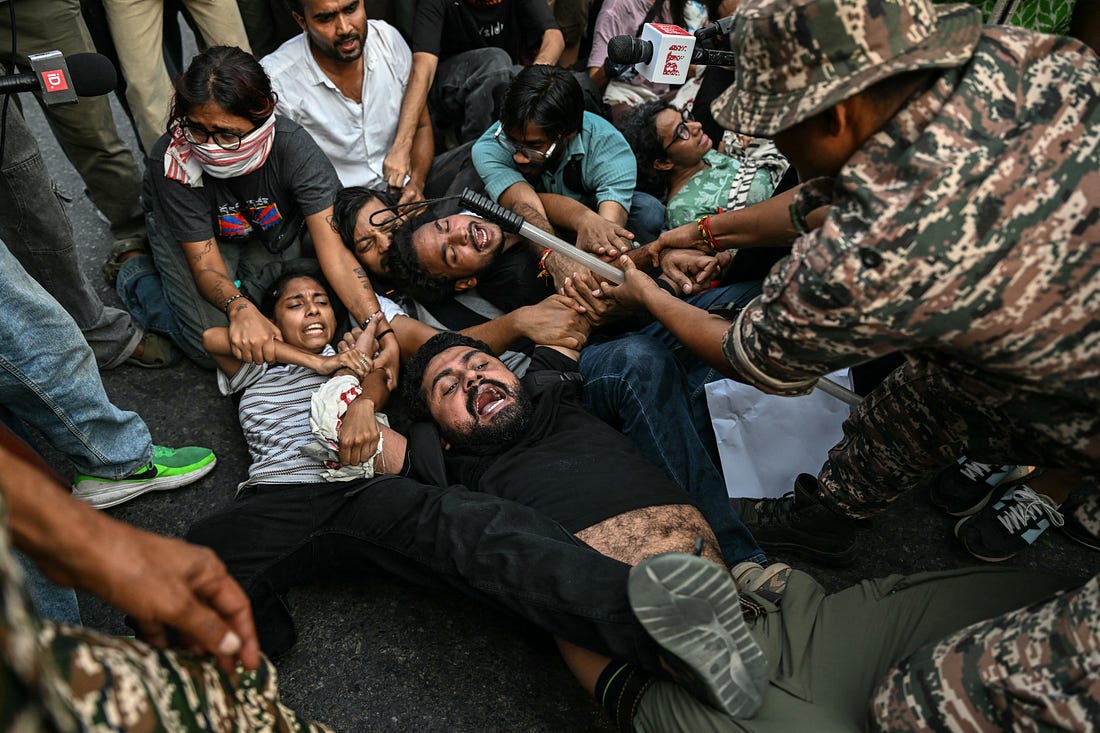
Security personnel detain demonstrators during a protest demanding the resignation of India’s Chief Election Commissioner Gyanesh Kumar over alleged voter roll irregularities, near Jantar Mantar in Delhi on October 11, 2026. Photo by Sajjad HUSSAIN / AFP via Getty Images.

Protests Despite Crackdown

As crackdowns against protestors continued unabated, spontaneous demonstrations erupted in other parts of the city. A popular market for tourists called Dilli Haat suddenly emerged as the go-to spot as left wing student leader Neha Bora announced that as their choice of protest ground. A few hours later, the Safdarjung flyover, an extremely busy overpass in the heart of South Delhi, became another hot spot. The protests, however, could only occur in bursts, as people were being detained within minutes.

“Till the time there is even one person protesting on the street, this movement will continue,” said Bora in a video message on social media. Bora pleaded with supporters to protest wherever the police tried to detain them.

Even as the largely young, Gen Z protestors were being bundled into police buses and vans, some from the older generations came to show solidarity and support.

Hansraj Bhutani, 82, came out into the street with food and water in his bag. “I am here to support the protestors,” he said. “I have lived through the Emergency under Prime Minister Indira Gandhi. Even then, things weren’t this bad. I am requesting Modi to stop troubling the public like this.”

In Connaught Place, a central market in Delhi, hundreds of protestors trying to make their way to Jantar Mantar were detained. The police presence in the area heavily outnumbered the protestors. The government prohibited the gathering of more than five people in central Delhi.

Many protestors, who had walked in alone, found solidarity with the few others who managed to make it past the barricades.

Papri Das, Pavneet Kaur, and Rosy met each other at the Connaught Place market while heading towards the protest site. “It is disheartening to see how the government is seeking to silence our voices. But what is heartening is that people are still showing up, despite the crackdowns and despite the police brutality,” said Das, 34.

For Kaur, 35, the solidarity she found among each other gave her hope that this movement could be successful. “We just realized that the three of us belong to different religions. I am Sikh, Papri is Hindu, and Rosy is Muslim. This is exactly what the government fears—people becoming united to fight its tyranny,” she said.

Not far from Connaught Place, police entered a Sikh temple, the Gurudwara Bangla Sahib, and detained people en masse. “I witnessed at least a dozen people being brutalized while the Delhi police tried to detain them. One 75-year-old woman was brutalized by the police so badly, one of her fingers was dangling off, we had to get her a plastic surgery,” said a doctor who was offering medical relief to the injured inside the Gurudwara and did not want to be named out of fear of retaliation.

He said that the police entered the temple premises in their boots and without wearing a head scarf—as required of men entering Sikh places of worship. “Most people were injured due to the police twisting their fingers while trying to detain them. I saw a lot of pinching and nail marks on injured protestors. They are not using batons, but using these other means to brutalize protestors,” he said.

The protests continued on Sunday, with spontaneous marches emerging in Connaught Place multiple times throughout the day and the police detaining hundreds of protestors. “I have been detained almost every day since October 2. I will continue to protest this regime and I will continue to show up on protest sites every day, there is no fear anymore,” one protester told Drop Site through a window of a police bus.

Support Networks

In response to the July protests, a citizen-led volunteer group began to take shape. The group, which calls itself the Protest Support Initiative, has multiple wings, each catering to a different aspect of providing aid and support, with about 150 volunteers. One wing is in charge of driving people home after they are let go from their detention centers, often in far-flung places. Another, led by doctors, is in charge of providing first-aid. There’s also a wing of therapists who help people who’ve undergone trauma during the detention or during confrontation with the police.

For Meghnad, a popular journalist and content creator, forming the group seemed like the most natural thing to do. “No one else was doing it, but someone had to. So might as well be us,” he said. “Eighteen year olds would come up to me asking how do we get home after the police leave us in random parts of the city after detention, I had to help them. I also realized many of these young protesters come from extremely repressive environments at home. They’ve found a space to express themselves through these protests, so we have to be there for them.”

Until October 9, the group had 20 people who had volunteered to drive detainees home. After the October 10 protests, that number has risen to 93. But along with all the support, they now also face the scrutiny and intimidation that comes from the authorities. “Three people were following me throughout the protests on 10th. I routinely get a call from Delhi police checking on me,” said Meghnad.

Satvik Soni, a filmmaker co-leading the Protest Support Initiative, said he had over 140,000 followers on Instagram before the government banned his account in India.

Soni said there was an “organizational gap” in how the protests were being mobilized, and that he and Meghnad have spent over 2 lakh rupees, or $2,600, from their own savings to provide aid to protesters.

“Two things need to happen for people to join the protests in large numbers,” said Soni. “The CJP and other activists have made it cool to attend the protest. But someone needs to make it safe as well, and I think that’s where we come in.”

He said the last round of CJP-led protests, which led to the resignation of the Education Minister, left many protestors detained or injured in its wake. “The protestors had been stranded, and they were chased by right-wing goons and Delhi police,” Soni said. “The leaders left, so we had to step in.”

Posta under Asia, Politic&Society | Merkt , , , , | Kommenter innlegget

Kunstfront for FRED og MOT krig – Utstilling i Fana Kulturhus, 15. oktober – 9. november 2026

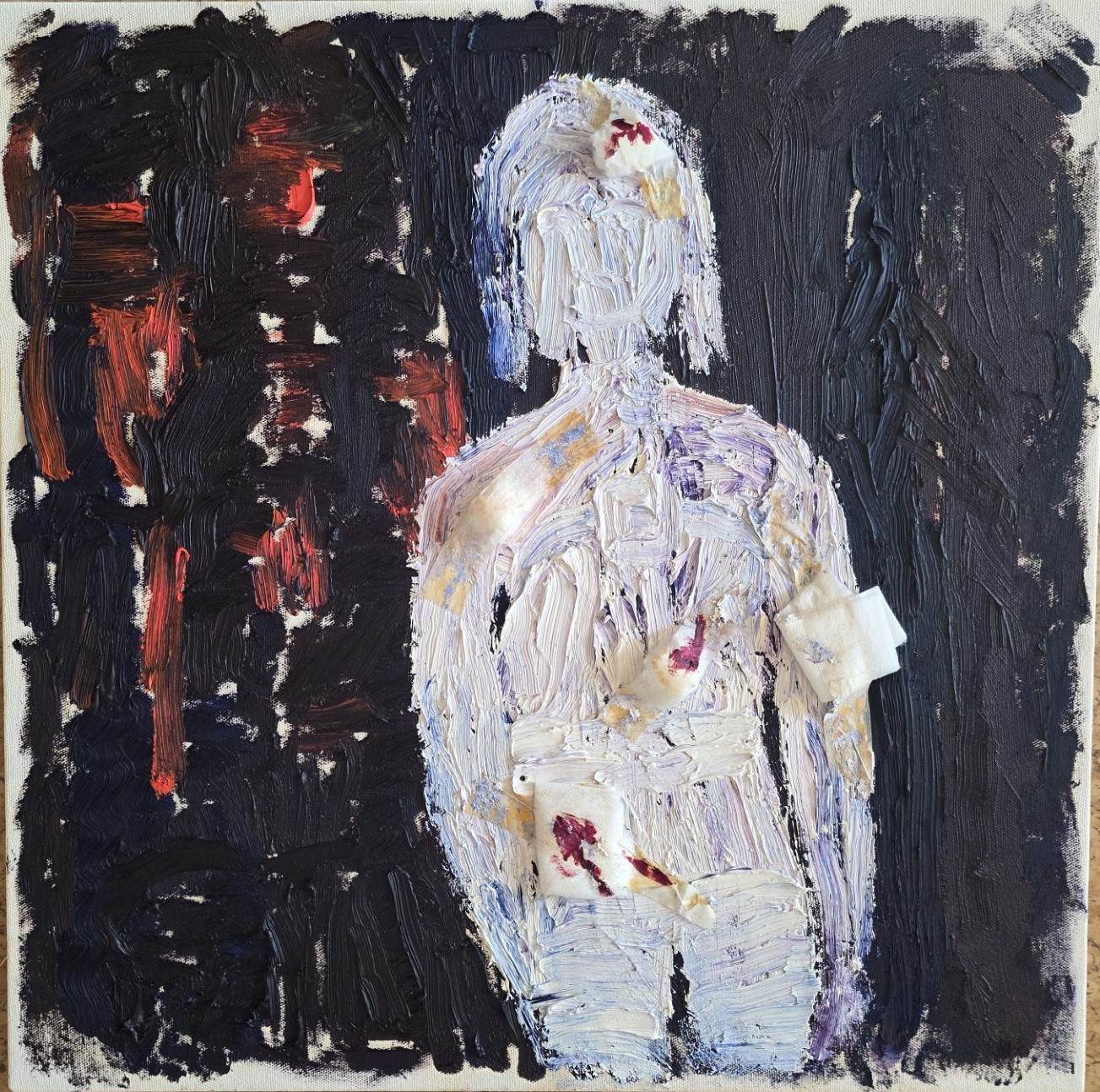
«Tilstand», Olje på lerret, 60 x 60 cm, 2024, Ivar Tveito Jørdre

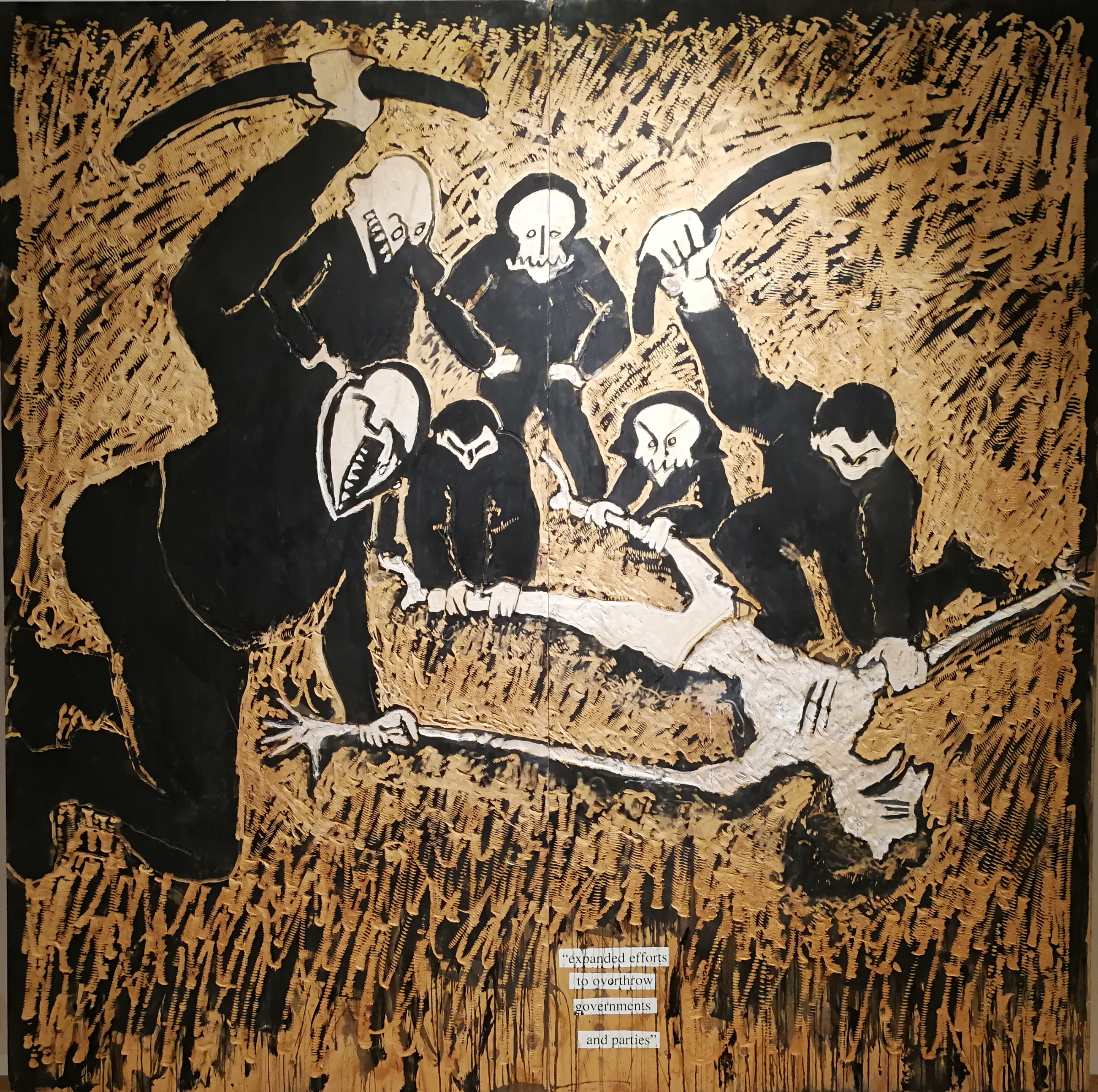
«Slik er vi….enda», Tresnitt-plate 2m40cm x 2m40cm, 2006, Roger Gjerstad

Kunstfront for FRED og MOT krig – Verda treng aktivistisk og politisk KUNST, som aldri før!

Er samfunnet interessert i politisk kunst? Det er diverre tvilsamt at mange er det. Endå det er veldig viktig at kunstnarar brukar sin kunst som motmakt mot verdas maktstrukturar. I vår tid meir enn nokon gong er Kunstfront mot krig og for fred, sentralt. Me tenkjer at det er for lite politisk kunst i vår tid. Kunst som kritiserar det kapitalistiske system og kunst som set søkeljoset på ei verd der internasjonal folkerett og rettsorden er under sterkt press, trengs, og som tittelen på utstillinga seier:

Kunstfront for FRED og MOT krig!

Sterkare politisk kunst trengs for medvitsgjering og som middel for endring av system/samfunn.

Ein installasjon om Gaza By og store tresnitt-panel vil håpnadsfullt vise kva me ønskjer å vise.

Nedanfor er det ein tekst som forklarar noko om føremålet vårt med utstillinga og om kvifor me meinar politisk kunst er eit veldig viktig verkemiddel for medvitsgjering, samfunns- og systemkritikk av kapitalismen.

Til denne utstillinga brukar me også eit «Kunstfrontmanifest», Motmakt mot kapitalismen ved hjelp av ein Kulturfront, skreve av oss i 2016 (sjå lenke).

På denne utstillinga tek me føre oss ulike typar kunstuttrykk for å vise (med visuelle verkemiddel) sider ved det kapitalistiske samfunnet, systemkritikk, framandgjering, konkrete saker som krig og fred, osb. Døme på andre idear/måtar å vise kunst som motmakt på i praksis, som ein utstilling kan vera med å sette i gong, kan vera sokalla GRAFISKE KUNSTVEGGER – som ope debattforum – der kunstverka kan virke  som ei veggavis, ei oppslagstavle, ei politisk meining. Biletet/a kan t.d. stå i ei avgrensa tid på eitt år, før det evt. vert flytta til ein annan stad/kommune. Andre døme er poetiske uttrykk, gateteater, demonstrasjonsgigs, o.l.

For å kome vidare i forståinga av kva kunst er og korleis kunsten fungerar (eller ikkje fungerar) innanfor kapitalismen sine råmer, lyt ein sjå på ideologisk og politisk filosofi. Her kan Marx sine tankar hjelpe til:

“På same måte som vara ser kapitalistane på kunsten som omsetteleg, med sin mytiske og fetisjaktige karakter. Så snart kunsten opptrer som vare, så endrar han seg til ein ting som ein kan sanse som har oversanselege eigenskapar. Kunsten vert ufarleggjort og kan brukast i kapitalen si interesse. Her ligg også manipuleringa og undertrykkinga av kunsten som eit reiskap for kapitalen sitt ve og vel. Ein skal på borgarleg vis «kose» seg med kunst og investera i han, men kunsten må ikkje føre til folkeleg opplysning og kime til opprør og endring. Kunsten står dermed med eit bein i kapitalismen og eit bein i opprøret og sosialismen. Det vert då viktig å få begge bein radikale (rotvelting) og på bakken, og ikkje berre med eit bein utanfor kapitalen, ei frigjering av kunsten er naudsynt for endring” (fritt oversett).

Marx seier at vara sin mystiske karakter ikkje spring ut av bruksverdien ho har. Vidare i Økonomisk-filosofiske manuskripter og andre ungdomsverker, ss. 189-208, skriv han: “Ut fra nasjonaløkonomien selv har vi, med dens egne ord, vist at arbeideren synker ned til å bli en vare, ja til den elendigste vare, at arbeiderens elendighet står i omvendt forhold til produksjonens makt og størrelse, at konkurransen nødvendigvis fører til en opphoping av kapitalen på få hender, det vil si til gjeninnføring av monopolet i enda verre form, og endelig at forskjellen mellom kapitalist og grunneier, mellom bonden på åkeren og arbeideren i manufakturbedriften forsvinner og at hele samfunnet må dele seg i to klasser – eiernes klasse og de eiendomsløse arbeidernes klasse.”

På 1980-talet hadde EIT KUNST-MARXISME PROSJEKT teke opp desse ovannemde tinga til handsaming, så vart det stille LENGE. Håpet er å få desse perspektiva fram att som viktige i venstresida sitt arbeid. Denne utstillinga ser me på som ei god byrjing. Det er også viktig for oss å få gode innspel frå publikum til gode idear på tema og politiske saker ein kunstfront kan arbeide med, og gode overskrifter alá “kva er det du irriterar deg mest over i dagens Noreg” eller “kva er den fullkomne framandgjering i kapitalismen i dag”.

Kunst må verte ein naturleg del av anna politisk arbeid – dette bør venstresida ta inn over seg og gjera noko med!

Sjå også bloggen https://artfightforchange.wordpress.com/ for meir info og søke etter: Motmakt mot kapitalismen ved hjelp av ein Kulturfront

Roger Gjerstad og Ivar Tveito Jørdre, kunstnarar og politiske aktivistar

Posta under Art & Science, Artist/Kunstnar, Marxism, Politikk&Samfunn | Merkt , , , , , , , , | Kommenter innlegget

«The Cornell 7 Case Demands More Than Outrage» – Tarana Burke – the founder of the Me Too movement

Watch: «I am Jane Doe» protests across US call for end to sexual violence

Protests were held across the US on 8 October, calling for an end to sexual violence, following allegations of sexual assault involving members of a fraternity at Cornell University.

Survivors, students and advocates rallied and protested in communities and on college campuses across more than 40 states.

This comes after a lawsuit was filed against by “Jane Doe”, who alleges she was given drugs and alcohol before being sexually assaulted by several members of Cornell’s Chi Phi fraternity while incapacitated in October 2024. She has accused Cornell University of failing to adequately investigate and discipline those involved.

Following the filing of the civil lawsuit, prosecutors reopened the case. New York Governor Kathy Hochul appointed the state’s attorney general as special prosecutor.


The Cornell 7 Case Demands More Than Outrage

by

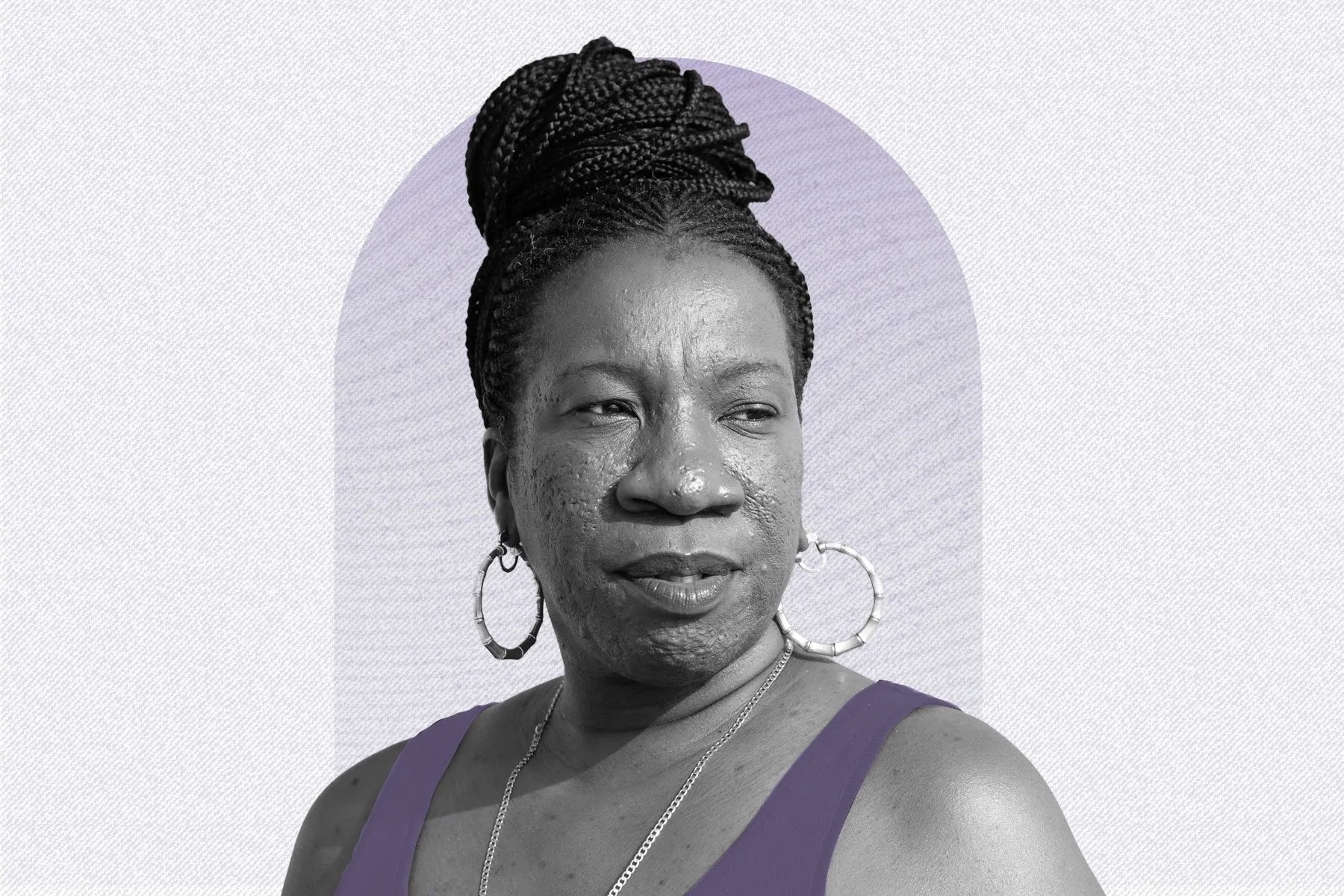
Tarana Burke

Tarana Burke is the founder of the Me Too movement.

OCT 9, 2026

By now, most of America has heard about the young woman who says she was gang raped by fraternity brothers while she was a student at Cornell University. 

The case has been dubbed the «Cornell 7» across mainstream and social media, after the seven Chi Phi members named in her recent lawsuit. The woman who filed the suit, referred to as Jane Doe, first reported her experience to Cornell campus police in November 2024. According to her lawyer, after Cornell’s Title IX process, two of the seven were expelled, and the other five were suspended, sent to workshops, and assigned essays. Cornell says none of them got off with only an essay.

At the time, the Tompkins County District Attorney declined to prosecute. After public outcry, the DA issued a statement explaining that Jane Doe’s original statement to police described the drug use and sex as «voluntary, conscious, and consensual.” “However, recognizing that the process of healing from trauma is personal and different for every human, my office has reopened this investigation,» he wrote. Now, New York Governor Kathy Hochul has appointed state Attorney ‌General Letitia James as special prosecutor in the case. 

How did the case come to light? It took The Cornell Daily Sun, the campus student newspaper, breaking the story roughly two years later for this to capture the hearts, minds, and headlines of Americans across the country. The story struck a nihilistic nerve. 

This case lands squarely in a moment of massive frustration, disappointment, and anger over how the Jeffrey Epstein and Ghislaine Maxwell case was handled. New CDC data shows that nearly half of American women and one in six men have experienced some form of contact sexual violence. Based on how broad this issue is and based on how some of the most visible cases have turned out, apathy about our ability to see our way from a society steeped in rape culture to one where sexual violence is rare should come as no surprise.

As someone fully immersed in this work, even though I see a pathway forward, I understand these feelings from a very deep place in my spirit. We should be disgusted. We should be heartbroken. We should be enraged.

So what do we do with these feelings?

We provide an outpouring of support to Jane Doe and to other women who have come forward with their accounts of sexual assault, such as Kendall Francis, who took to TikTok to speak out about how her college, LSU, handled her Title IX case. According to ESPN, in July, the LSU Office of Civil Rights and Title IX found her alleged attacker, a football player, responsible for “forcible rape” and suspended him for two semesters. The player appealed and in August, Administrative Law Judge Janet Waguespack reduced his punishment to four semesters’ probation, allowing him to remain on campus. The player’s lawyers maintain that their client is innocent. 

Again, Francis’ story struck a nerve, catching the attention of East Baton Rouge District Attorney Hillar Moore, whose office is now investigating the case.

The outpouring of support matters, both so these young women can get the justice they’re seeking and so survivors everywhere know that support is out here. But what many of us know is that for every Jane Doe and Kendall Francis who reports and seeks justice, there are hundreds, if not thousands, of survivors who won’t, for a lot of reasons. Chief among them is feeling alone in the fight. They aren’t alone. But I’ll admit it’s hard to tell when spotlights dim, headlines fade, and accountability seems stifled.

As if right on cue, something else happened this week while these cases took over headlines. The Trump Administration’s Department of Education altered Title IX rules, declaring that harassment has to be «severe, pervasive, and objectively offensive» before a school must act, that most off-campus violence falls outside a school’s responsibility, and that a college survivor can be cross-examined at a live hearing by the advisor her attacker chose.

This decision landing right as the Cornell 7 case came to light is telling. It’s one of the clearest illustrations of the direct line between the damage this administration has done to the fight against sexual and gender-based violence—especially among young people. 

The Trump Administration’s decision to make it more burdensome to file a Title IX complaint only adds to the helplessness so many survivors feel. Patriarchy protects itself the way any system of power does. It writes the rules, staffs the offices, and then leaves survivors like Jane Doe and Kendall Francis to fight for justice on their own.

Of course, it is worth remembering the challenge we collectively face isn’t simply a matter of one rule or how it is applied; there are questions we must confront about where our culture has ended up. After all, these Cornell students were tweens when recordings of now-President Donald Trump leaked of him using crude language to describe how he treats women. The context may be different, but we have to ask: How far is the line between «grab ’em by the p—y» and «free p—y», the message the lawsuit says one of the Cornell 7 sent his fraternity brothers, inviting them to join in the hours-long assault on Jane Doe? 

Yet, in the face of these various challenges, we must also remember: We are not helpless.

On October 15, it’ll be nine years since #MeToo went viral. We’re far past the hashtag, but we’re still in the movement, and it’s a very real, very active movement fighting tooth and nail to destroy systems that prevent justice. The answer to such systems has always been the organized power of the people those systems harm. The rage people are feeling right now, from Baton Rouge to Ithaca, can be organized and directed exactly where it’s needed. That means our outrage can’t be selective. It can’t show up when Epstein or Cornell makes the news and disappear when the coverage moves on. Because when the next national story takes hold, there will still be students on high school and college campuses all over this country who are fundamentally unsafe.

We’ve made real progress in almost ten years of the MeToo movement, and lasting change will only come from constant demand. Frederick Douglass famously said: «Power concedes nothing without a demand.» Black people in the civil rights era didn’t wait for a government full of segregationists to find its conscience. They organized until it had no choice. Sexual and gender-based violence is solvable, but those solutions have to be demanded, and we have the numbers to demand them.

Too many survivors who stay silent believe they’d be fighting alone if they raise their voices. The CDC’s most recent national survey found that nearly 80 million American adults, close to 58 million women and more than 20 million men, have experienced contact sexual violence. For some people, those are just numbers. In reality, they’re a base of power: millions of people who know this trauma intimately and are primed to act.

What action against sexual violence can look like

First, you can join an organization dedicated to addressing sexual violence head-on. Several national organizations are working to bring survivors and our allies together to demand systemic change. Organizations like mine, me too. International, along with the National Women’s Law Center and UltraViolet, are on the front lines organizing survivor leaders, fighting for survivors in courtrooms, and keeping people engaged on these issues. Others, like Justice for Migrant Women, Educate Us, and the National Domestic Workers Alliance, work on where sexual and gender-based violence meets immigration, domestic work, and education. The Survivor Justice Network, a coalition of organizations fighting sexual and gender-based violence from a social and political standpoint, runs the Survivors Vote campaign to organize survivors as a voting bloc. And there are countless regional and local organizations fighting this fight every day, especially local rape crisis centers, many of which are struggling. 

In April 2025, the Justice Department terminated hundreds of grants worth more than $800 million, including money for victim services, and this spring $200 million meant for violence against women programs was still sitting unspent. Centers like the DC Rape Crisis Center (DCRCC), the oldest in the country, don’t only provide direct services to local survivors. They take on the larger issue of sexual violence and how it’s affecting the people they serve.

Next, you can use your resources well. Speakimng of DCRCC, local rape crisis centers are the first line of defense, and when students can’t get support on campus, they often go looking for it at the rape crisis center in their college town. Find the survivor support organizations near you and give to them directly. It’s the best way to shore up the front line so survivors can get what they need and the fight can continue.

Third, you can get active in local politics. 

Ask your elected officials where they stand on sexual and gender-based violence and on legislation they can move right now, like the Survivors» Rights Restitution Act, which Rep. Ayanna Pressley introduced in September with Reps. Teresa Leger Fernández and Deborah Ross to compensate survivors whose federal rights were violated, including Epstein’s survivors. Pressure them to vote accordingly, and make your support heard and understood.

Lastly, we must unite around our shared challenges. National outrage helps shake people up enough to pay attention, but culture won’t shift just because we change laws and elect better politicians. People need to understand how sexual and gender-based violence shows up in their daily lives, how it intersects with the other issues they care about, and how long it stays with families, communities, and institutions. Until the whole of society sees this as an abomination, we won’t have the lasting cultural impact that makes sexual violence a rarity. 

Jane Doe and Kendall Francis each refused to carry this quietly. The rest of us owe them and survivors like them more than a week of outrage.

We can let them see what it looks like to turn outrage into outcomes.

Tarana Burke, in Time Magazine

Posta under Kvinne- og jentekamp, Our global world, Politic&Society | Merkt , , , , , , , , | Kommenter innlegget