Obvious war crimes done by USraeli attacks on Iran

Over 100 US legal experts condemn strikes on Iran as possible ‘war crimes’

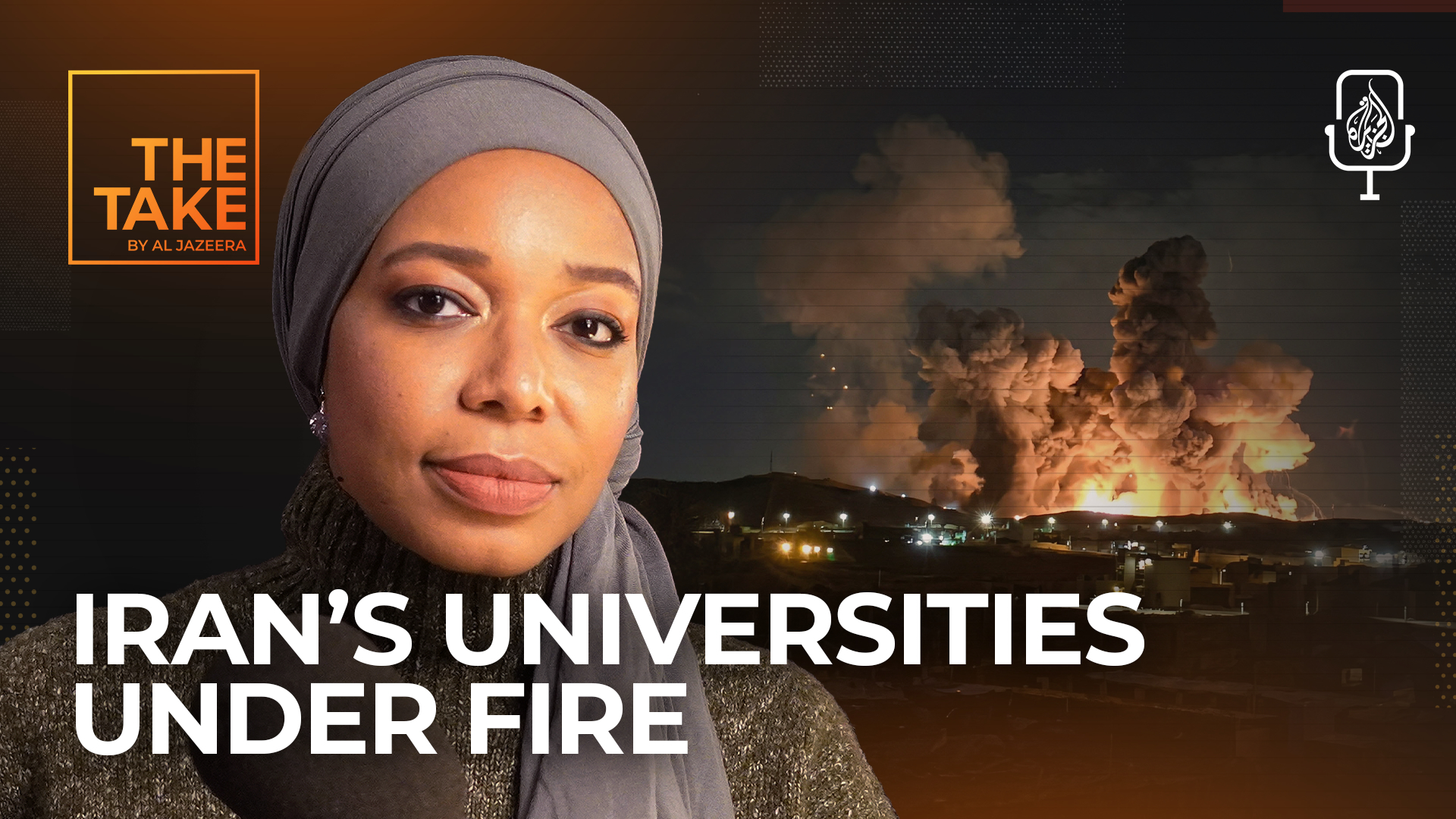
United States-based scholars sign open letter raising concerns about conduct, rhetoric during US-Israeli war on Iran.

Aftermath in Iran of US and Israeli airstrikes
A picture released by the Iranian government’s foreign media department shows graves being prepared for victims, mostly children, of a United States attack on a girls» primary school in Minab, Iran [Iranian Foreign Media Department via AP]

By Al Jazeera Staff

Published On 3 Apr 2026 – aljazeera.com

More than 100 United States-based international law experts have signed an open letter condemning US and Israeli military strikes on Iran as a violation of the United Nations Charter and potentially amounting to “war crimes”.

The letter, published on Thursday, also said the conduct of US forces and statements by senior US officials “raise serious concerns about violations of international human rights law and international humanitarian law”.

The scholars warned that the US-Israeli campaign, which began on February 28, was launched without UN Security Council authorisation and without credible evidence of an imminent Iranian threat.

“Force against another state is only permitted in self-defense against an actual or imminent armed attack or where authorized by the UN Security Council. The Security Council did not authorize the attack. Iran did not attack Israel or the United States,” the letter said.

The experts’ concerns fall into four areas: the legality of the decision to go to war; the conduct of hostilities; threatening rhetoric from senior officials; and what they describe as the dismantling of civilian protection structures inside the US government under Defense Secretary Pete Hegseth’s “gloves off” approach to warfare.

The scholars highlighted a strike on a primary school in Minab, Iran, on the first day of the war that killed at least 175 people, most of them children, as well as attacks on hospitals, water plants and energy infrastructure.

“We are seriously concerned about strikes that have hit schools, health facilities, and homes,” the letter said.

‘Alarming disrespect’ for international law

The letter also condemned public statements by senior US officials, including President Donald Trump.

In particular, it noted a mid-March comment from Trump where he said the US may conduct strikes on Iran “just for fun”. It also cited comments from Pentagon chief Pete Hegseth from early March in which he said the US does not fight with “stupid rules ⁠of engagement”.

“Public statements by senior officials indicate an alarming disrespect for the rules of international humanitarian law accepted by states, and which protect both civilians and members of the armed forces,” the letter said.

It also added that the war is costing US taxpayers up to $2bn a day.

The letter was co-authored by prominent legal scholars including Yale Law School’s Oona Hathaway and Harold Koh, Philip Alston of NYU, and former Human Rights Watch chief Kenneth Roth.

The experts said that due to their connection to the US, their main focus was on the conduct of that government, but they “remain concerned about the risk of atrocities across the region”.

They also highlighted the “importance of equal application of international law to all, including countries that hold themselves out as global leaders”, expressing concern about the harm this war is doing to the international legal order and the system of international law.

The signatories are urging Washington to change course, writing: “We urge US government officials to uphold the UN Charter, international humanitarian law, and human rights law at all times, and to publicly make clear US commitment to and respect for norms of international law.

Recommended Stories

list of 3 items

listen to these podcasts

podcast episode artwork

From: The TakeWhy Iran believes it can outlast the USIran appears to believe it can survive this war. That calculation may be shaping its stance on a ceasefire, even as strike…

podcast episode artwork

From: The Inside Story PodcastWhat would it take for Iran to reopen the Strait of Hormuz?Several countries say they will take action against Iran’s near-total closure of the Strait of Hormuz. But with no end in …

podcast episode artwork

From: The Inside Story PodcastAs support for war fades, what Is Israel seeking in Iran?Israel and the US continue to bomb Iran. But Israeli opinion polls suggest support for the war is dropping, while Iranian …

Related

Posta under Imperialism, Midt-Austen, Our global world | Merkt , , , , , , , , , | Kommenter innlegget

Suspend the EU-Israel Association Agreement – Stop the Israeli far-right and their death penalty!

Suspend the EU-Israel Association Agreement – Stop death penalty!

«Viva Palestina», oil on canvas, 85 x 40 cm, 2013, Ivar Tveito Jørdre

Israeli far-right ministers wore pins with nooses as the government legalised executions of Palestinians — and the European Union is still giving Israel preferential trade.

In the Knesset, lawmakers have pushed forward plans to execute Palestinian detainees — inside a military system where conviction rates reach 99%, and thousands are already locked behind bars.

The EU bans the death penalty outright and makes human rights a core condition of its trade deal. That means this deal can be suspended — immediately — when those principles are violated. And that pressure could help stop this law before executions are carried out. 

Tell the EU: suspend the EU–Israel trade deal now — and use every lever to rescind this law. 

The EU–Israel Association Agreement isn’t unconditional. It includes a binding clause that makes respect for human rights an “essential element” of the deal — meaning the EU has the legal basis to suspend it if those obligations are breached.

EU officials have already raised serious concerns about war crimes in Gaza. Now, with Israel moving to bring back executions, that breach is becoming even harder to ignore.

The EU has taken action like this before — suspending agreements with other countries over human rights violations. And as the EU is Israel’s largest trading partner, pressure is building: across Europe, a majority of Europeans support suspending the deal. 

No trade with executioners. No trade with war criminals.

Let’s make this impossible for EU leaders to look away.

Add your name — and tell the EU to act.

More Information

Suspend the EU-Israel Association Agreement

International Federation for Human Rights 12 March 2024

EU to launch Israel trade review as Gaza situation deteriorates

Politico 20 May 2025

EU Commission calls Israel’s death penalty law ‘a clear step backwards’

Politico 31 March 2026

Israel passes death penalty law for Palestinians convicted of lethal attacks

Reuters 30 March 2026

From action.eko.org

Posta under Europa, genocide, Midt-Austen | Merkt , , , , , | Kommenter innlegget

NO KINGS, NO DEMAGOGS, NO WAR MORONS, NO FASCISM, NO TRUMPISM!

No Kings protests: millions rally in cities around the world against Trump and his administration – as it happened:

This liveblog is now closed. Read the full story here.

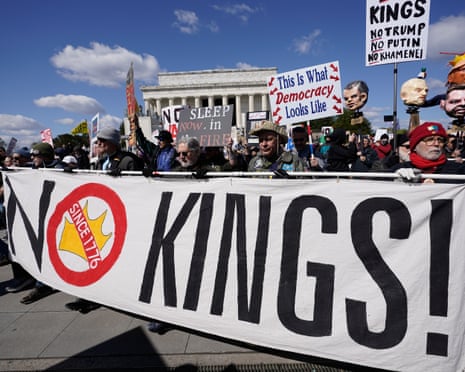
People march while holding a banner that reads 'No Kings!'

Demonstrators rally in front of the Lincoln Memorial during the No Kings protest in Washington on Saturday, 28 March 2026. Photograph: José Luis Magaña/AP

Sun 29 Mar 2026
theguardian.com

Proud Boys leader among No Kings counter-protestersBruce Springsteen headlines rally in MinnesotaProtest against the far-right underway in UKWhat is the 3.5% protest rule and what does it mean for the US?Second No Kings protests in October 2025First No Kings protests in June 2025 as Trump held military parade in Washingt

Posta under Fagrørsle og kamp, Our global world, World Peace Wave | Merkt , , , , , , , , | Kommenter innlegget

Stop Plans for Nuclear Weapons Production – Stop US Imperialism

Stop Plans for Nuclear Weapons Production

Iran’s nuclear weapons program can’t be stopped with more US nuclear weapons!

«Behind the idyllic», oil on canvas, 2022, Ivar Tveito Jørdre

Earlier this month, President Trump attacked Iran, sparking a war in the Middle East, under the guise of preventing Iran from developing nuclear weapons, alongside evolving and otherwise unclear motivations. This move disregards diplomacy and international law as stabilizing tools that can, and have, provided security and increases the long-term danger of nuclear proliferation.

While simultaneously motivated to prevent other countries from developing nuclear weapons, the Unites States is currently trying to carry out the most expensive expansion of our nuclear weapons complex in history, including making hundreds of new plutonium bomb cores for new nuclear weapons.

These bomb cores are called «plutonium pits,» and they’re the «triggers» for all modern US nuclear weapons. The United States has not produced these cores since 1989 but is now mandating that the national nuclear labs start producing 80 cores per year by 2030 to equip the first new weapons since the end of the Cold War.

Act now: Tell Congress to stop this nuclear expansion.

To add insult to injury, this kind of production, which involves extremely dangerous radioactive materials, puts workers and nearby communities at risk. In New Mexico, Indigenous Pueblo communities surrounding the nuclear production site at Los Alamos National Lab have already been plagued by decades of contamination from other nuclear weapons activities. The same is true in Georgia, where a second production site at the Savannah River Site threatens low income and majority-Black communities who have also borne decades of health and environmental risks from past nuclear production. We’ve seen this before: marginalized communities are put at risk in exchange for a false sense of national security.

Yet the US government is speeding ahead, and the costs are skyrocketing while federal regulations put in place to protect workers and communities are gutted. The United States made a commitment in 1970 when we joined the Nuclear Non-Proliferation Treaty to «pursue negotiations in good faith on effective measures relating to cessation of the nuclear arms race at an early date and to nuclear disarmament…» This plan to build 80 bomb cores a year for new weapons moves us in the exact opposite direction. It fuels the nuclear arms race that we can already see brewing internationally and essentially guarantees that other nuclear states will follow suit.

We urge member of Congress to stop this unnecessary, expensive, and potentially dangerous expansion of US nuclear weapons.

Sincerely,

Hunter Noffsinger
Organizer
Global Security Program
Union of Concerned Scientists

Posta under genocide, Imperialism, nedrustning, Our global world | Merkt , , , , , , | Kommenter innlegget

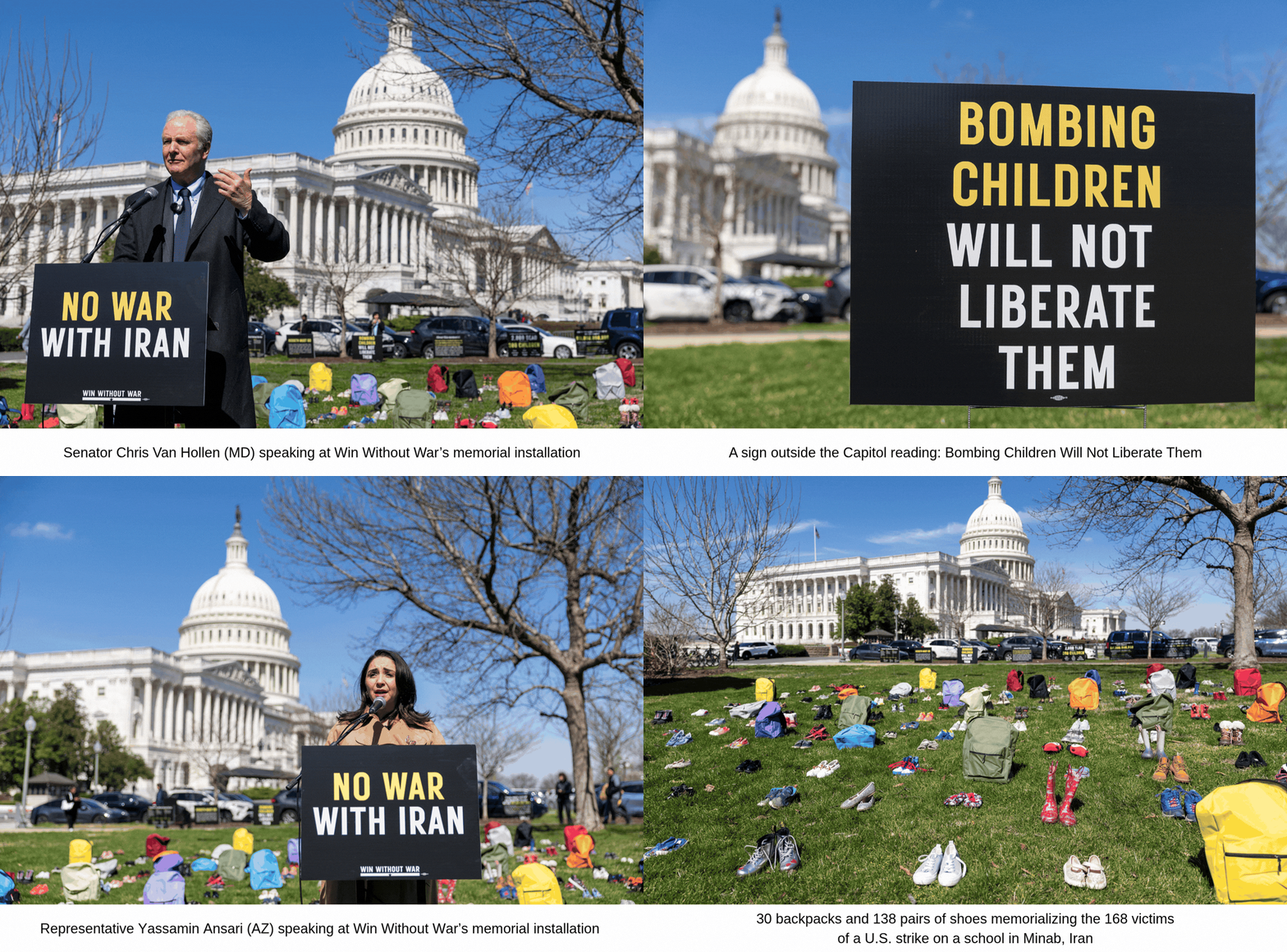
30 backpacks – 138 pairs of shoes – A brutal memory of an illegal and unjust war!

In memory of the USareal bloody attack on the girl school in the Iranean city of Minab!

30 backpacks.

138 pairs of shoes.

A critical moment to honor lives cut short.

On Capitol Hill this week, we memorialized 168 people — children, parents, and teachers — killed by a U.S. airstrike on a school in Iran.

A series of images from our memorial installation in front of the Capitol

On February 28, hours into Trump’s senseless, illegal war against Iran, a U.S. Tomahawk missile hit Shajareh Tayyebeh Elementary School in Minab during morning classes. With over 100 children killed, the strike was one of the deadliest civilian casualty incidents involving U.S. forces in decades.

The Trump administration still hasn’t taken responsibility — first baselessly assigning blame elsewhere. Trump later proclaimed, “I don’t know about that.”

On Wednesday 18th of March, we made sure decision-makers in DC couldn’t look away. To the more than 600 of you who made contributions toward our installation — thank you. This event would not have been possible without your generosity.

Win Without War was grateful to be joined by Sen. Chris Van Hollen and Reps. Jim McGovern, Greg Casar, Delia Ramirez, Yassamin Ansari, Sara Jacobs, Pramila Jayapal, Chuy Garcia, and Maxine Dexter, who each spoke at the memorial, assembled with support from MoveOn Civic Action and the Center for International Policy Advocacy. Click here to watch the event and listen to their remarks.

Rep. Ansari told those gathered, «A devastating and open-ended war without clear objectives will not bring freedom or democracy to the Iranian people. It will only bring more suffering.”

“We must end Trump’s illegal war with Iran and work to ensure safety for U.S. servicemembers and Iranian civilians alike,” Rep. Jayapal added.

The Minab strike is now being linked to outdated targeting data. But it is also the result of this president’s destructive war of choice, which has killed thousands in Iran and across the region, including 13 US servicemembers.

And now, as Trump and Hegseth prepare to ask Congress for $200 billion more to fuel their illegal war and all the suffering and economic catastrophe it’s causing — money that could instead go to things like extending ACA premium subsidies for millions or covering Medicaid for hundreds of thousands of children — we’re demanding not another dime for Trump’s disastrous, unauthorized war.

It means accountability. It requires looking beyond just the facts and figures of war. That starts with remembering and reflecting on the human costs of Trump’s war. Anything less erases our humanity and allows the violence to drive forward.

Together, we continue to reject a status quo that feeds, grows off, and promises more devastating violence — and use our commitment to one another as the foundation to build the more peaceful world we want and deserve.

Remembering that we’re part of a community of hundreds of thousands strong is a huge source of hope and strength. The road ahead is long, but none of us walks alone.

Thank you for working for peace,
The Win Without War team

Posta under Asia, Imperialism, Our global world | Merkt , , , , , , | Kommenter innlegget

The jeopardy of war: Iran and the US economy

Iran and the US economy

The Iran war rages on.  Having failed to repeat his Venezuela option’’ ie decapitating the Iranian leaders and then getting Iran to surrender, US President Trump has been dragged into a long war.  So far, he has opted for escalation, cajoled by his advisers and forced on by unbridled attacks on Iran and Lebanon by Israel.  Strikes by both sides on so-called upstream gas production facilities in recent days are a significant escalation, with potentially long-term consequences. The latest strikes were the first time facilities associated with the production of fossil fuel energy had been hit in the conflict, rather than sites associated more generally with the oil and gas industry.

As I said in my first post at the outbreak of the attack by the US and Israel, that “two things need to happen before oil prices shoot up to $100/b or above. First, there must be significant and prolonged disruption of all traffic through the Strait of Hormuz, given that the Strait carries about one in five barrels of oil in the world. Second, the missile and drone attacks must start hitting oil production installations. If those two factors come into play, then the oil price per barrel could be in triple figures.” 

This has come to pass.  Today, crude oil prices hit $116/b (before falling back to $110) and even worse, natural gas prices in Europe exploded to over €68 per MWh, thus reaching their highest levels in over three years.

The International Energy Agency (IEA) now reckons that the war in the Middle East is “creating the largest supply disruption in the history of the global oil market“. “With crude and oil product flows through the Strait of Hormuz plunging from around 20 mb/d before the war to a trickle currently, limited capacity available to bypass the crucial waterway, and storage filling up, Gulf countries have cut total oil production by at least 10 mb/d. In the absence of a rapid resumption of shipping flows, supply losses are set to increase.”

Global oil supply is projected to plunge by 8 mb/d in March, with curtailments in the Middle East partly offset by higher output from non-OPEC+ producers, Kazakhstan and Russia following disruptions at the start of the year. The loss of energy imports and the rise in prices hits some countries more than others. Asia in particular, suffers, followed by Europe, while, at least for energy, the US economy is relatively least affected.

Indeed, one part of the US economy is benefiting, namely US oil companies.  They stand to receive a windfall of more than $60bn this year if crude prices maintain the levels they have hit since the start of the Iran war. Modelling by investment bank Jefferies estimates American producers will generate an extra $5bn cash flow this month alone following a roughly 47 per cent rise in oil prices since the conflict began.  The capitulation of Venezuela to US control is also enabling US energy companies to raise production and increase sharply revenues from the now highly priced Venezuelan oil exports.

But for the rest of the US economy, the sharp rise in energy prices, whether at the gas stations or in home heating and industry, is already starting to feed through to prices overall.   Even before the war started, US producer prices (ie the prices that manufacturers sell their goods to wholesalers and retailers) were on the rise.  The producer price index (PPI) rose 0.7% in February with fuel and related products up 1.1%.  That meant PPI inflation was up 3.4% from February last year. Inflation in the US was not heading towards the Federal Reserve target of 2% a year, but instead heading back up. 

As for economic growth, the second estimate of US real GDP growth in Q4 2025 was revised down sharply to an annualised 0.7% qoq, well below 1.4% in the advance estimate. The new estimate reflected downward revisions in every component of GDP: exports, consumer spending, government spending, and investment. US real GDP growth for 2025 is now estimated at 2%, down from 2.4% in 2024 and 3.4% in 2023, while per capita real income rose only 1.1% in 2025 and fell in the last quarter of that year.

Slowing growth in national output is now also accompanied by falling employment growth.  In January, the US economy lost 92,000 jobs. Job openings in the professional and business services sector have fallen to just 4.0 per 100 employees, the lowest since the 2020 pandemic slump and down nearly 60% since the peak of white-collar employment in 2022. When white-collar hiring slows this sharply, the rest of the job market usually follows.

Now the Iran war will widen the scissors between slowing economic growth and employment and rising inflation – in other words, stagflation is the order of the day. Donald Trump’s one-time pick to lead the Bureau of Labor Statistics said the US economy is too weak to handle oil at over $100 per barrel: “I don’t think this is an economy that is going to be able to handle $100 a barrel for oil, it’s just not,” EJ Antoni told the FT. “The economy is weaker than we thought it was, and inflation is worse than we thought it was.” New home sales plunged by 17.6% in January, the sharpest decline since 2013. 

This stagflationary environment has thrown the US Federal Reserve into a quandary.  Should the Fed raise its policy interest rate in attempt to curb inflation; or should it lower the rate to support employment and growth?  Yesterday, the Fed decided by a majority on the monetary policy committee to do nothing. The Fed increased its forecast for inflation this year and indicated that only one rate cut was likely in 2026, if at all. Far from heading towards the Fed’s target for inflation of 2%, inflation is now heading back towards 3% or above.  Today, the UK’s Bank of England and the ECB also held their policy rates.

Mainstream economists reckon that what primarily causes inflation is a rise in ‘inflation expectations’, a behavioural theory that this blog has refuted several times.  Five-year, five-year forward inflation expectations have not moved much in the last five years. Rising inflation had mainly a supply-side cause in the post-pandemic period and it will be the same this time.

The impact of the war is intensifying the widening gap between the rich elite in the US and the rest of American households – a gap that mainstream economists have called a ‘K-shaped’’ economy.  Spending growth has been notably faster at the top end of the income spectrum, while consumers at the bottom, who saw a brief burst of high wage growth post-pandemic, are now seeing wage growth slow.

Forbes magazine just released its latest annual ranking of global billionaires. The pace at which extreme wealth is rising is simply staggering.  According to inequality expert, Gabriel Zucman, the wealth of global billionaires has now reached the equivalent of 17% of world GDP.

The Iran war is also exposing new risks to the US economy that could trigger a financial crash. The 2008 global financial crash was not caused by high public debt, as many mainstream economists continually argue.  On the contrary, it was the meltdown in private sector debt that led to bailouts by government and then the rise in public debt followed.  In 2026, a private debt meltdown is again the danger. The recent report by an obscure financial analyst group, Citrini Research, on the future impact of AI caused a stock market sell-off in software companies before financial investors decided that there would be no crash in that sector.

However, what has become an issue is the possibility of defaults and bankruptcies in firms that have borrowed money, not from the traditional commercial banks, but instead from what are called private credit sources. In the past two decades, direct lending by private funds has become a crucial strand of the US financial system, providing credit to start-ups and other companies that would struggle to get bank loans or sell bonds. A classic private credit fund takes money from pension funds and endowments and locks it up for five years or more. That allows these private funds to make long-term loans to companies without fear that their investors will want their money back.  

But some of the big boys in private finance decided to attract pension funds and others to invest by offering “semi-liquid” funds, which promised investors quarterly access to their money, with the caveat that withdrawals could be capped at 5 per cent of fund assets to avoid fire sales.  These ‘financial products’ were a hit, attracting nearly $200bn investment and growing 60 per cent annually between 2021 and last year.

But these private credit funds are not regulated like commercial bank lending, so there is an inherent risk involved, just as there was with sub-prime mortgage lending in the financial crash of 2007-8.  It’s true that the size of the private credit market is relatively small compared to the total US loans market. Also, private credit funds are highly capitalised, with equity typically accounting for 65-80% of total assets more than six times the capitalisation of the banks, where equity represents about 10%.  As a result, the Fed’s 2025 stress tests found that even under severe recession scenarios, private credit would not threaten financial stability. Across the full spectrum of US credit markets, private credit has only a modest share of total credit outstanding.

So there’s nothing to worry about? That is what they said about the mortgage companies that lent wildly in 2008.  Small cogs that clog up can also cause blockages for large cogs. As the US economy slowed, the private credit default rate (ie companies borrowing from private credit funds) has hit 9.2%. That’s higher than the 2008 bank loan default rate.

UBS says private credit defaults could hit 15%. That’s three times the peak bank loan default rate in 2008.

As a result, investors in private credit funds are trying to get out. And while most private credit funds have rules that limit quarterly redemptions to 5 per cent of assets — enabling them to “gate” (ie prevent) excess outflows — the exodus already echoes 2008.

Moreover, private credit and commercial banks are closely connected. “Banks are lenders, counter parties, service providers and, at times, backstops to non-bank entities,” observes Hernández de Cos, lamenting the “complex ecosystems of leverage, liquidity transformations and duration risk” beyond regulators’ control, which makes private credit a potential channel of systemic risk. US banks have $300 billion in exposure to private credit: Wells Fargo leads with $60 billion in loans to private credit funds. JPMorgan, which recently marked down software-linked loans and curbed lending, has $22 billion in exposure.

Goldman Sachs estimates that up to $70bn could flow out of private credit funds in the next two years and force the worst-hit managers to sell loans to meet redemption requests. And the longer the Middle East turmoil grinds on, the more risks will rise. Or to put it another way: the Iran war-private credit combination may not seem damaging enough to cause a global recession, but it could certainly spark a financial crash.

But maybe the AI technology boom will come to the aid of the US economy.  Some are arguing that already the US productivity of labour is rising faster as a result of the adoption of AI models and AI agents in companies.  In 2025, US labour productivity rose 2.8% compared to 2.3% in 2024, above the long-term historic average and above consensus forecasts.

Labour productivity is calculated as real GDP divided by hours worked. This can vary with changes in technology and in the amount of capital per worker.  But mainstream economists also look at total factor productivity (TFP), which is a measure of the growth in productivity not accounted for by increased capital investment or labour intensity. That is also picking up.

Everything depends on how quickly companies and their employees adopt AI models in their work and how far that spreads through the economy.  The St Louis Fed economists reckon that workers who used AI models could save 5.4% of their work hours, or 2.2 hours a week. But a 2024 working paper by Kathryn Bonney and others found that only 5.4% of firms had formally adopted generative AI as of February 2024.  That suggests that worker adoption remains mostly informal and won’t appear in productivity statistics. 

In a paper, Jed Kolko reviewed recent research on AI and its impact on the US labour market.  He concluded that “early research findings on AI’s impact on the labor market are inconclusive, weak signals about the future, and only one part of the AI research landscape.  And that “the commercial diffusion of the current generation of large language models (LLMs) is so recent that any lasting economic impact would likely take years to show up in employment, output, or productivity data.“

Current data from the Census Bureau’s Business Trends and Outlook Survey shows that fewer than one-fifth of firms are using AI in any capacity, and even fewer are using AI directly for producing goods and services. Indeed, the “transitional disruption from AI to date is not outpacing recent technological changes.” The occupational mix has changed over the past three years at a similar pace to the years after the start of the commercial computer era (1984) and the commercial Internet era (1996) and has not accelerated since the release of ChatGPT.

So the hoped for productivity gains from shedding human labour and replacing it with AI agents still seem some time away.  Meanwhile, the huge investment bubble in AI could soon burst.  Take the leader in AI, OpenAI. It is a $730 billion company in invested assets, but last year it generated just $13.1 billion in revenue, losing $8 billion in doing so. This year, the losses could hit $14 billion, with cumulative losses reaching $143 billion by 2029!  These projected losses are five times greater than Uber accumulated before making a profit. OpenAI claims it will be profitable by 2029, but its AI model ChatGPT’s web traffic share has dropped from 86.7% to 64.5% in the last 12 months as Google’s Gemini eats into its market share. And the cheap Chinese DeepSeek can match the performance of ChatGPT at just 1/30th of the cost.

OpenAI needs 1.2bn paying subscribers to make a profit by 2029. That does not seem likely. OpenAI hopes to keep the loans and equity investments coming because it claims it can soon achieve an AI model that is super-intelligent, reasoning on its own at a superior level to the human brain. This is the AI companies’ ‘holy grail’, the moment of total enlightenment.  But the holy grail was just 19th century fiction. 

As Ruchir Sharma put it back last October, “America is now one big bet on AI“. It’s seen as the magic fix for every threat to the US economy.  But can it deliver?  More likely, there will be an AI financial bust first and possibly a recession before that question will be answered.  So AI as the saviour for Trump and the US economy remains an each-way bet.

From Michael Roberts blog – March 19, 2026

Related

Iran and the impact on the global economy March 2, 2026In «marxism»

Trump’s Hobson’s choice March 12, 2026In «marxism»

Iran’s misery June 21, 2025In «marxism»

Posta under Capitalism, Marxism, Midt-Austen, Our global world | Merkt , , , , , , , , , , , | Kommenter innlegget

The important Palestinian historian, Walid Khalidi, in memory!

Walid Khalidi, historian of the Palestinian cause, dies aged 100

Khalidi, a leading scholar of the Nakba and co-founder of the Institute for Palestine Studies, died in the US on Sunday, 8. March.

Listen to this article | 6 mins

Walid Khalidi gives lecture, "Palestine and Palestine Studies, One Century since the First World War and the Balfour Declaration," on 6th March 2014 at the Centre for Palestine Studies, SOAS, University of London
Walid Khalidi gives a lecture, «Palestine and Palestine Studies, One Century since the First World War and the Balfour Declaration», on March 6, 2014 at the Centre for Palestine Studies, SOAS, University of London [SOAS University of London]

By Nils Adler – aljazeera.com

Walid Khalidi, the venerated Palestinian historian whose research helped document the Nakba and shaped generations of scholarship on Palestine, has died aged 100.

Khalidi, dubbed “the historian of the Palestinian cause”, passed away on Sunday in Massachusetts in the United States, according to an obituary issued by the Institute for Palestine Studies (IPS) – the research centre that he co-founded in 1963.

Following the news, tributes from scholars, diplomats and Palestinian officials flooded social media, with Husam Zomlot, the Palestinian ambassador to the United Kingdom, calling Khalidi “a national treasure, a guardian of memory, and a mentor to generations” in a post on X.

Born in Jerusalem in 1925 into a prominent intellectual family, Khalidi received his early education in Ramallah before attending St George’s School in Jerusalem.

He later graduated from the University of Oxford in 1951 and went on to enjoy an illustrious academic career, teaching political studies at the American University of Beirut until 1982, before becoming a research fellow at Harvard University’s Center for International Affairs.

Chronicling the Nakba

Khalidi was perhaps best known for his meticulous documentation of the destruction of Palestinian villages during the Nakba (“catastrophe”), the ethnic cleansing of Palestine by Zionist militias in 1948.

His landmark book All That Remains, published in 1992, catalogued how more than 400 Palestinian villages were destroyed or depopulated during the first Arab-Israeli war and combined historical research, maps and testimonies to reconstruct the lives of communities that had disappeared.

The IPS described Khalidi as a “pioneer in uncovering many long-concealed features that explained how the Zionist movement succeeded in occupying Palestine in 1948”, adding that in the 1960s, he was the first to reveal “its master plan for the occupation of Palestine and the expulsion of its people, known as ‘Plan Dalet’”.

Another major work by Khalidi, Before Their Diaspora, used archival photographs to document Palestinian society before 1948, offering a rare visual record of daily life in cities and villages across the country.

INTERACTIVE - Israel Palestine land Nakba 1948-1720674812
(Al Jazeera)

Academic and diplomatic roles

After a period teaching at Oxford, Khalidi spent decades at the American University of Beirut, and co-founded the Institute for Palestine Studies, which grew into one of the leading research organisations dedicated to Palestinian history, politics, and society.

Khalidi later served as a research fellow at Harvard’s Center for International Affairs, lectured at institutions including Princeton University in the US, and was elected a fellow of the American Academy of Arts and Sciences.

Beyond academia, he also played a role in Palestinian diplomacy.

After the 1967 war, which later became known as the Naksa, in which Israel seized the West Bank, East Jerusalem, Gaza, the Syrian Golan Heights and Egypt’s Sinai Peninsula, Khalidi moved towards diplomacy.

He served as an adviser to the Iraqi delegation to the United Nations, later joined an Arab Summit delegation to the British government in 1983, and, in the mid-1980s, served as a special adviser to the Arab League secretary-general.

He was also part of the joint Jordanian-Palestinian delegation to the 1991 Madrid peace conference.

Khalidi was a proponent of a two-state solution, writing in Foreign Affairs in 1988 that a Palestinian state within the 1967 borders in “peaceful coexistence alongside Israel” was “the only conceptual candidate for a historical compromise of this century-old conflict”.

Khalidi is ‘synonymous with his beloved homeland’

Tributes from Palestinian officials and scholars highlighted Khalidi’s role in shaping the historical understanding of Palestine.

Khalil Jahshan, the executive director of the Arab Center Washington DC, said in a post on X  that Khalidi’s name was “synonymous with his beloved homeland, Palestine” as he offered  “heartfelt condolences to his family, to the people of Palestine, and to all who knew him”.

The Institute for Palestine Studies described Khalidi as one of the most prominent historians of Palestine and said his work helped build the foundation for modern scholarship on Palestine.

Jehad Abusalim, policy analyst and author of Light in Gaza, wrote on X that Khalidi had “dedicated his life to preserving Palestinian history”, adding that “his scholarship and research are a foundation that generations will continue to build on”.

For many historians, Khalidi’s legacy lies not only in his own scholarship, but also in the institutions he helped build and the generations of students and researchers he mentored.

At a time when much of Palestine’s historical record risked being scattered or lost, Khalidi devoted his career to documenting it.

His work ensured that the history of Palestinian society before and after 1948 would remain part of the global historical record.

RECOMMENDED STORIES

list of 4 items

Posta under Imperialism, Midt-Austen, Palestina | Merkt , , , , , , | Kommenter innlegget

Appell om olje-strupetaket på Cuba

STRYPETAKET PÅ CUBA

7. mars i eit møte med 17 høgreekstreme latin-amerikanske og karibiske statsoverhovud sa Trump (i den nye reaksjonære klubben sin, der ingen venstrestyrte land var invitert) at no må dei gjera noko med Cuba. No står Cuba for tur. Han sa at «utanriksminister Rubio kunne ta seg litt tid frå Iran-krigen så han kunne ordne opp I dette». USA har i lengre tid stoppa all oljetilførsel til Cuba og prøver no å strype landet økonomisk og politisk. Men det som er endå verre er at dei også stopper andre land som vil frakte olje til øya. Og som vanleg med USA-imperialismen er det veldig brutalt dette. Det er verkeleg ein krig utan bomber. Så langt.

Dette er ein kjend USA-politikk kor dei prøver å lage situasjonen så vanskeleg som mogleg for å få regjeringar til å falle. Det er mange eksemplar i imperialismen si historie der statar, og spesielt USA, prøver å gjera det så ille at folk skal gjere opprør. Slik som ein såg teikn på i protestane på Cuba, sommaren 2021. Men, yankiane lukkast ikkje då, ikkje alltid andre gonger heller. MEN, då brukar dei kanodiplomatiet med trugsmål om invasjon. Om ikkje det hjelper heller, så invaderar dei eller aller best hjelper til med eit militærkupp. Som yankiane så veldig mange gonger før har gjort, i mykje over 100 år. (snart vert det vel feiring av eit rundt årstal for invasjonane sin barndom. I den nye ballsalen til Trump, vis han vert ferdig, då.)

ER DET NOKON HER SOM TVILAR PÅ USA SOM VERDAS FARLEGASTE STAT? DEI SLÅR ALLE ANDRE IMPERIFORSØK I HISTORIA NED I JERNSTØVLANE MED SIN BRUTALITET I OVER  150 ÅR. DEI MÅ STOPPAST!

Trump og hans høgreekstreme krigshaukar fekk «applaus» frå dei høgreekstreme regjeringsvenene sine i fleire latin-amerikanske land, og ei nobelprisvinnar,  då Det kvite hus-mafiaen 3. Januar bortførte Venezuela sin president Nicolas Maduro og kona Cilia Flores. Eit soleklart brot på Folkeretten og internasjonal rettsorden. Reglane er slik Mr. Trump: Ein driv ikkje å bortfører andre lands statsleiarar. OG., ein trugar ikkje land som fraktar olje til land ein ikkje likar. Det er forbod mot det, forstår du, nedskrive i traktatar som eigentleg FNs sikkerhetsråd skal verne om.  Men, DET GJEV JO DE FAEN I!

– Vil den norske regjering stadfeste klart at denne oljeembargoen og øvrige sanksjonar mot Cuba er brot på Folkeretten og internasjonal lov og rett? Og i tilfelle militær inngripen, fordøme det med sterkast mogleg kraft? Då vil me borgarar ha sanksjonar mot, ja, nettopp USA!

Cuba har vore i ein desperat situasjon i fleire år, ein indikator på det er at den ei gong så låge barnedødlegheita er tredobla, og at rundt 20 prosent av befolkninga har utvandra sidan 2019. 

Dette skuldast DEI HARDE ØKONOMISKE SANKSJONANE, dei har vore der i 65 år! Med opptrappingar av blokaden under Trumps første OG andre regjering, og Bidens motvilje mot å fjerne dei nye restriksjonane OG alle, i sin periode. Det er hovudårsaka til Cubas skjebne!.

Cuba brukar olje til å lage straum til nesten heile landet, og dei bruker det til omlag all transport. 

Når Trump nå hindrar olje i å komme inn i landet, og Cuba berre klarar å produsera nok olje sjølv til å dekke 1/3 av sitt behov, rammar det absolutt alle sider av livet. Det er straumbrot i lange periodar. Landet strypast sakte men sikkert og det cubanske folk lir.

Me håpar regjeringa ser med største alvor på situasjonen på Cuba, som vert verre dag for dag. Når sjukehusa ikkje lenger kan ta seg av den mest basiske helsehjelp, ja, då er det ille!

Me i LAG-Bergen og tilslutta organisasjonar krev:

-at Noregs regjering må fordømme USAs oljeblokade.

-at Noreg må sende olje til Cuba. Noreg har både råd og kapasitet til det.

-at Noreg må sende humanitær hjelp og støtte til energiuavhengigheit, f.eks. solcellepanel.

Ignorering av internasjonal lov og rett, slik USA no gjer, kan påverke oss alle.

Dette er farlege tendensar også globalt sett, skal dette verte internasjonal praksis, så vert det ei verd me ikkje på nokon som helst vis ønskjer å leva i. Me ser det for alvor i Iran-krigen no.

Slike grove brot på internasjonal lov og rett må me som borgarar, OG regjering, reagera og handle sterkt mot!

STOPP TRUMP – LEVE CUBA!

STOP TRUMP – VIVA CUBA!

LA LUCHA PARA SIEMPRE! VINCEREMOS!

Ivar Tveito Jørdre (Appell halde på Cuba-markering, mot USAs oljeembargo), Vågsallmenningen, 14. mars


Tekst til markeringa på sosiale media:

Siden Fidel Castros revolusjon på Cuba i 1959, har USA forsøkt å skape regimeskifte. En hovedmetode har vært økonomisk krigføring som rammer Cubas handel – både med USA og tredjeland.

Trump-administrasjonen har nå tatt politikken til et nytt og grotesk nivå. USA har siden desember aktivt stoppet oljeleveranser til Cuba og siden januar truet alle land som leverer olje. I et allerede svært fattig land som bruker olje til både transport og strøm, er dette i ferd med å skape en humanitær katastrofe.

Oppå en allerede tøff økonomisk og politisk situasjon, rammer oljeblokaden alle sektorer av økonomien.

Det finnes nå knapt medisiner, og barnedødeligheten skyter i været. Søppelet blir ikke hentet inn, noe som fører til epidemier. Folk flest opplever dagslange strømbrudd, leveransen av vann stopper, og maten råtner uten kjøleskap. Mange eldre sitter i mørklagte boliger uten mulighet til å komme seg noe sted, og noen frykter for at dette er opptakten til en krig. FN sier at situasjonen blir verre dag for dag.

Vi vet at bergensere flest sier nei til kollektiv avstraffelse og utsulting av sivile for politiske mål. 

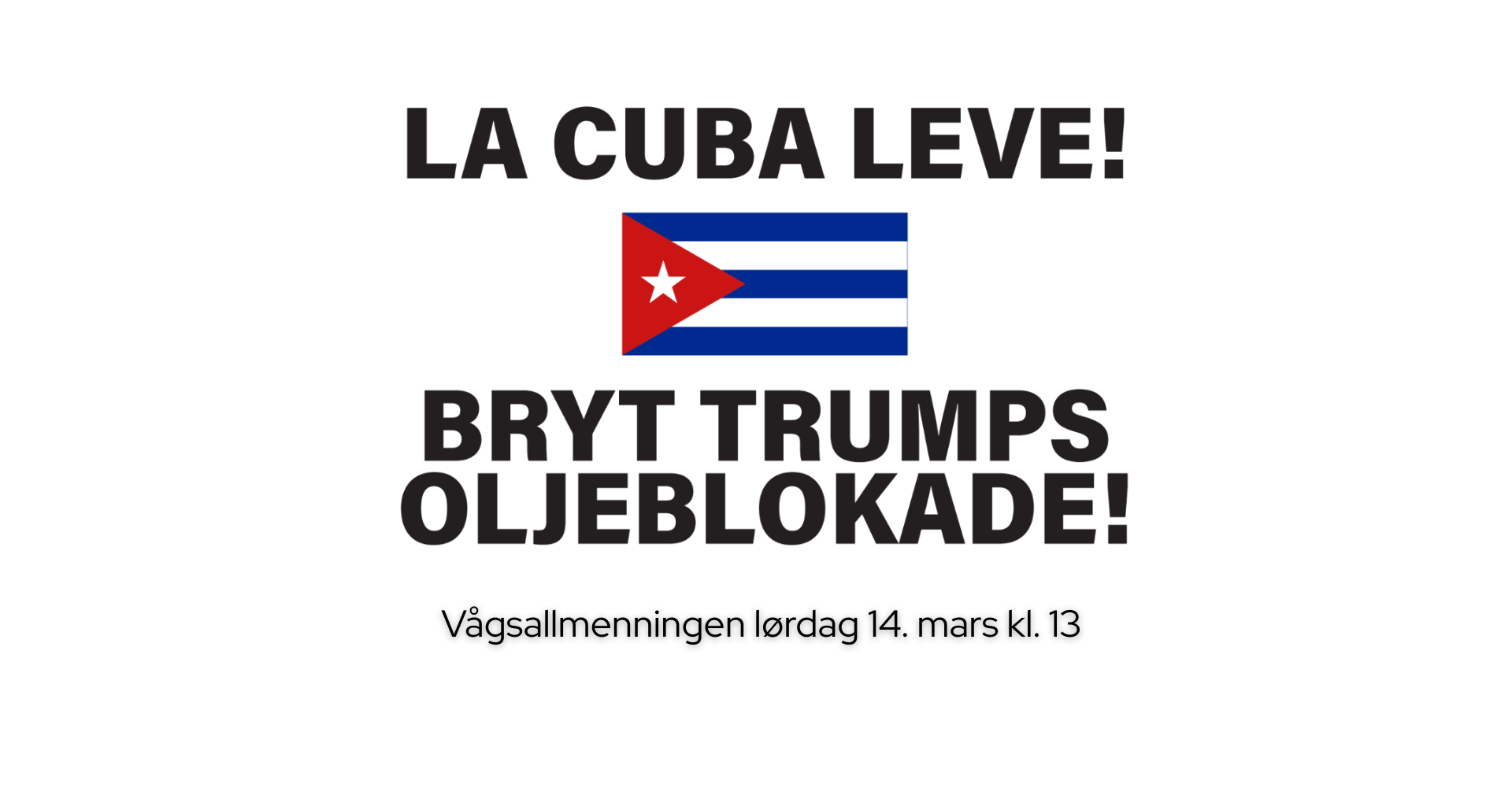
Vi inviterer derfor deg til markeringen La Cuba Leve på Vågsallmenningen lørdag 14. mars klokka 13. 

Paroler:

■ Norges regjering må fordømme Trumps oljeblokade.

■ Norge må sende olje til Cuba.

■ Norge må sende humanitær hjelp og støtte til energiuavhengighet, f.eks. solcellepanel.

Arrangører:

Latin-Amerikagruppen i Bergen
Rødt Bergen
Norsk Folkehjelp i Bergen
Antikrigsinitiativet i Bergen
Internasjonal kvinneliga for fred og frihet
NKP Vestland
Bergen Rød Ungdom

Posta under Politikk, samfunn | Merkt , , , , , | Kommenter innlegget

The blatant lies of the Iran War by Israel and US

Debunking the lies of the Iran War

The U.S.-Israeli war on Iran has been built on lies. Here is the truth about Iran’s nuclear weapons program, the claim that Iran was an imminent threat, and the lie that Trump has a plan for what happens next.

BY MITCHELL PLITNICK  MARCH 4, 2026 – mondoweiss.net

When the United States invaded Iraq in 2003, many of us knew, and argued loudly, that the American public was being lied to. We knew that Iraq had no weapons of mass destruction and could back up our claims. The war went ahead anyway, but eventually, the lies were exposed. 

Rather than build up support for his illegal and immoral war on Iran, as George W. Bush did nearly a quarter century ago, Donald Trump elected to simply ignore public opinion and start the war on his own. But, while Trump has his war and is not likely to be stopped by domestic forces until the war runs its course, he has found a need to justify his criminal actions.

As is their way, Trump and his minions simply lie. They’re not convincing many people, as polling shows that only about one in four Americans supports the Israeli-American attack on Iran. 

This time, the lies are coming in true Trumpian fashion: they are inconsistent, contradictory, and confusing, meant more to overwhelm the audience than to convince it. But we shouldn’t be complacent about these lies. They have a way of both framing the debate and taking on a life of their own over time. 

It’s important to examine some of these lies, and we should start with the biggest one.

The “Iran nuclear weapons program” lie

Over and over, we hear about the threat of an Iranian nuclear weapon. But rare indeed are the arguments for why this should be considered a casus belli when all reliable intelligence assessments have agreed that Iran has not pursued a nuclear weapon since 2003. 

That assessment never wavered and never changed. It remains in place today. In the United States, it was reinforced by Donald Trump’s own intelligence services, collectively, just last year. 

Moreover, while Trump’s endless boasting about having “obliterated” Iran’s nuclear program was always a lie, it is undeniable that significant damage was done to Iran’s key nuclear facilities last year. Yet we are somehow meant to believe that Iran’s nuclear potential is a threat, a mere eight months later.

The issue of a nuclear weapon has been a chimera from the start. Unfortunately, it was also manipulated by Iran at times. Having little real leverage against the United States, either militarily or diplomatically, Iran would sometimes turn to nuclear enrichment to try to get leverage in its efforts to either confront the West or press for sanctions relief.

That was a dubious strategy, even if it was understandable under the circumstances, as it gives the United States all it needs to falsely characterize Iran’s nuclear program as an effort to acquire a nuclear weapon. Iran would also, from time to time, diminish or even suspend cooperation with the International Atomic Energy Agency (IAEA). This, too, was an understandable strategy under the circumstances, but it had the same effect of creating evidence for arguments about the covert and dangerous nature of Iran’s nuclear program.

These tactics have been part of Iran’s game plan for 20 years. It’s not often discussed in those terms in the West, but it’s well understood in most governments and, coupled with the consistent intelligence assessments, makes it clear that Iran has not been in pursuit of a nuclear weapon. Whether Donald Trump can grasp this is, of course, an open question. 

Yet when presented with a deal they perceive as in their interests, Iran has shown remarkable flexibility. The 2015 JCPOA, often called the Iran Nuclear Deal, provided for far more intrusive inspections than any country has ever been forced to undergo. Iran agreed and upheld its part of the bargain, despite the fact that the United States—which had agreed not only to lift certain nuclear-related sanctions but also to encourage investment in Iran to help its economy recover—had been actively discouraging economic support for Iran’s recovery. And despite the fact that its main regional adversary, Israel, had its own secret, undeclared, and unmonitored nuclear weapons stockpile of dozens, perhaps hundreds, of warheads. 

This time, Iran agreed not only to IAEA inspections that were at least as intrusive, it also agreed not to stockpile enriched uranium. That means they would enrich only what they needed for their civilian use, and any excess would be handed over to whomever the IAEA agreed to send it to. 

That’s what the Omani foreign minister announced to the world the day before Israel and the United States launched their attack on Iran. Given how closed-mouth Oman is in general and how close to the chest they have always kept information during all the negotiations they have mediated, this declaration was unprecedented. That he made that statement indicates he knew the attack was coming and hoped to thwart it. Sadly, he failed because neither Israel nor the Trump administration cares about being embarrassed by being caught in an outright lie. 

The nuclear lie is the root of all of this, but many other lies are a part of the picture. 

The “imminent threat” lie

The Trump administration has argued that there was an imminent threat to U.S. troops in the region. When Secretary of State and National Security Adviser Marco Rubio was asked to detail the threat, he said that, “It was abundantly clear that if Iran came under attack by anyone, … they were going to respond and respond against the United States. If we stood and waited for that attack to come first, before we hit them, we would suffer much higher casualties. We knew that there was going to be an Israeli action, we knew that that would precipitate an attack against American forces.”

So, Rubio is arguing that we had to attack Iran because otherwise Israel, beyond our control, was going to attack Iran and precipitate an attack on U.S. troops in the region. That, he argued, was the “imminent threat.”

The circular reasoning here is fallacious to the point that one would think it was spoken by a kindergartener. 

There can’t be an imminent threat spurred by something you yourself have control of. 

Moreover, just last June, we saw Trump literally force Israeli warplanes to reverse course mid-flight. He is more than capable of stopping an Israeli attack before one happens. Netanyahu would not dare spit in Trump’s face in that manner. 

The U.S. was well aware that Iran had no plans to attack it. On Sunday, the Pentagon revealed, in a congressional briefing, that there was no intelligence in American possession whatsoever that indicated Iran was planning an attack. There simply was no imminent threat.

The “underground missiles” lie

“They’re totally fanatic about this, about the goal of destroying America. So they started building new sites, new places, underground bunkers that would make their ballistic missile programs and their atomic bomb programs immune within months if no action was taken.”

That was Netanyahu spelling out his cover story for this war of choice. This is a different kind of lie: it’s not exactly false, but it is decontextualized and deeply misleading. 

Iran was reinforcing its underground facilities. This is only sensible. They had been attacked in June by two nuclear powers, both of which are militarily much stronger, especially in terms of air power, than Iran. 

Iran was obviously aware that their nuclear facilities and ballistic missile stock and program were the main targets. Building underground facilities for the nuclear program and missiles is simply good sense, and absolutely Iran’s right. Further, all the United States had to do regarding the nuclear program was strike an agreement with Iran, and the IAEA would have had full access to the underground nuclear facilities.

Again, the idea that this justifies an unprovoked attack is absurd and well outside what is permissible under international law.

The Pahlavi lie

I’m using Reza Pahlavi, the son of the long-deposed Shah of Iran, as a marker for the general lack of any vision of what happens as a result of this criminal attack.

For Israel, this question is less pressing. While an Iran that looks like Syria or Libya would mean considerably less security for Israeli citizens, that is not a bad thing from Netanyahu’s point of view. His brand of demagoguery literally feeds off the fear of the citizens he rules, and threats only enhance his ability to eliminate the democracy that exists for Jews in Israel. 

For the U.S., it’s a more pressing matter, yet one they apparently haven’t thought through. 

They seem initially to have believed that Pahlavi could be brought in to lead Iran in place of the Islamic Republic, although Trump has expressed his lack of confidence in Pahlavi. He offered flowery words about being a stopgap leader who was simply going to usher in a new, pro-Western, pro-Israel, Iranian democracy.

But let’s recall who Pahlavi is. His father, Mohammad Reza Pahlavi was a brutal dictator, reinstalled by the United States in 1953 after the democratically elected prime minister, Mohammad Mosaddegh, was ousted in a CIA-backed coup.

Pahlavi himself lived in exile from the time his father was ousted, and after his father’s death, he named himself the new king of Iran. In 1982, Pahlavi was part of a plot, backed by the U.S. and Israel, to launch a coup in Iran, but it was abandoned when the Israeli leadership changed and the new prime minister, Yitzhak Shamir, thought the venture unwise. There are other instances like this in his history.

Pahlavi denies being connected to Israel or to American intelligence, but that is hardly credible. He is the son of a monarch, and his calls for democracy, given his history, ring hollow. More to the point, while there are some who have called his name during protests, Pahlavi, like other exiled Iranian figures and groups, has no coordinated support within Iran.

The Trump administration is currently encouraging Kurdish and other ethnic militias to help overthrow the Islamic Republic government, but the efforts have thus far been met with skepticism. That’s not surprising given the American history of abandoning such people after they rise up, reinforced only recently during the protests in Iran. 

The truth is, the United States has no idea what will happen if the Iranian government does fall. They are killing one leader after another, thinking they will eventually find someone who will work with the U.S. as Delcy Rodriguez has in Venezuela. I’m aware of no one who actually studies Iran who thinks that is going to happen. It’s even less likely now that he’s killed most of the people he thought might fit that bill. 

Deception is the main characteristic of American planning here, and one aspect of that is self-deception. Trump has allowed Netanyahu to convince him to engage in this foolish and reckless endeavor. It says much that none of Trump’s predecessors, going all the way back to the days of Ronald Reagan, were this stupid.

Make no mistake, this is an American war, even as it fulfills Netanyahu’s dearest and oldest dream. Trump was not forced or even tricked into this. He, and others on his staff (chiefly Marco Rubio) are flush with their apparent success in Venezuela, and Trump has visions of going down in history as the man who eliminated the hated Islamic Republic, a target of widespread, bipartisan American scorn since 1979.

There was never any possibility of a diplomatic resolution, as evidenced by what Iran offered just before Israel struck the first blow. For both Israel and the Trump administration, this war is rooted in the deep desire to eliminate the one country that has defied American and Israeli hegemony for years. The threat of a nuclear weapon is a lie, the concern about Iran’s quite abysmal human rights record is a complete sham. 

It’s a war of choice, built on lies. We’ve been here before, two decades ago. Most Americans learned a lesson from that, which is why so few support this calamity. Unfortunately, the ones making the decisions are among the few who learned nothing. 

Free speech is under attack—especially when it comes to Palestine.

From the censorship of student voices to the assassinations of journalists in Gaza, the cost of telling the truth about Palestine has never been higher. At Mondoweiss, we publish fearless reporting and critical analysis that others won’t touch—because we believe the public needs to know the truth about Palestine.

We’re funded by readers who believe in justice, transparency, and freedom of the press.

If you believe journalism should challenge power—not serve it—please make a donation today.Suport Journalism for Justice today

 ?Take future action with a single click.
Log in or  Sign up for FastAction

Posta under Politikk, samfunn | Merkt , , , , , , , | Kommenter innlegget

The Trump administration’s lies about reasons for war

What the Trump administration says about why it went to war with Iran

MARCH 7, 2026 – npr.org

franco

Franco Ordoñez

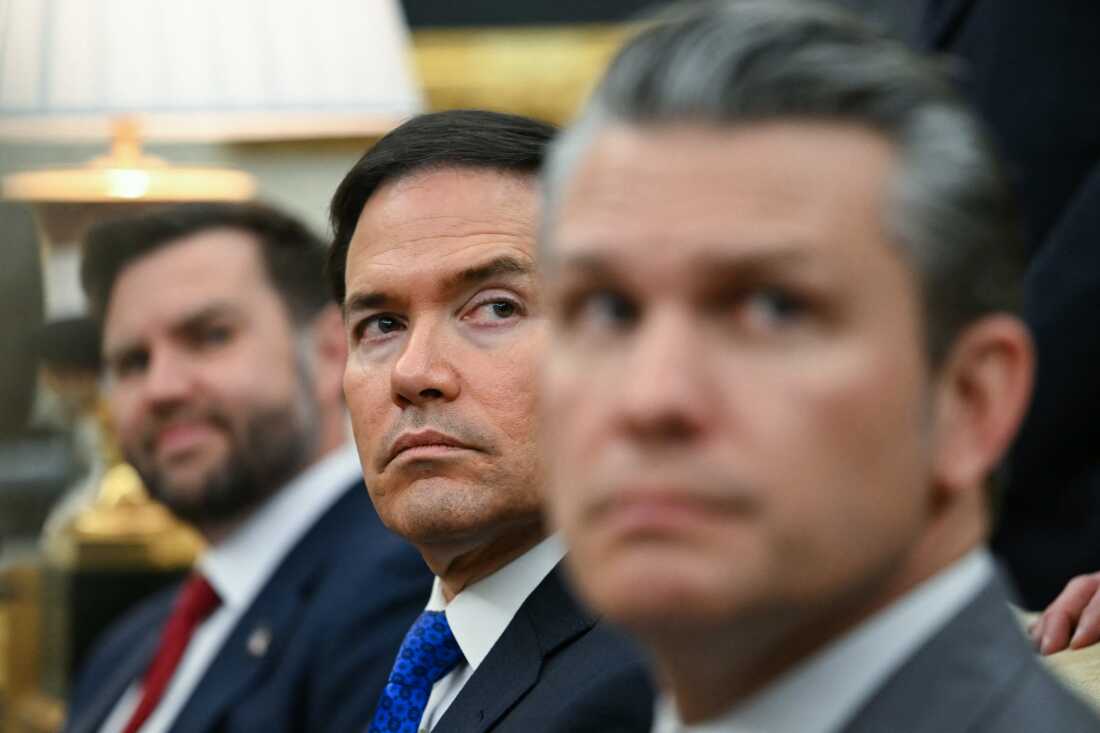
Vice President Vance, Secretary of State Marco Rubio and Defense Secretary Pete Hegseth look on as President Trump meets with German Chancellor Friedrich Merz in the White House on March 3.

Vice President Vance, Secretary of State Marco Rubio and Defense Secretary Pete Hegseth look on as President Trump meets with German Chancellor Friedrich Merz in the White House on March 3.

Andrew Caballero-Reynolds/AFP via Getty Images

Stay up to date with our Politics newsletter, sent weekly.


The Trump administration says it is «laser focused» and mission driven in its attacks on Iran, but messaging from President Trump, Secretary of State Marco Rubio and Defense Secretary Pete Hegseth has been varied. The wide range of motivations they have cited for why they attacked Iran now are sometimes at odds with each other and far from precise.

Here’s a look at what the administration says about why it launched strikes on Iran and where the conflict goes from here:

«The United States of America will come to their rescue»

«If Iran sho[o]ts and violently kills peaceful protesters, which is their custom, the United States of America will come to their rescue. We are locked and loaded and ready to go.» — President Trump in a Jan. 2 Truth Social post

In early January, Trump threatened taking military action if Iran continued to kill demonstrators during historic protests against the regime. A couple of weeks later, Trump followed up, urging demonstrators to «keep protesting» and adding, «Help is on its way.»

But the regime continued to kill protesters in mass numbers, which many international observers saw as crossing Trump’s red line and adding pressure on him to strike.

Days after launching initial strikes on Feb. 28, Trump again pointed to the number of protesters killed as rationale for going to war. But when pressed to clarify the imminent threats for taking action, the White House has not mentioned protesters among the top reasons for striking when it did.

«Something had to be done»

«Something had to be done, and it’s been 47 years. They’ve been killing people all over the world for a long time. They were the kings and fathers of the roadside bomb.» — President Trump during a bilateral meeting with German Chancellor Friedrich Merz on March 3

When announcing the beginning of strikes, Trump vowed that Iran’s network of proxy groups that fight across the region must be stopped. Iran has long supported the loose group of armed forces known as the Axis of Resistance. Iran has provided military and financial support to Hamas, Hezbollah and the Houthis.

Hezbollah has already hit back, striking Israeli forces. That led to Israel sending troops across the border while bombing the Lebanese capital.

Hezbollah and Hamas have been weakened over the past year due to fighting with Israel, but the attacks and the killing of Iran’s supreme leader have the potential to inspire more activity by the groups.

«You would have had a nuclear war» — or would we?

«If we don’t stop them or if we didn’t stop them or if we didn’t start — they’ve been decimated — but if we didn’t do what we’re doing right now, you would have had a nuclear war and they would have taken out many countries.» — President Trump during a bilateral meeting with German Chancellor Friedrich Merz on March 3

Trump has claimed that the U.S. strikes in June on three of Iran’s key nuclear sites, including one called Fordo, built deep inside a mountain, rendered them «completely and totally obliterated.»

Days later in June, a U.S. official who was not authorized to speak publicly said intelligence assessments showed that the strikes set Iran’s nuclear enrichment program back merely «a few months.»

On Wednesday, Trump again said the program was obliterated but immediately followed up by saying that Iran would have had a nuclear weapon in two weeks if the U.S. hadn’t struck.

«Missiles capable of reaching our beautiful America»

«The regime already had missiles capable of hitting Europe and our bases, both local and overseas, and would soon have had missiles capable of reaching our beautiful America.» — President Trump defending the U.S. military operation on March 2 before awarding the Medal of Honor to three soldiers
One of the more consistent rationales the White House has given for launching strikes is that Iran was threatening U.S. forces and allies in the region with its growing ballistic missile program. But Trump took it a step further by saying that Tehran would «soon» be able to hit targets in the U.S. with ballistic missiles.

But that claim is not backed up by any public U.S. intelligence reports. The Defense Intelligence Agency reported last spring that Iran would not be able to develop a long-range missile by 2035.

Defense Secretary Pete Hegseth also charged Tehran with working to further fortify its nuclear capabilities against a strike. He said Iran was building missiles and drones to create a «conventional shield» for its nuclear weapon ambitions.

«We knew that there was going to be an Israeli action»

«The president made the very wise decision. We knew that there was going to be an Israeli action. We knew that that would precipitate an attack against American forces, and we knew that if we didn’t preemptively go after them before they launched those attacks, we would suffer higher casualties.» — Secretary of State Marco Rubio to reporters on Capitol Hill on March 2

Those comments led to widespread criticism, including from supporters on the right, that Trump was allowing Israel to lead him into war.

The White House quickly sought to regain the narrative. A day later, Trump rejected that characterization and argued that the U.S. forced Israel’s hand.

But on Wednesday, White House press secretary Karoline Leavitt said a phone call between Trump and Israeli Prime Minister Benjamin Netanyahu before they launched the war may have impacted the timing of the attack, but that prior to that phone call, Trump «had a good feeling that the Iranian regime was going to strike the United States» assets and our personnel in the region.»

«UNCONDITIONAL SURRENDER!»

«There will be no deal with Iran except UNCONDITIONAL SURRENDER! After that, and the selection of a GREAT & ACCEPTABLE Leader(s), we, and many of our wonderful and very brave allies and partners, will work tirelessly to bring Iran back from the brink of destruction, making it economically bigger, better, and stronger than ever before.» — President Trump in a March 6 Truth Social post

«This is not a so-called regime change war, but the regime sure did change and the world is better off for it.» — Defense Secretary Pete Hegseth at a March 2 Pentagon press briefing

Trump says combat will continue until U.S. objectives are met, but he and his aides have given confusing explanations about the future of Iranian leadership.

When announcing the strikes, Trump said the U.S. military would destroy Iran’s ballistic missile program, prevent the regime from obtaining a nuclear weapon and stop support of military proxy networks.

But he also strongly implied seeking regime change when he called on the Iranian people «to be bold, be heroic and take back your country.»

But Hegseth and the administration have since distanced themselves from those comments. Hegseth told reporters: «This is not a so-called regime change war, but the regime sure did change and the world is better off for it.» And Leavitt, the press secretary, on Wednesday did not list regime change as one of Trump’s objectives for ending the war.

«We thought we had a deal»

«We thought we had a deal, but then they backed out and then they came back and we thought we had a deal and they backed out. I said, «You can’t deal with these people. You got to do it the right way.'» — President Trump defending the U.S. military operation on March 2 before awarding the Medal of Honor to three soldiers

Two Fridays ago, Trump expressed frustration over nuclear negotiations with Tehran but also indicated he was willing to give negotiations more time. Hours later, the U.S. launched airstrikes on Iran.

Senior administration officials have repeatedly said that the negotiations with Iran were not making headway and that Iran seemed to be slow-walking the process while continuing its nuclear ambitions.

Omani Foreign Minister Badr al-Busaidi, who had been helping mediate talks, said negotiations were ongoing and making progress. Writing on social media, he said he was dismayed by the strikes and accused the U.S. of undermining serious negotiations.

MIDDLE EAST CONFLICT

Trump defends Iran strikes, offers objectives for military operation

MIDDLE EAST CONFLICT

Poll: A majority of Americans opposes U.S. military action in Iran

Vantor satellite image shows firefighting efforts and damage assessment at Ras Tanura oil refinery following a fire incident.

MIDDLE EAST CONFLICT

Middle East conflicts largely avoided energy facilities in the past. Not in this war

Iranians carrying their belongings arrive in Turkey after passing through a border crossing.

MIDDLE EAST CONFLICT

Trump wants to help pick Iran’s next leader as the war stretches into Day 6

Posta under Politikk, samfunn | Merkt , , , , , , | Kommenter innlegget