
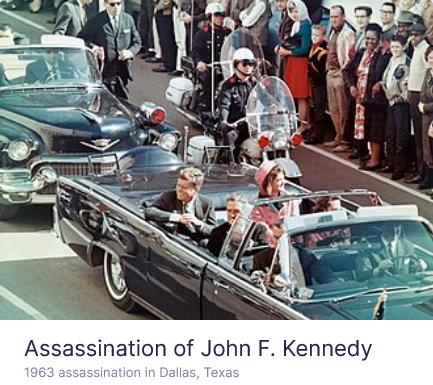
Zionism, Dimona, and the Dallas Line: A Brief History of Cui Bono, or How a President Refused to be «Fooled»
The history of world politics is filled with the childish, naive faith that
mainstream historians—each a genius in their own regard (!)—have in
coincidences. According to official reports, one of the most heavily
guarded leaders on earth was gunned down by a «lone, deranged» man
holding an outdated rifle, and the case was closed. Yet, that ancient,
cynical, and utterly ruthless question of criminology and political
philosophy continues to hang heavily over the Dallas skies: Cui bono?
That is, «Who benefited?»
If the lights suddenly go out in a movie theater and your wallet vanishes,
the very first place you look when the lights come back on is the «lucky»
fellow standing right by the exit, smiling at you with your newly acquired
cash in hand. In the aftermath of the Kennedy assassination, as the
massive spotlights of global geopolitics illuminated the stage, the actor
standing there with the nuclear keys in hand was, without a doubt, the
State of Israel and the Zionist lobby.
- The Dawn of Money and the Lobby: Romantic Beginnings
Our story begins between 1939 and 1948, as the smoke of World War II
still lingered, with massive funds worth millions of dollars flowing from
across the ocean by American Zionists (ZOA) into the lands of Palestine.
The young and charismatic senator, John F. Kennedy, was well aware of
this shifting tide. During the 1960 Zionist Congress, he stepped up to the
podium and bowed to the magical American electoral formula of «Jewish
votes and financial backing,» declaring, «Israel is not the cause of one
party; it is the cause of all America.» At that moment, the lobby leaned
back, assuming they would soon watch a «pliant ally» occupy the White
House.
However, we have bad news for the Zionist elite: Kennedy was not the
naive, small-town politician they could easily «fool» or expect to swallow
every lie. - The Dimona Chess Match: The Tale of the «Textile Factory»
While the State of Israel attempted to fool the world by disguising the
Dimona facility rising secretly in the Negev Desert as a mere «textile
factory» or an innocent «agricultural laboratory,» Kennedy’s CIA and U-2
spy planes had already captured the truth. There was no fabric being
woven there; on the contrary, an atomic bomb was being
manufactured—one that would flip the entire balance of the Middle East
on its head.
At that exact moment, the fake honeymoon between the Zionist lobby
and JFK ended, giving way to a brutal power struggle. Kennedy began
writing severely harsh, ultimatum-like letters to Israeli Prime Minister
David Ben-Gurion, sounding very much like a strict school principal:
American inspectors will enter that facility, and that nuclear program will
stop. The pressure was so fierce that Ben-Gurion, the founding father of
Israel, crumbled under this diplomatic whip and was forced to resign in
June 1963. For the lobby, this was an «existential» threat.
During the same period, Kennedy’s brother, Attorney General Robert
Kennedy, was not sitting idly by. He grabbed the American Zionist Council
(AZC) by the collar, demanding, «You are agents of a foreign state;
register under FARA and air all your dirty laundry and financial sources.»
The financial oxygen flowing to the lobby’s veins was about to be cut off. - «Parallelism of Interests» Without a Round Table
Mainstream media tries to debunk these theories by pointing out that the
Zionists, the CIA, the Pentagon, and the American Mafia never gathered in
some smoke-filled, dark room, wearing camouflage attire to say, «Let’s
flip a coin to see who gets to shoot Kennedy.» They are right; no such
meeting ever took place. Professional assassins and deep-state
apparatuses do not operate via scheduled appointments. What brought
them together was the criminological principle known as the «Parallelism
of Interests.»
These factions, who supposedly did not know one another, actually met
at the exact same common denominator:
- The Pentagon wanted to rid itself of a president who intended to
withdraw troops from Vietnam. - The Mafia was suffocating under the judicial vice grip of Robert
Kennedy. - The Zionists were desperately scrambling to protect their nuclear
program and financial freedom in America.
And right in the dead center of all these structures stepped that famous
«lone vigilante,» Jack Ruby (Jacob Rubenstein)—a man who worked with
the mafia, smuggled weapons for Zionist groups, and was intimately
intertwined with the local police department. Ruby locked the entire
system down by silencing the gunman, Oswald, live on television. They
didn’t need to meet in a room; one pulled the trigger, another cleared the
area, and another covered up the tracks with official reports. Each ran in
their own lane, but they all crossed the exact same finish line.
The Texan Behind the Scenes and the Hour of Financial Payback
Historical narratives usually depict Lyndon B. Johnson (LBJ) as a fatherly
, Texan «statesman» who took over the office in tears following Kennedy’s
tragic death. However, the language of financial records and secret phone
wiretaps is far less emotional and far more pragmatic. LBJ’s covert ties
to the lobby trace back to the late 1930s, to the days of «Operation Texas,»
during which he illegally smuggled Jewish refugees fleeing Europe into
the United States through Texas. LBJ’s career was a highway paved with
the money of Zionist financiers.
Right after Kennedy’s death, a phone conversation (The White House
Tapes) between the newly sworn-in LBJ and his close friend and Zionist
businessman Jim Novy—who had been showering him with money since
his Texas days—serves as the delivery receipt for the new era:
Lyndon B. Johnson: «Jim, my friend… You know what happened. But I
have never forgotten the people who stood behind me since those days
we started in Texas. Now I am in this seat, and I promise you; the safety
and future of those boys (Israel) are under my personal guarantee. Those.
.. unnecessary tensions during the Kennedy era are over. Whatever needs
to be done will be done, just lean back.»
Jim Novy: «I know, Mr. President, we have always believed in you. We
knew since Texas that we were betting on the right horse. Now, everyone
in those lands (Israel) has breathed a sigh of relief. Any kind of (financial
) logistical support you need is ready just like before.»
With this conversation, all pressure on Dimona was thrown into the trash,
and American military aid to Israel during the LBJ era skyrocketed to a
hundred times the total of all previous presidents combined.
The Warren Commission
Master Illusionists of the Nuclear CrisisOrganizing an assassination is
difficult, but writing a 26-volume official report and hiding the elephants
in the room requires a far greater intellectual dexterity. The Warren
Commission, established by President Johnson, was designed not to find
the killer, but to pour concrete over the massive geological fault lines that
caused Kennedy’s death. In the thousands of pages of the commission’s
report, Israel’s name, the Dimona facility, or the fierce nuclear standoff
with Ben-Gurion were never once included as vital data; they were
effectively «evaporated.»
LBJ himself drew the boundaries for Supreme Court Chief Justice Earl
Warren, whom he had forced to head the commission, during this secret
phone call:
Lyndon B. Johnson:
«Earl, I want you to head this commission because the unity of the
country depends on it. There are too many rumors flying around. That the
Soviets did it, that the lobbies did it, that it was an intelligence job…
These rumors will lead us into World War III.»
Earl Warren:
«Mr. President, this is a very heavy burden. I am concerned that the
investigation could lead us to very different international factions and
deep relationships.»
Lyndon B. Johnson: «It won’t, Earl! Because our target is clear. There is
only one man involved: Oswald. That’s it. The commission’s duty is to
declare to the world that there is no state, no organization behind this
man. And don’t dig too deep into the Ruby matter either; he is just a
deranged local club owner. These are the boundaries of the report, and I
cannot allow anyone to step outside them.»
In the shadow of these orders, the famous Department of Justice
investigation launched by Robert Kennedy against the American Zionist
Council (AZC)—which was preparing to declare the lobby a «foreign agent
«—was quietly shelved.
The Winner Takes It All
On November 22, 1963, once those shots rang out in Dallas, the very first
steps taken by the newly sworn-in President Lyndon B. Johnson declared
the ultimate victor of this bloody macro-chess match. With a single move,
Johnson completely dismantled all American inspections and pressure
over Israel’s nuclear program. The FARA sledgehammer that Robert
Kennedy had raised over the lobby was quietly shelved, and that
once-cornered lobby evolved into the colossal AIPAC structure that pulls
the strings of American foreign policy today. The Pentagon got its bloody
war in Vietnam to sell billions in weaponry, and the mafia caught its
breath.
No matter what official reports, history textbooks, and
«coincidence-loving» analysts write; to find the killer in a geopolitical
assassination, you do not look at laboratory results—you look at bank
accounts and the smoke rising from nuclear reactors. The day Kennedy
became an obstacle to global lobbies and the military-industrial complex,
he was liquidated by that grand, silent parallelism of interests. After all,
at a table where everyone greedily eats their share of the pie, looking for - the chef is simply a waste of time.
Sources:
U.S. Department of State Archives: Foreign Relations of the United States
(FRUS), 1961–1963, Volume XVIII, Near East, Document 160, 175, 237.
U.S. Senate Archives / Hearings before the Committee on Foreign
Relations, United States Senate, Eighty-Eighth Congress, First Session,
1963.
LBJ Presidential Library / White House Telephone Tapes records
(November-December 1963)
Michael Collins Piper – Final Judgment: The Missing Link in the JFK
Assassination Conspiracy (1994)
Louis Gomolak – Operation Texas: LBJ and the Rescue of European
Jews from Hitler
(Prologue: LBJ’s foreign-affairs background, 1908-1948) , Ph.D.
Dissertation 1989
Michael Beschloss – Taking Charge: The White House Tapes of Lyndon
Johnson, 1963–1964, book 1997
Warren Commission Report (1964)
Written by: Eylem


