
How the US attack on Venezuela, abduction of Maduro unfolded
After months of planning, US forces, with 150 jets taking off from 20 airbases, took on an operation to abduct Maduro.

In a move that stunned the world, the United States bombed Venezuela and abducted President Nicolas Maduro amid condemnation and plaudits.
In a news conference on Saturday at his Mar-a-Lago resort in Florida, US President Donald Trump praised the operation to seize Maduro as one of the “most stunning, effective and powerful displays of American military might and competence in American history”.
It was the riskiest and most high-profile military operation sanctioned by Washington since the US Navy’s SEAL team killed al-Qaeda leader Osama bin Laden in a safe house in Pakistan’s Abbottabad in 2011.
News of the 63-year-old Maduro being abducted took over the global news cycle.
After months of escalation and threats over Maduro’s alleged involvement in shipping drugs to the US, the Trump administration had increased pressure on Caracas with a military buildup in the Caribbean and a series of deadly missile attacks on alleged drug-running boats. The legality of the strikes, which killed more than 100 people, has been heavily questioned by the United Nations and legal experts.
The US had also offered a $50m reward for information leading to Maduro’s arrest.
But while the military was conducting operations in the Caribbean, US intelligence had been gathering information about Maduro. Meanwhile, special forces were covertly rehearsing a plan to forcibly remove him from power.
Here’s everything we know about how Maduro and his wife, Cilia Flores, were “captured”.
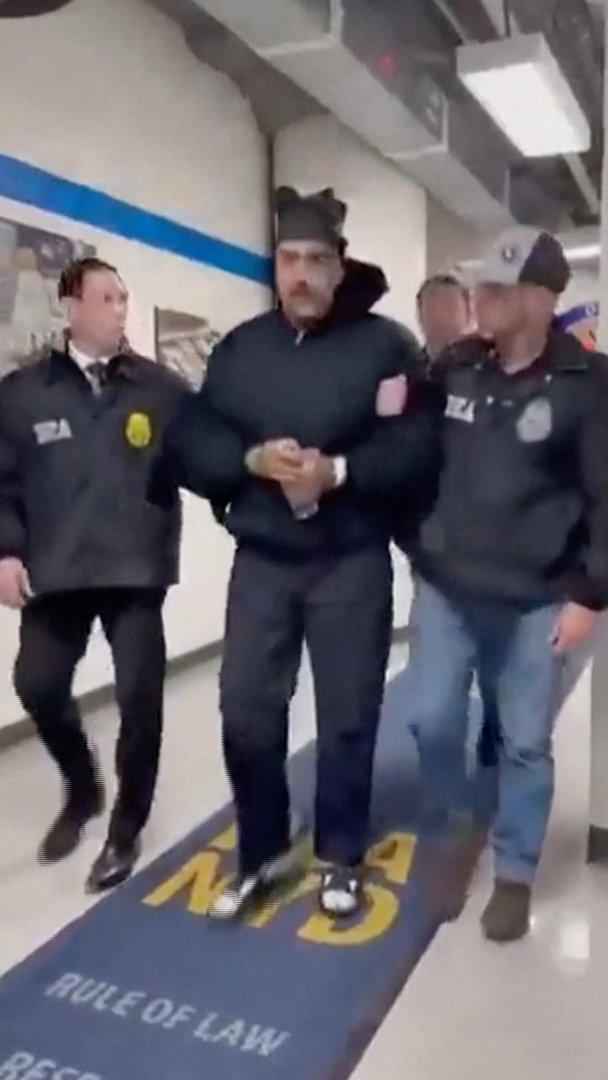
Video shows Venezuela’s President Maduro in US custody
Next
01:55
Cubans brace for tougher times as Venezuela’s oil lifeline faces uncertainty
03:55
At least 4 killed after clashes erupt between Syrian army and SDF in Aleppo
06:31
West Bank: Dozens injured as Israeli troops raid Birzeit University in attack on student protest
- 04:11
 Israeli army vehicles enter village in southern Syria ahead of Paris talks
How was Maduro abducted?
The operation, named “Absolute Resolve”, was carefully rehearsed for months, according to General Dan Caine, chairman of the Joint Chiefs of Staff, who spoke at Trump’s news conference.
Advertisement
Trump also told Fox News that US forces had practised their extraction of Maduro on a replica building.Get instant alerts and updates based on your interests. Be the first to know when big stories happen.
“They actually built a house, which was identical to the one they went into, with all the same – all that steel all over the place,” Trump said.
At 11:46pm local time on Friday (03:46 GMT on Saturday), Trump gave the green light.
On Friday night, Caine said that “the weather broke just enough, clearing a path that only the most skilled aviators in the world could move through”. About 150 aircraft were involved in the operation, taking off from 20 different airbases across the Western Hemisphere.
As part of the operation, US forces disabled Venezuela’s air defence systems, with Trump saying that the “lights of Caracas were largely turned off due to a certain expertise that we have”, without elaborating.
Several deafening explosions rang out across Caracas, with Pete Hegseth, the US defence secretary, describing it as part of a “massive joint military and law enforcement raid”, which lasted less than 30 minutes.
US helicopters then touched down at Maduro’s compound in the capital at 2:01am (06:01 GMT) on Saturday, with the Venezuelan president and his wife then being taken into US custody.
There has been no readout on whether there was an exchange of fire in the chaotic scramble, or if they were taken without a struggle.
At 4:29am (08:29 GMT), just two and a half hours later, Maduro was put on board a US aircraft carrier, en route to New York.
Trump later posted a photograph of the Venezuelan leader on his Truth Social platform, blindfolded and wearing a grey tracksuit.
After departing the USS Iwo Jima, US forces escorted Maduro onto a flight, touching down in New York’s Stewart Air National Guard Base at about 4:30pm (21:30 GMT).
How many people were killed in the US strikes?
The US strikes hit Caracas as well as the states of Miranda, Aragua and La Guaira, according to the Venezuelan government.
To Linda Unamumo, a public worker, the US attacks caused an explosion that was so strong, it destroyed the roof of her house.
“Even up until a little while ago, I was still crying… I was crying because I was so scared… I had to leave my house with my daughter, with my family, and go to another house, a neighbour’s house. It was really traumatic. I wouldn’t wish it on anyone, really,” she told the AFP news agency.
While official casualty counts have yet to be released, an official told The New York Times on condition of anonymity that at least 40 people had been killed in the attacks.
Advertisement
According to Trump, a few US members were injured in the operation, but he believed no one was killed.
What did witnesses hear and see?
Alexander Ortega was jolted from sleep after a series of explosions that rocked his neighbourhood.
The 41-year-old shopkeeper was with his family in Higuerote, a coastal town about 120km (74 miles) east of Caracas, when US military forces began attacking the nearby airport.
“What happened was crazy, because, well, I was asleep, and I thought what was in the sky last night was fireworks,” Ortega told Al Jazeera.
Margarita Rodríguez, a 73-year-old Higuerote resident who lives near the airport, was also jolted by the attacks.
“I was sitting on my bed, about to go to sleep, when I heard what I thought were cats running on the roof,” Rodríguez recalled. “I thought, ‘My god, what on earth are those cats doing’? But then it happened again.”
She soon got a text from her nephews in Caracas, who said they had felt an earlier attack at about 1am (05:00GMT), and she realised her roof was rattling from the explosions.
What’s next for Venezuela?
During his news conference on Saturday, Trump announced that the US would “run” Venezuela until a new leader was chosen.
“We’re going to make sure that country is run properly. We’re not doing this in vain,” he said. “This is a very dangerous attack. This is an attack that could have gone very, very badly.”
The president did not rule out deploying US troops in the country and said he was “not afraid of boots on the ground if we have to”.
Trump also, somewhat surprisingly, ruled out working with opposition figure and Nobel Peace Prize winner Maria Corina Machado, who had dedicated her prize, which he wanted to win himself, to the US president.
“She doesn’t have the support within, or the respect within, the country,” he said.
The Constitutional Chamber of Venezuela’s Supreme Court ordered Vice President Delcy Rodriguez to serve as acting president following the US’s abduction of Maduro.
The court ruled that Rodriguez would assume “the office of President of the Bolivarian Republic of Venezuela, in order to guarantee administrative continuity and the comprehensive defence of the Nation”.
The court also said it would work to “determine the applicable legal framework to guarantee the continuity of the State, the administration of government, and the defense of sovereignty in the face of the forced absence of the President of the Republic”.
Trump had said earlier on Saturday that the US would not occupy Venezuela, provided Rodriguez “does what we want”.

listen to these podcasts
Related
- North Korea fires missiles towards sea as South Korean leader visits ChinaThe missile test comes as President Lee Jae Myung arrives in Beijing to meet his Chinese counterpart, Xi Jinping.Published On 4 Jan 20264 Jan 2026

- From: NewsFeedTrump says opposition leader Maria Corina Machado unfit to run VenezuelaUS President Donald Trump says Venezuela’s opposition leader Maria Corina Machado lacks the respect to run the country.Published On 4 Jan 20264 Jan 2026

00:21
From: NewsFeed
Video shows Venezuela’s President Maduro in US custody
Video shows Venezuelan President Nicolas Maduro arriving at the Drug Enforcement Agency detention centre in New York.
Published On 4 Jan 20264 Jan 2026

- 00:36
More from News
- Real Madrid’s Mbappe out of Spanish Super Cup derby with Atletico

- Congress’s role questioned as Democrats vow to rein in Trump on Venezuela

- Israeli FM visits Somaliland after world-first recognition storm

- Who could be the next Manchester United manager?

Most popular
European leaders hit back at Trump’s US takeover designs on Greenland
Trump boasts about abduction of Venezuela’s Maduro amid global outcry
Maduro says he’s a ‘prisoner of war’: Why that matters
‘Closing his eyes’: Why is Russia’s Putin quiet on US abduction of Maduro?

By Julio Blanca and News Agencies
Published On 4 Jan 20264 Jan 2026


