
Books & the Arts / January 6, 2025
Why Is the Right Obsessed With Epic Poetry?
From Elon Musk to Jordan Peterson, a certain strand of conservatism has recruited the poetry of Homer and Dante in their culture war.
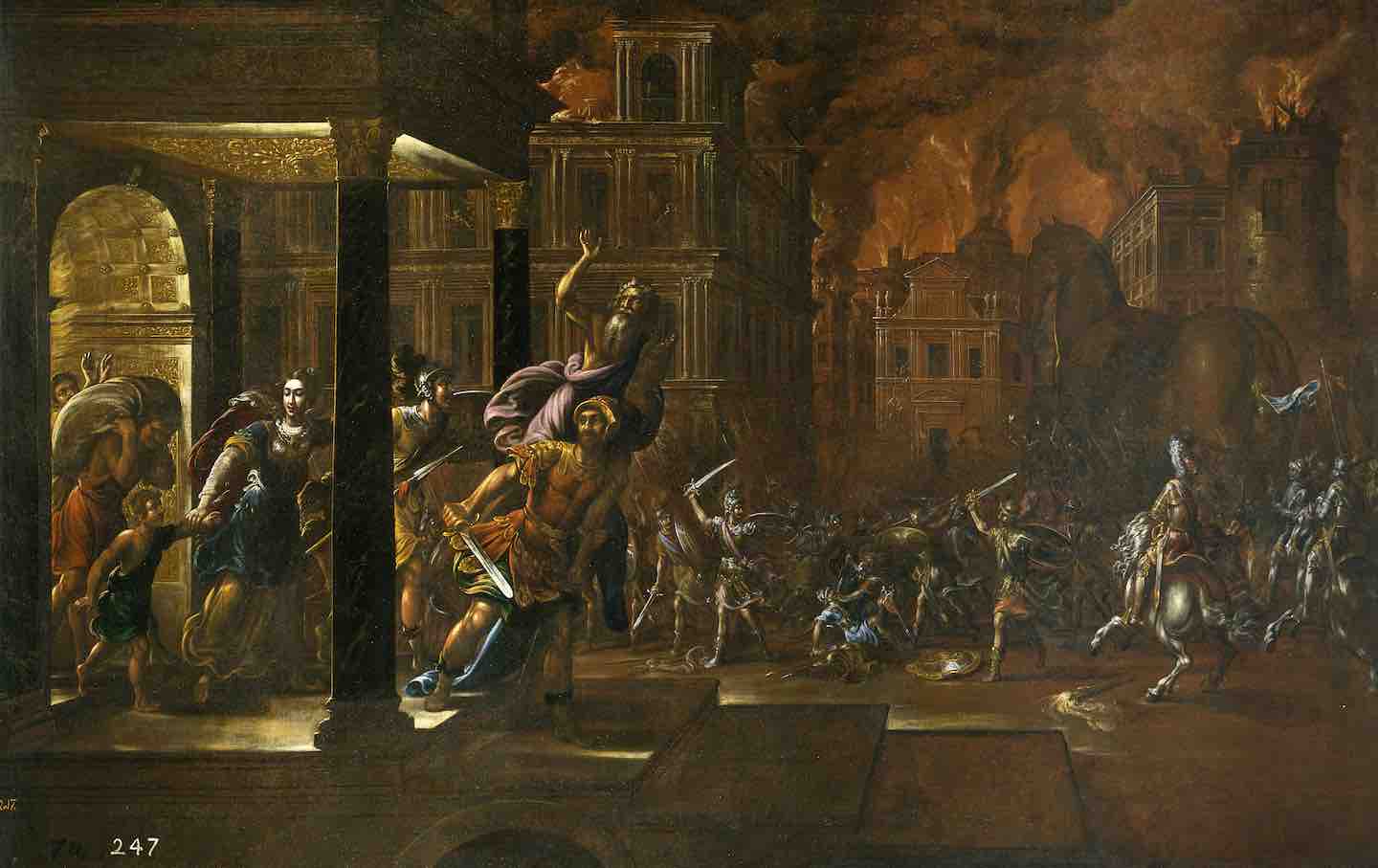
In September 2023, the richest man in the world was daydreaming about the Trojan War. “I sometimes wonder if perhaps Rome was started by exiles from Troy,” Elon Musk wrote on X, the social media platform he had bought and swiftly renamed. His thoughts on the legendary war—documented in Homer’s two epic poems—were prompted by an online controversy over Emily Wilson’s translation of The Odyssey. The British classicist argued that previous translators had imported their own sexism into the poem and obscured the presence of slavery, so right-wing accounts labeled her work “Woke Homer.” Joining the fray, Musk announced that he was listening to The Iliad in a 1950s translation by E.V. Rieu (a man). “Best story ever,” the billionaire said. But Musk’s interest was larger than the war on wokeness. Instead, it was something that has long been central to epic poetry: the founding of empires.
“At some point in antiquity,” Musk’s musing about the Trojan exiles continued, “a few ships of very competent soldiers (with almost no women) landed on the coast of Italy. Where did they come from?” Without realizing it, Musk had reinvented the plot of Virgil’s epic The Aeneid, whose protagonist sails from war-ravaged Troy to a land where his descendants would later found Rome. Historians are skeptical that this has a basis in fact, but it was useful propaganda for Augustus Caesar, who established himself as Rome’s first emperor while Virgil was writing his poem. By retelling the myth that the city was founded by one great man, The Aeneid seemed to confirm that Rome should be ruled by one emperor rather than by its citizens. In recent years, epics have played a similar role for the American right.
Epics have often shored up empires. After Virgil’s death, Augustus Caesar ordered that his unfinished poem be preserved, against the poet’s wishes. Since then, many poets have recycled Homer’s and Virgil’s materials to create new epics written to advance their own ambitious nations. And later emperors used ancient epics to glamorize their campaigns. Alexander the Great had The Iliad as his bedside companion. Napoleon, complaining that “the others were taken,” brought the pseudo-medieval Scottish epic of Ossian on his doomed expedition to Moscow. Epics don’t only glorify the present; they also offer grand and terrible visions of the future. In 1968, the British politician Enoch Powell quoted The Aeneid in a notorious speech prophesying that immigration would cause “rivers of blood.” This capacity to speak to the future makes the genre a powerful political tool.
As Musk mused about those “very competent soldiers (with almost no women)” voyaging from Troy to the future Rome, he was surely thinking of his own quest to colonize space. But perhaps the South African–born billionaire was also thinking about his adoptive nation. For Musk, who recently praised Trump’s “epic tweets” and used his platform to push the Republican campaign, the genre contributes to a new political vision for the United States. Musk is not alone in sensing this: Two other prominent right-wing thinkers have used epic poetry in their attacks on liberal democracy. What dark future does it help them to articulate?
Jordan Peterson writes about epics in each of his three books. In 12 Rules for Life (2018), the Canadian psychologist permits himself a modest boast: “I read and perhaps understood much of Milton’s Paradise Lost, Goethe’s Faust and Dante’s Inferno.” Peterson often compares his own quest to understand evil with the heroic act of descending into the underworld, described in each of these epic works. This grandiose self-identification is part of his appeal: Peterson convinces his readers that they, too, can be the hero. Likewise, his first book, Maps of Meaning (1999), explains the psychology of political beliefs using two archetypes taken from myth and literature: the brave Hero and the envious Adversary. The Adversary is based on Satan, but since the devil is largely absent from Scripture, Peterson went instead to Paradise Lost, recruiting Milton to defend the West from the “murderous ideology” of identity politics. Unfortunately, Peterson’s grasp of Paradise Lost is a little slippery.
In Milton’s epic, Satan is an angel who becomes resentful when God announces that he has set up his own Son (a kind of pre-human Christ) as the ruler of the angels. Satan’s envy is based on a belief that he is better than any other angel. This leads Satan to an ill-fated rebellion in which he is defeated by the heroic Son and cast out of Heaven. To read Paradise Lost is to see that Satan’s belief in his own superiority is mistaken. Curiously, though, Peterson takes Satan at his word, referring to him as “the highest angel.” Peterson needs to do this to maintain his dualistic psychology, in which the Hero and the Adversary are neat opposites. Interestingly, this misreading seems to reflect a major contradiction in his work: Even as he counsels his readers to overcome resentment and take responsibility for themselves, his constant dog whistles appear to encourage young white male readers to see their resentments of a pluralistic liberal society as justified.
Peter Thiel has a more involved relationship to epic than Musk and Peterson. Shortly after graduating from Stanford, he cowrote The Diversity Myth, a campus polemic that defends the Western classics from attempts to diversify the syllabus. Even after cofounding PayPal and making his fortune, Thiel has played up ambitious reading as core to his identity as a libertarian and a CEO. He publishes quasi-academic essays that put forward his financial positions and bolster his reputation as a visionary. Unlike Peterson, Thiel doesn’t look to literature for psychological insights. In one essay, “The Straussian Moment” (2007), he quotes Milton’s Satan to make an argument about the limits of modern therapeutic culture: “The mind is its own place and in itself / Can make a Heaven of Hell, a Hell of Heaven.” Milton, as Thiel correctly notes, wants the reader to know that this is untrue. We can’t change the world by thought alone, he insists. We must act.
This is the reason for Thiel’s interest in epic, a genre representing the most consequential human actions. In his 2014 book Zero to One: Notes on Startups, or How to Build the Future, Thiel compares tech founders to Romulus and Remus, the mythic founders of Rome. However, it is not as a founder but as a venture capitalist that he now hopes to accomplish something world-changing. Since 2005, when he quit PayPal and established Founders Fund, Thiel has backed Musk’s company SpaceX as well as the Seasteading Institute, which aims to establish communities at sea outside of international law. An avowed libertarian, he longs to live in a place where capitalism is unchecked by the laws of democracy, and again he uses epic to justify the idea that the ocean is the best escape from the Hell of other people.
In his 2015 essay “Against Edenism,” Thiel discusses Goethe’s Faust. Goethe’s protagonist makes a deal with the devil, exchanging his soul for scientific knowledge. Faust becomes a rich and powerful man and a favorite of the Holy Roman Emperor. He launches an ambitious project to reclaim land from the sea, ruthlessly dispatching anyone who gets in his way. Ever the contrarian, Thiel defends Faust: “It is too easy for us to make fun of the Faust myth,” he declares. But who is making fun of it? No doubt, Thiel was really referring to the people who had mocked the Seasteading Institute, his own attempt to reclaim land from the sea. Unsurprisingly, he then asks us to look kindly on poor Faust:
Admittedly, it does seem slightly ludicrous to forget about one’s immortal soul and instead busy oneself, as Faust does, with the project of reclaiming land from the sea. But why are these options mutually exclusive? Can we not do both?
Goethe’s play is called a tragedy, but it ends well for its protagonist: Despite his misdeeds, Faust receives divine salvation. Thiel might hope the same will be true for himself—that if he manages to fund an invention whose benefits trickle down to the rest of humankind, his life will seem less like a Faustian tragedy and more like an epic.
Identifying with ancient Romans is something not uncommon in Silicon Valley. In May, at his 40th-birthday celebration, Mark Zuckerberg wore an oversize T-shirt with the motto Carthago delenda est: “Carthage must be destroyed.” This phrase, used in Rome to call for war with the republic’s African enemy, was apparently a reference to Facebook’s competition with Google. As so often with Zuckerberg’s performances of masculinity, it felt unintentionally parodic. But we should take these clumsy allusions seriously: Some tech companies have become as powerful as empires and their leaders like emperors, as so often before, in search of an epic to consecrate their great deeds.


