
Cubans remember Che Guevara 50 years after his death
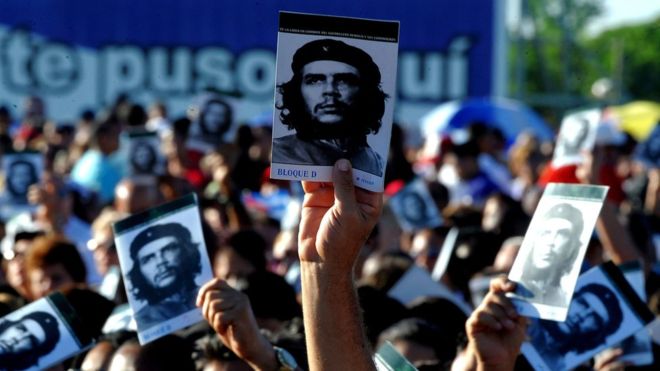
Several thousand people have attended a ceremony in the Cuban city of Santa Clara to remember the revolutionary icon Ernesto «Che» Guevara, 50 years after his capture and death.
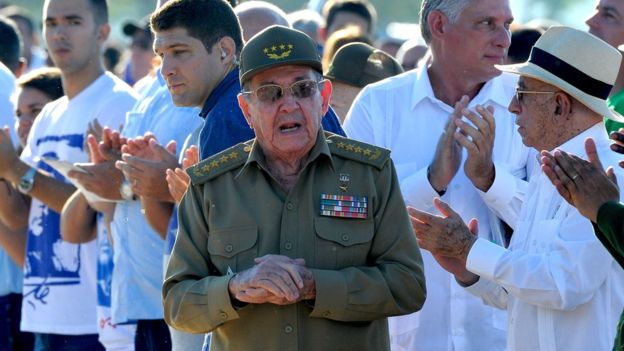
Among crowds at his statue and mausoleum was his old friend, Cuban President Raúl Castro.
Many more watched at home on state TV as President Castro laid a white rose on Guevara’s tomb.
The revolutionary still divides opinion as much today as he did in life.
For five decades his name has adorned every corner of Cuba, from banknotes to billboards, his image one of the most recognisable in Latin America.
The people who turned out in Santa Clara – the city synonymous with his greatest victory in battle – clad in Che T-shirts or holding up his image in pictures, think of him as nothing less than a hero.
They came to celebrate the charismatic, uncompromising Argentine they adopted as one of their own.
«We hold him very close, we have him near us always. We know what Che represents to Cubans, to Latin Americans and to the world. For us it’s a great honour to have his image on our chests and in our hearts,» said one man.
An except of Fidel Castro’s speech in 1967 announcing the death of Che Guevara to the Cuban people was played in which he famously urged Cuban children «to be like Che», a slogan that endures today.
Judging from the number of schoolchildren in the audience, Guevara’s life will remain a crucial part of the education of young people in Cuba for decades to come.
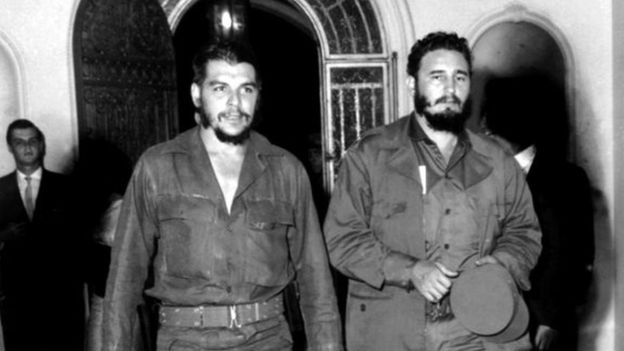
His supporters see him as an example of commitment and self-sacrifice, his critics see a man they consider brutal and cruel.
But whether he’s considered a fearless hero or a bloodthirsty radical, one thing is sure – he was part of a generation that is coming to the end of its time in Cuba.
Fidel Castro died last year and most of Guevara’s comrades who turned out for this event are in their 80s.
President Raúl Castro is due to stand down next year, a moment that will see someone other than a member of the Castro family at the helm in Cuba for the first time in almost 60 years.
Related:
Remembering Ernesto «Che» Guevara
Born on June 14, 1928, Ernesto “Che” Guevara did not come into the world a revolutionary. He grew up in a middle-class Argentine family and trained to be a doctor, preparing to live a bourgeois life. But unlike others in his class, he was unable to shut his eyes to the injustices upon which material wealth was based: generational poverty and state-imposed policies designed to keep the poor ignorant and exploited. Life blessed him with the opportunity to live out his days in comfort, but instead he died age 39, fighting for revolution, murdered by CIA agents on Oct. 9, 1967, in the jungles of Bolivia.
Guevara’s eyes were famously opened to the harsh realities of capitalism for those born less privileged than him when, as a medical student in his early 20s, he hopped on a motorcycle and went on a tour of South America. He found disease, destitution and illiteracy—along with the sort of compassion and generosity that appears to be inversely related to the amount of wealth one possess. From that point on, he labored to uplift the working class from Cuba to Guatemala to the Congo. And, although his death was premature, his legacy continues to serve as an inspiration to revolutionaries around the world today.


Realated:
Remembering Che Guevara 50 Years After His Assassination
Cuba y Bolivia homenajean al guerrillero heroico Che Guevara
Peregrinación en Bolivia a 50 años de la muerte del Che


