

On June 20, Defense One reported that Michele Flournoy, whom it described as“the woman expected to run the Pentagon under Hillary Clinton,” said she would “direct U.S. troops to push President Bashar al-Assad’s forces out of southern Syria and would send more American boots to fight the Islamic State in the region.”
Flournoy disputed the report, denying that she advocated “putting U.S. combat troops on the ground to take territory from Assad’s forces or remove Assad from power.” But Defense One stood by its report:
[Reporter Patrick] Tucker told The Intercept that Defense One did not issue a correction because they felt they accurately reported Flournoy’s policy position. “Strike weapons at standoff distance is troops,” said Tucker. “Those are military personnel. That is U.S. military power — at war with the Assad regime. There is just no way around it.”
He added, “We took a very inclusive use of the word ‘troops,’ one that matched the literal definition of ‘troops,’ but nowhere do we ever suggest or say ‘ground troops.’”
Flournoy is indeed advocating that direct U.S. military power be used to overthrow the Syrian government – exactly what many advocates of more direct U.S. military intervention for regime change in Syria hoped would be accomplished in September 2013, in the proposed U.S. military intervention that was rejected by Congress.
A natural question is: if Congress rejected such a military intervention in 2013, why would one assume that Congress would approve such a military intervention in 2017?
Advocates of more direct U.S. military intervention for regime change in Syria like Flournoy may assume that once they are ensconced in power, they will control the timing of events; they’ll be able to create provocations and escalations, and at a time of their choosing, they’ll be able to cross the bridge of Congressional authorization for the use of force – or evade it.
It would thus be salutary for the Republic if Michele Flournoy would be sharply challenged on her views of Congressional war powers before assuming the position of Secretary of Defense. A natural place to do this would be in her confirmation hearing before the Senate.
This is where a Senator Alan Grayson could be very useful. Grayson was one of the most vocal members of the House in opposing the proposed U.S. military intervention in Syria in 2013. As a Senator, he would participate in Flournoy’s confirmation hearing.
Of course, any Senator can ask Flournoy to testify under oath concerning whether she agrees that the Constitution and the War Powers Resolution are good law. But having one who does so with spectacular vigor, drawing media and public attention, could be especially salutary.
Recall that when John Brennan was nominated to head the CIA, Senator Rand Paul filibustered the nomination, using the opportunity to successfully press the Administration to clarify the legal authority it was claiming to target U.S. citizens with drone strikes.
To my knowledge, no Democratic Senator has in recent memory challenged a national security nominee with such vigor in the direction of less war. Until now, the process of creating Democratic Senators has seemed to select against this kind of vigor in challenging national security nominees in the direction of less war. A Senator Grayson could change this dynamic.
Note that lying to Congress under oath is a serious federal crime, which has been prosecuted in the past.
If you’d like Representative Grayson to pledge that as Senator Grayson he’d insist that national security nominees testify under oath that they will obey the Constitution and the War Powers Resolution with respect to any proposed direct U.S. military intervention for regime change in Syria, you can tell him so here.
Leaked emails show how Democrats screwed Sanders

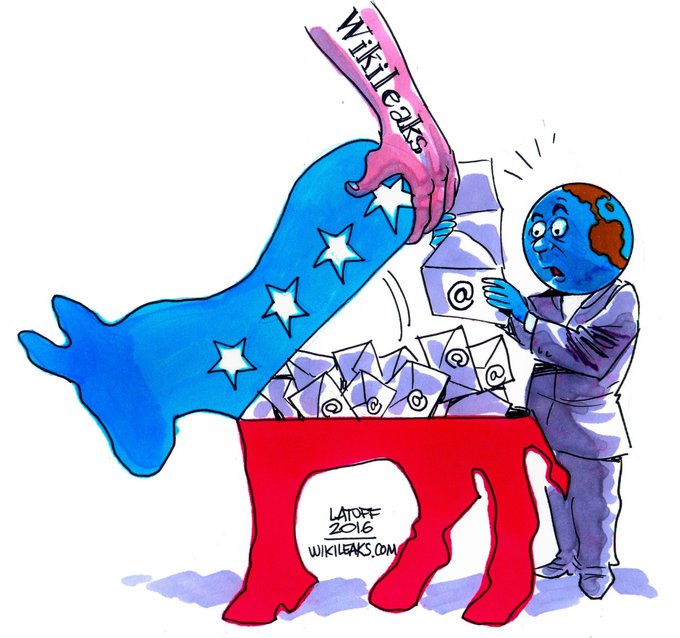
The notorious hacker collective WikiLeaks dumped a massive trove of e-mails from the Democratic National Committee onto the Web Friday just as Hillary Clinton was preparing to celebrate her presidential nomination at the Democratic convention next week.
In the thousands of internal e-mails, it was revealed that a Democratic Party official tried to use Bernie Sanders’ supposed religious beliefs to derail his presidential campaign; one staffer pitched an idea for a phony sexist Trump ad and DNC Chair Debbie Wasserman Schultz tried to score a staggering seven tickets to the Broadway smash “Hamilton.”
BURNING BERNIE
The suggestion of going after Sanders based on religion was included in one of 19,252 e-mails.
In one message dated May 5, 2016, with the subject line “No s–t,” the chief financial officer of the Democratic National Committee, Brad Marshall, plotted how to portray Sanders, who was raised Jewish in Brooklyn, as an atheist.
“It might [make] no difference, but for KY and WVA can we get someone to ask his belief,” Marshall wrote, apparently referring to Sanders and upcoming Kentucky and West Virginia primaries.
“My Southern Baptist peeps would draw a big difference between a Jew and an atheist.”
– DNC official Brad Marshall
“Does he believe in a God. He had skated on saying he has a Jewish heritage,’’ Marshall asked.
“I think I read he is an atheist.”
“This could make several points difference with my peeps. My Southern Baptist peeps would draw a big difference between a Jew and atheist.”
The chief executive officer at the DNC, Amy Dacey, responded with a single word: “Amen.”
Marshall told The Intercept that he didn’t recall the sleazy e-mail.
But then he claimed it wasn’t an attempted hit job on Sanders.
“I can say it would not have been Sanders. It would probably be about a surrogate,” Marshall told the Web site.
He did not explain why the DNC would try to slime a Sanders surrogate. Read more.
More links:
THE DEMOCRATIC NATIONAL CONVENTION ALREADY LOOKS LIKE A ‘GAME OF THRONES’ NIGHTMARE
Democrats In Turmoil: DNC Chair Wasserman Schultz Resigns After Wikileaks Revelations
Debbie Wasserman Schultz to Resign D.N.C. Post
Democrats Scramble to Control Wikileaks Fallout
WikiLeaks – Search the DNC email database


