
The advance of Bernie Sanders in the primary elections of the Democratic Party and the political position of the socialist
Pedro Fuentes and Tiago Madeira
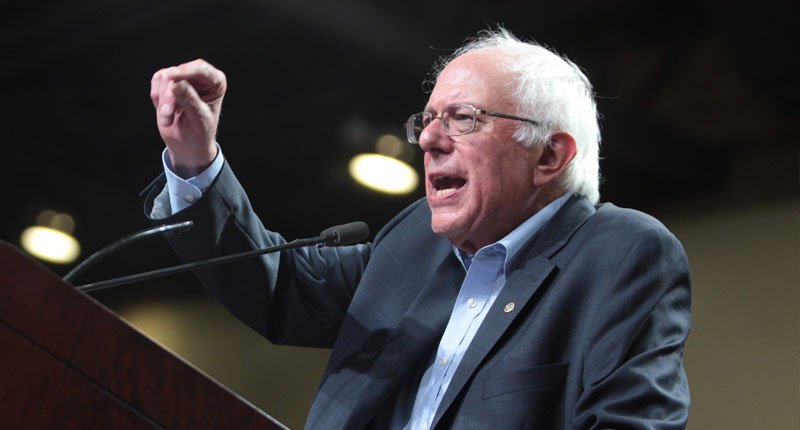 Senator Bernie Sanders of Vermont speaking at a town meeting at the Phoenix Convention Center in Phoenix, Arizona (Gage Skidmore/Flickr)
Bernie Sanders is an independent self-declared socialist. He ran and won his Senate seat in the lists of the Democratic Party in Vermont, one of the smallest states in the US. To self-declare a socialist in the US is not a small matter, and right now he runs in the democratic primaries against Hillary Clinton, the favorite candidate and former Secretary of State of the Obama, part of the Clinton clan which is closely linked to the national ruling class.
Everything seemed a cakewalk for her since her opponent, even he was already well known for its critical activity in the Senate against Republicans and Obama’s policies, is branded as an»outsider» and does not belong to the apparatus of the Democratic Party. However, he has progressed in the opinion polls, while Hillary has been scratched by an state investigation for using a private e-mail account to deal with state affairs when she was Secretary of State.
On the other hand, the Republican primaries looks like a madhouse with 12 candidates and polls leaded by Donald Trump, a right leaning provocative magnate media communication tycon, a kind of American Bolsonaro (Brazilian ultraconservative rightwing member of the House).
Unexpected results in the latest polls
It is highly unlikely, let’s say impossible, for Sanders to defeat Hillary Clinton. Anyway, during the last week Sanders is ahead in the polls in New Hampshire, one of the first states to vote in the primary processes: 44% of Democratic voters support Sanders and 37% for Clinton. The most significant is that in March the support for Sanders was at 8%. In five months, Sanders has gone from 8% to 44% among Democrats in New Hampshire, ahead of Clinton.
The newspaper El Pais of Spain in an article published on August 13th says that «it is too early to gauge the impact of these threats. Clinton maintained, according to the polls last week, a large advantage over Sanders in the whole United States. But the reality is that he is narrowing in some key states, and the case of private mail is gaining weight and is presumed as a matter of ongoing debate in the campaign. » The Washington Post, in a video on the newspaper’s website editorial says that «they never thought Sanders would be much of a threat to Clinton.»
One feature of the Sanders’s campaign, who does not have the tens of millions of dollars that Hillary has, is organizing gatherings that are filled with young people and that are becoming popular. Sanders seems to be the continuation of the radicalization process opened by Occupy Wall Street that had its expression in electing a Seattle’s councilior that belongs to Socialist Alternative, Kshama Sawant, and also in the social struggles that started for the $15 minimum wage (a struggle already won in Seattle and elsewhere and that has become strong in the Fast Food industry in New York), and the strength of the of black people’s resistance after Ferguson and Baltimore. The emergence of «Black Live Matters» a movement network that has the support of many athletes and artists, although it is limited to the fight against repression of blacks, has acquired a large scale at the country level and it is also part of this process.
If the US economy improves, who will benefit?
For some time we have been arguing that an important aspect of the world situation is that the US is moving. Many pages were written extensively about the American’s decline, an objective reality. But undoubtedly, US remains the strongest imperialism; the strongest country, dominant of new technologies, which has the most powerful domestic market, and with England is the most powerful (also dominant) financial capital. It also has the highest GDP in the world. While this is not the topic of the present text, it is a topic that can not be avoided by the specific implications for workers and socialists everywhere. [1]
This does not mean to beautify the «Uncle Sam», because it is the country that are unfolding perhaps the greatest social inequalities and thus also where the contradictions are becoming more acute. A report in New York found that half of the population is at the level of poverty. [2] In his book «Capital in the 21st Century? Thomas Piketty gives abundant data on the growth of inequality in the US in the last decade, significantly higher than in Europe.
In this context, the improvement from the hardest point of the crisis, has in the mass movement an ultimately progressive effect. It does not mean that the «American dream» is back, because unemployment has improved by increasing the exploitation of workers, creating more contradictions and inequalities. But at the same time, the economical improvements changes the mood of the masses, in the sense that it is observed that the social struggle can produce results and it is necessary to support those who advocate more taxes on the rich and less on the poor.
Precisely the question of who bears the tax burden, whether the wealthiest or the poorest, is the most remarkable debate that was introduced in American society and it began to polarize the country. It is logical that a sector who believed that Obama would tax the rich (which he did not in essence) thinks that less could be done with Hillary who is part of the high US establishment. Hence, this situation that was unexpected for the Washington Post has a deep logic. The commentator of the newspaper El Pais says that «Sanders attacks Clinton from the leftist flank and it turns on the party base around a controversial issues such as the tax issue (either towards the rich or the poor), the financial regulation, the free trade and the environmental policy.»
The contradictions of Sanders and a debate on the left. Can a new alternative to bipartisanship emerge?
All the political power history in the US involves only two parties: Republican and Democrat. This regime had a few moments of high volatility as it happened during the Vietnam’s war [3]. But now it may happen again; for the first time, we can have a third field that brings together greens, environmentalists, Trotskyists and many independent groups that emerged in the years after Occupy Wall Street. And the objective movement that is developing around the candidacy of an outsider as Sanders, even it happens within the Democratic primary, can be a lever for that.
An independent alternative would be a tremendous step in the US and worldwide. Superior to the emergence of Syriza (without contempt), because, as we said, US is still the center of imperialism and because of the importance that would have to the world class struggle.
For a while, the issue of supporting Sanders became a main topic in the American left. The Jacobin magazine commented about a meeting that happened a few months ago and that was attended by most of the leftist groups to discuss the topic. Since then the situation evolved specially within the parties and Trotskyist organizations. On one side, ISO that has a national penetration and leads the Chicago Teachers Union, positioned against it. On the other hand, Socialist Alternative, which managed through the campaign for the $ 15 minimum wage to win a seat in the Municipal House of Seattle, is engaging in Bernie Sanders’s candidacy.
The biggest contradiction in Sanders campaign is that, if on one hand it stands out as a credible national campaign, which gives voice to the sentiment against inequality and has the potential to mobilize hundreds of thousands of people against the corporative politics of billionaires, on the other hand it is bounded to the primaries of the Democratic party, which is dominated by the politics that he fight against.
Todd Chretien, a member of the ISO (International Socialist Organization) and contributor to the International Socialist Review, recognizes that Bernie Sanders’s campaign will stand against the status quo of American politics: «[Sanders] has promised to support a trillion-dollar green jobs program for renewable energy. He defends Social Security and advocates for a single-payer health system. Faced with an intramural battle between the Clinton and Bush wings of the 1 Percent, he calls for a «political revolution.» On top of that, he identifies himself as a socialist and says his hero is Eugene V. Debs [founder of socialism in the US and presidential candidate the socialist Party of America in the early twentieth century].»[4]
The position of the ISO is based on the understanding that the participation of Sanders in the primary of the Democratic Party and its commitment to support Hillary in case he lose the nomination is critical to deny the support by the Socialists. Even it cause a shock or a removal, their work would inevitably bring voters back to the Democratic Party, as it happened with the pre-campaigns of Dennis Kucinich in 2000 and Jesse Jackson Rainbow Coallition in the 80s. This way, the participation in the organization of Sanders campaigns would render more difficult, not easier, to build an independent alternative left to the bi party system.
Bhaskar Sunkara, the editor of Jacobin Magazine, agrees that «there are dangers in a Sanders bid for president», but he believes that the name of Sanders is stronger than other Democrats like Dennis Kucinich and he is taken more seriously, for being an independent senator and a strong voice for wealth redistribution. Thus, «Sanders?s candidacy doesn’t have to channel left forces into what will likely be a Clinton nomination. Instead, it could be a way for socialists to regroup, organize together, and articulate the kind of politics that speaks to the needs and aspirations of the vast majority of people. And it could begin to legitimate the word «socialist,» and spark a conversation around it, even if Sanders’s welfare-state socialism doesn’t go far enough. He concludes that «the best bet for the Left in the electoral arena is to support both independent political campaigns and insurgent primary runs by socialists and other radicals». [5]
For Philip Locker, member of the Socialist Alternative and political coordinator of Kshama Sawant’s campaign, to abstain from primary process and the Sanders’s campaign would hurt the construction of an alternative to the policy of corporations, facilitating for their left supporters to follow the nomination of the Democratic Party: «We need a correct political understanding and critique of Bernie Sanders» politics. But we also need to actively engage with the genuine workers and youth being drawn to Sanders» campaign by his fierce denunciations of the political establishment. Socialists need to go through this experience with them, helping to speed up the process of drawing the conclusion that an independent political alternative to the Democrats is needed.»[4]
Just as the support of Syriza was a topic during the Greek election, here we are also facing an important development of an anti-capitalist alternative and the growth of Trotskyism in the US, which by the way, had a long tradition. [6] The fact that the Trotskyists are the ones who discuss in the US about how to deal with Sanders indicates that the Trotskyist movement is still alive and is the most conscious vanguard of the revolutionary militancy.
We believe that we must support Sanders. For us, the discussion in the US with their concrete specificities is similar to the one we live in most of the world. The discussion for the Trotskyists about supporting Sanders hinges in the following options: If we should intervene, without losing sight of our strategy, in processes of real political movements to dispute them, even if they are contradictory; or because of those contradictions or because they are not defined or framed in our program we should stay out and then criticize their results if they fail. It is more than a tactical problem, it is a discussion about which political guidance to follow in view of new political processes which of course are not Trotskyites or Trotskyites-leaning. We are talking about building new organizations, new parties fairly and democratically, respecting leaders and activists who disagree with us. Making lawful discussions about which is the best policy, but far from the «entrists policies» or fraction policies which certain Trotskyists groups can justify as an argument «for joining the process».
Not understanding this, leads to isolation and propagandism; one can not reach the political vanguard and to build a political alternative without participating in what already exists. On the other hand, this vanguard will not listen if we are not in that process. Or would it have been possible to build the platform of the left in Greece with half of its Central Committee and most party members staying outside Syriza?
The Sanders’s issue bring back in clear terms what Trotskyism should do. If politics is still done only with the program that Trotsky built in 1938 and particularly in his political struggle against stalinism, or if we are able to update the program and to make politcs in light of the changes that had happened in the world.
Pedro Fuentes and Tiago Madeira are members of MES/PSOL – Rio de Janeiro, Brazil
[1] In an upcoming article, we will try to explain why we differ from those who say we are already in a new stage of multipolarity, and with those who believe that this is already a period dominated by chaos. These characteristics exist, but with elements of an international situation where the American hegemony – declining as the world-system – is still excelling.
[2] See http://www.nytimes.com/2013/04/22/nyregion/city-report-shows-a-growing-number-are-near-poverty.html
[4] See http://www.socialistalternative.org/2015/05/20/debate-what-should-left-say/
[5] See https://www.jacobinmag.com/2015/05/bernie-sanders-president-vermont-socialist/
[6] Joseph Cannon, leader of SWP, was not only founder of the 3rd International, but also from its left opposition, and member of the 4th International during Trotsky’s period until the 80s, when a new generation ended capitulating to stalinism. Other of SWP prominent leaders, Farrell Dobbs, directed one of the most historical strikes of the US, of the truck drivers of Minneapolis in 1934 (en.wikipedia.org).
See also: http://www.thenation.com/article/bernie-sanders-for-president/


